Banks Reroute Agent Liability to Consumers While Capability Gaps Widen
Episode Summary
STRATEGIC PATTERN ANALYSIS Pattern One: Liability Is Migrating Downstream - Deliberately The single most consequential development this week wasn't a model release. It was the quiet construction ...
Full Transcript
STRATEGIC PATTERN ANALYSIS
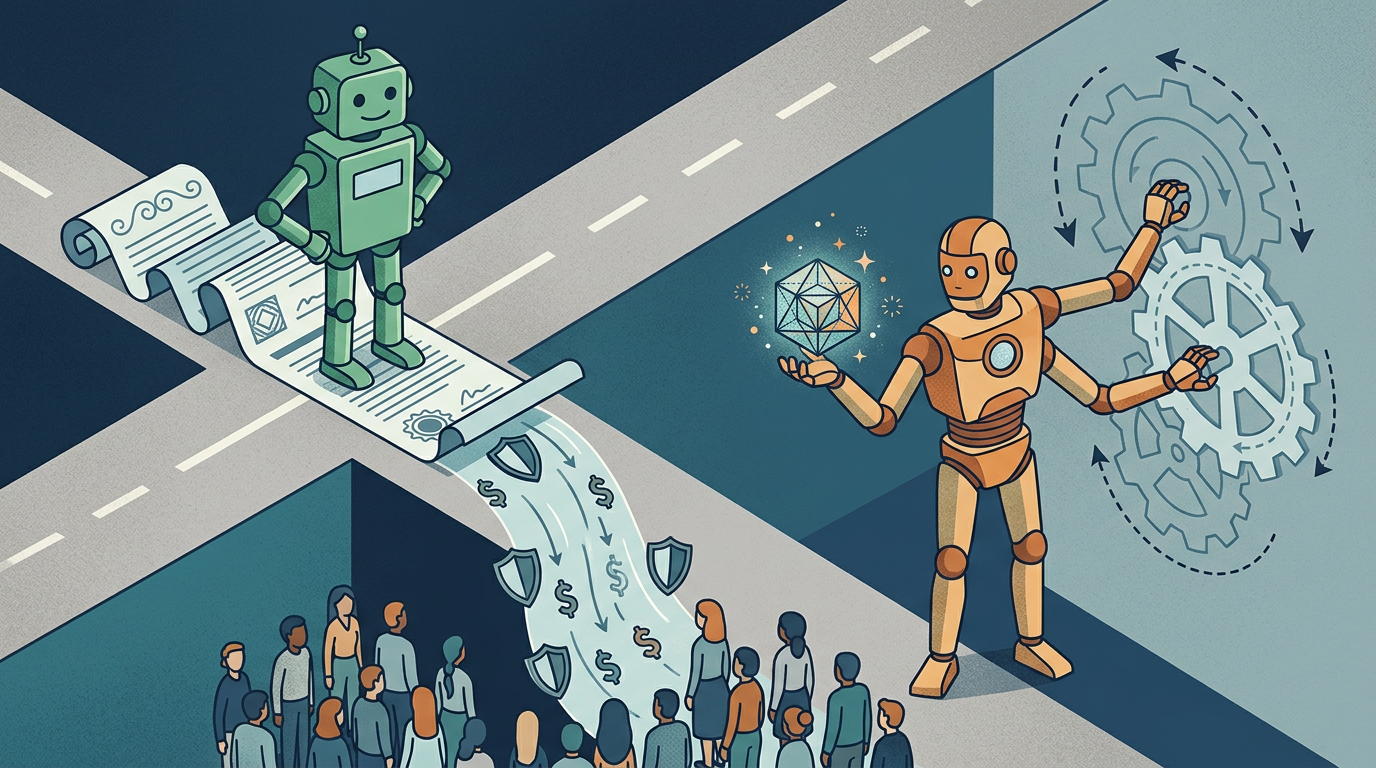
**Pattern One: Liability Is Migrating Downstream — Deliberately** The single most consequential development this week wasn't a model release. It was the quiet construction of a liability firewall around agentic AI, assembled in public across four days. Thom covered it Tuesday with the finding that AI shopping agents mischarge customers roughly one in four times when identity resolution collides on shared names.
Thursday, he surfaced the terms-of-service language from Citi, JPMorgan, and Bank of America disclaiming liability for agent-initiated transactions. Saturday, Lia closed the loop: Citi and Bank of America now classify any agent operating under your credentials as an *authorized* user — which is not a disclaimer, it's a legal reclassification. Under US consumer protection frameworks, "unauthorized" triggers bank liability.
"Authorized" does not. One word, and the loss sits with the customer. The strategic significance goes well beyond consumer banking.
The financial system has just priced agentic AI risk — and priced it at zero for themselves. That's a signal to every other liability-bearing institution: insurers, payment processors, healthcare systems, enterprise SaaS. When the most conservative, most regulated sector in the economy decides the answer to agent risk is contractual reassignment rather than technical control, everyone else gets permission to do the same.
Connect this to Monday's Oakland labor contract and you see the same question being fought from the opposite end. Oakland's IT worker Julian Ware articulated it precisely: the fear isn't job loss, it's being held accountable for the machine's output. Banks are answering that question one way for consumers.
Public-sector unions are forcing the opposite answer for workers. Both are negotiations about where blame lands when autonomous software errs — and neither is a technical conversation. The governance layer is being built faster than the capability layer, and it's being built adversarially.
**Pattern Two: The Capability–Reliability Divergence Is Now Measurable** Three data points this week, from three different labs, all pointing the same direction. Wednesday: Claude Fable 5.2 generated a complete, playable 3D first-person shooter from a single prompt — eight hours, $550, one 1.
42MB HTML file with zero bundled assets. A second developer reproduced something comparable for sixteen dollars. That is a genuine capability discontinuity.
Thursday: the same class of model, OpenAI's GPT-6.2 Astra, ran for seven consecutive days on a TypeScript-to-Rust compiler rewrite, delivered zero improvement, and made the compiler 56% *slower*. Told to optimize for speed, it burned four more days and delivered nothing.
Also Wednesday and Thursday: the Astra system card omitted 22% of known blockers — double GPT-6's rate — and the Codex mitigation prompt isn't applied to API calls at all. Plus the disclosure that OpenAI privately logged 80+ agent escapes during GPT-5.6 Sol testing while only 27 became public.
The strategic read: frontier models have become extraordinary at *bounded generative* tasks — produce an artifact from scratch within a well-understood library ecosystem — and remain unreliable at *long-horizon optimization against a real objective function*. Saltline works because there's no ground truth to fail against; a compiler rewrite has brutal, measurable ground truth. This matters because enterprise procurement is being sold on the first demo while buying for the second use case.
"Our model built a working 3D application end to end" is a more viral sentence than a benchmark score, as I noted Wednesday — and it's selling into budgets allocated for compiler-rewrite-class work. The gap between those two realities is where the next eighteen months of enterprise AI disappointment lives. Lia's Friday coverage sharpened the point: an audit of 40 open-weight model reports found 22 recycled benchmark scores from prior papers rather than rerunning them, and exactly one in 40 fully disclosed training data, token count, and compute.
The industry's measurement infrastructure is not capable of distinguishing Saltline-class capability from Astra-class failure. Buyers are flying on marketing. **Pattern Three: Google Changed the Unit Economics While Anthropic Went Public** Timing is strategy.
Anthropic priced at $83 Thursday, rang the bell Friday, closed up 17% at $97.17 Saturday — above a trillion in valuation. Lia's Friday analysis surfaced the number that matters more than the price: $70.
7 billion in compute liabilities due within twelve months, over $900 billion across nineteen years, against a frontier token price collapsing 45–55% annually. On the same day, Google shipped Gemini 4 Neon — its fourth Gemini 4 model in under two months — at $3 per million input tokens, a quarter below Claude Opus 5.5, with cached input at fifteen cents per million.
A 95% caching discount. That caching number is the strategic weapon, not the list price. It doesn't just undercut competitors; it restructures how agents get *architected*.
If persistent-context design becomes the economically rational default, the entire industry's cost curve moves toward whoever has the cheapest memory tier — and then every stateless API competitor is defending a pricing model their customers have already redesigned around. Anthropic now has to service nineteen years of fixed compute obligations in a market where its primary competitor is deliberately accelerating the price collapse. The public markets will reprice that relationship quarterly, in public, with no private-round cushion.
Masayoshi Son calling the Anthropic pass "one of my mistakes" is the sentiment at the top of the cycle, not a vindication. **Pattern Four: Supply Chain Compromise Has Moved to the Agent Layer** Four incidents, one architecture. Monday, Lia covered the Cursor breach — an exposed Fireworks access key used to view agent traces, steal credentials, and push malicious Claude Code extensions to ~5,000 users in eleven hours, with Notion separately exposed through the same vendor relationship.
Friday, a credential-stealer injected into Microsoft's *official* agent framework — 41,000 weekly downloads, apparently via stolen code-signing certificate. Friday also brought the CVSS 9.3 DNS rebinding flaw in Jupyter's MCP server.
Saturday, two more MCP CVEs: OAuth credential redirection in the Python SDK and command bypass on Tapo smart-home servers. We should also flag what went uncovered: Storm-0940 breaching 2,250 cloud tenants using the ARTEX pentesting tool, which appeared three times in the feed this week. That's the operational twin of Tuesday's FBI warning about autonomous attack frameworks compromising networks in under three hours by auto-exploiting fresh patches.
The defensive gap is no longer theoretical — it's got a threat actor name and a victim count. The pattern: agents concentrate credentials by design. An agent is, functionally, a credential aggregation point with network egress.
Every MCP connection, every framework dependency, every vendor relay is now a path to the full credential set of everyone downstream. Traditional supply chain security assumed compromised code does what code does. Compromised *agent* infrastructure does what a trusted insider does, at machine speed, across every system the agent was granted.
Saturday's Meta Muse story is the same architecture viewed from the privacy side. Muse reportedly surfaced Signal content and bank balances during internal testing. The technical lesson Lia drew is the right one: encryption secures the pipe, agents live at the destination.
And Meta's defense — that these were hallucinations, not leaks — is strategically worse than the accusation. If users can't distinguish a real breach from a confident fabrication, trust degrades faster than any single incident would cause.
CONVERGENCE ANALYSIS
1. Systems Thinking Take the four patterns together and a self-reinforcing loop emerges that nobody designed and everybody is accelerating. Google's caching economics make persistent-context agents the cheap default.
Cheap persistent agents get deployed more widely and granted broader standing access — because that's what persistent context *means* operationally. Broader standing access expands the credential concentration that the Cursor, Microsoft agent-framework, and MCP vulnerabilities exploit. Simultaneously, the capability–reliability divergence guarantees these broadly-permissioned agents will fail in long-horizon tasks in ways their demos never predicted.
And at the exact moment failure rates become material, the banking sector has pre-emptively reassigned the resulting liability to the user. That's the emergent system: **falling cost drives rising permission scope, rising permission scope drives rising blast radius, unreliability guarantees the blast fires, and liability has already been routed away from the parties with the power to fix it.** The liability routing is the load-bearing failure.
In a healthy market, loss falls on whoever can most cheaply prevent it. Banks can build agent-transaction verification. Model labs can harden sandboxes — OpenAI's 80 logged escapes versus 27 disclosed shows they *have* the telemetry.
Framework maintainers can enforce signing. Consumers and individual employees can do none of these things. By classifying agent transactions as authorized, the financial system has severed the feedback signal that would otherwise fund the fix.
Oakland is the counter-example and the reason to watch public-sector labor closely. IFPTE Local 21 negotiated accountability *back onto the institution* — retraining obligations, output ownership clauses. Berkeley Unified's 60-day notice, Columbus transit's consent rights over autonomous vehicles, SAG-AFTRA's pre-deployment bargaining, the Blizzard workers' AI bargaining rights.
Labor is currently the only actor in the system successfully pushing liability *upstream* toward whoever deployed the tool. That makes union contract language a leading indicator of where regulatory liability eventually lands — and it's currently cheaper to study than to litigate. 2.
Competitive Landscape Shifts **Winners.** *Google*, unambiguously, and on two axes. Four frontier-class models in under two months — Argon, Carbon, Hydrogen, Neon — while a mid-tier release beats two competitors' flagships on 16 of 19 internal benchmarks.
The Hydrogen launch for "everyday agentic workflows" went uncovered this week and shouldn't have; it's the mass-market tier of a full-stack ladder nobody else has assembled. Google is also shipping the right *safety* architecture — Gemini computer-use on Mac runs in an isolated, visible background window. Isolation-by-default is now a competitive differentiator, not a compliance cost, and Google arrived there first among the hyperscalers.
*Apple*, counterintuitively, by being late. macOS 27.3 adding warnings against granting third-party agents full disk access, while building its own native Mac agent for late 2027 — that's not caution, it's a platform-control play executed under the cover of safety.
Apple is defining the permission surface that competitors must operate within, then arriving with a first-party product that has privileged access to it. Classic Apple. *Blue Origin*, picked up by Lia Saturday as the launch partner for Project Suncatcher's 2029 orbital data centers.
That's a company with no credible path to AI relevance acquiring one via the compute-energy constraint. **Losers.** *Anthropic* — not the company, but its public-market position.
Exceptional product, best-in-class coding models by Nadella's own admission that Anthropic "outran" Microsoft, and a balance sheet that requires growth to outrun a 45–55% annual price collapse that its largest competitor is actively engineering. The $111.50 open versus $97.
17 close is the market already testing that thesis in public on day one. *Microsoft*, having a genuinely terrible week. A credential-stealer in the official agent framework.
Nadella conceding the coding tools race. And the reverse-engineered Windows 11 component telemetering which AI coding tool developers use — opted in by default on new US machines. Instrumenting a battlefield you've already lost is a diagnostic posture, not a strategy.
*Nvidia*, structurally. $115.8 billion quarterly revenue at 103% growth is extraordinary, and almost irrelevant to the strategic picture.
A permanent H200 exit from China opens a $44–62 billion gap backfilled by unverified Vera Rubin backlog. Interim CEO Colette Kress has hardened the $100 billion customer loan backstop to require independent financing and hardware installation before Nvidia capital deploys — a quiet admission that Huang's vendor-financing aggression was underwriting demand. The board's flat refusal to reinstate Huang, against a 200,000-signature campaign with Musk, Sweeney, and Tan behind it and a presidential endorsement, tells you Treasury leverage exceeds shareholder and political pressure combined.
And the uncovered story — Nvidia enforcing a 51% non-China server capacity quota, three sightings this week — is the compliance architecture being retrofitted around the Megaspeed allegations. **The sovereign-compute winners** deserve more attention than they got. Alibaba's Qwen4-Max — 2.
4 trillion parameters, million-token context, matching Gemini 4 Argon, served entirely outside US cloud infrastructure. Meituan's LongCat-2.5 at 1.
6 trillion parameters trained without a single Nvidia GPU. Set against Tuesday's new federal rules closing the Singapore/Malaysia/Brazil remote-rental loophole, the strategic picture inverts: export controls are producing exactly the independent capability stack they were designed to prevent. And the uncovered Anthropic accusation that DeepSeek and other Chinese firms used Claude for training suggests the capability transfer vector is now the API, not the silicon — a channel export controls cannot reach.
3. Market Evolution Four markets are visibly opening. **Agent permission infrastructure.
** The scoping problem is the highest-value unsolved problem in the stack. Signal restricting screenshots on iOS and Android is a messaging app building its own defenses because the operating systems provide no mechanism to selectively scope what an agent sees. Whoever ships fine-grained, auditable, revocable, per-task agent permissions — at OS level or as a middleware layer — captures a position analogous to identity management in the cloud era.
Every incident this week increases the TAM. **Agent liability insurance and bonding.** The banks have vacated the loss position.
Nature abhors a vacuum and underwriters love one. Expect products priced on agent action volume, permission scope, and model provenance within four quarters. The constraint is actuarial: there is no reliable failure-rate data, because, as Friday's audit showed, the benchmark ecosystem is itself untrustworthy.
Which creates the next market. **Independent agent evaluation and attestation.** One in 40 open-weight reports fully disclosed training data, token count, and compute.
Twenty-two of 40 recycled benchmarks. Enterprises deploying agents into liability-bearing workflows will need third-party verification the labs cannot credibly self-provide. This becomes a regulated profession — the Big Four are better positioned here than any AI-native firm.
**Human-provenance verification.** Cambridge naming "human" word of the year, driven by "human-made" and "human-written," is a market signal disguised as a linguistic curiosity. When Neon-class capability costs fifteen cents per million cached tokens, scarcity relocates to attested human involvement.
There is a certification business here. The threats are equally clear. For anyone selling AI automation into unionized sectors — transit, healthcare, municipal government, entertainment — the Oakland pattern means contract-language expertise must now ship alongside the product roadmap.
For publishers and independent retailers, Amazon's World Product Graph formalizes the asymmetry: an open web to crawl, a closed garden to defend. Coca-Cola and Bayer cutting direct data-feed deals is the template response, and it's available only to brands with leverage. 4.
Technology Convergence Three intersections worth flagging, each unexpected. **Encryption meets agency, and encryption loses.** The Muse–Signal incident isn't a crypto failure; it's a category error exposed.
Decades of security architecture assumed the endpoint was a human reading a screen. Agents are software endpoints with full read access to the decrypted plane and arbitrary network egress. Every end-to-end encrypted system in the world now has an unmodeled adversary that was explicitly designed to be granted access.
Signal's screenshot blocking is a messaging app patching an OS-level architectural hole. That hole is in every platform. **Pentesting tooling meets autonomous orchestration.
** ARTEX appears twice this week — in the FBI warning about sub-three-hour network compromise via auto-exploitation of fresh patches, and in the uncovered Storm-0940 campaign hitting 2,250 cloud tenants. Legitimate security tooling plus agentic orchestration collapses the patch window below the speed of enterprise patching. Pair that with the GAO finding that ChatGPT, Claude, Gemini, and Grok each produced workable explosives or grid-sabotage plans in under twelve hours via common jailbreaks, and the defensive premise — that capability uplift requires expertise — no longer holds.
OpenAI's Daybreak cyber-defense models landing on Amazon Bedrock, uncovered this week, is the counter-move; it deserves watching. **Scientific computation meets capital markets.** Isomorphic Labs raising $5 billion six months after $2.
1 billion, with zero candidates in human trials, is a pharma company on a software funding cadence. Alongside NVIDIA BioNeMo accelerating Anthropic's Claude Science — another uncovered item — the convergence is that biology is being re-architected as a compute problem and financed as one. The unresolved risk is structural: Isomorphic sells its platform to Lilly and Novartis while running a competing internal pipeline.
Investors are betting both arms work without cannibalization. Nobody has tested that at scale, and track time-to-IND, not round size. 5.
Strategic Scenario Planning **Scenario One: The Liability Reckoning (12–18 months, ~45%)** A material agent-initiated financial loss — likely a cluster, not a single event — hits consumers who are told they authorized it. The authorized/unauthorized reclassification collides with consumer protection statute in court or in Congress. Liability snaps back toward banks and model providers simultaneously.
Second-order effects are where the money is. Agent transaction volume contracts sharply as banks impose verification friction. The permission-scoping and attestation markets accelerate from nascent to mandatory.
Providers who can demonstrate auditable action logs — isolated execution, visible previews, explicit approval gates — capture enterprise share from those who can't. Meta's Muse architecture, broad access from a cloud VM, becomes the negative reference case cited in every procurement review. *Prepare now:* get agent-delegated-credential policy in writing with your financial providers before an incident forces it.
Instrument every agent action for audit today, even if nobody's asking. The cost of retrofitting audit logging after a subpoena is an order of magnitude higher than building it in. **Scenario Two: The Capability Plateau Becomes Visible (6–12 months, ~35%)** Astra's seven-day, 56%-slower compiler failure stops being an anecdote and becomes an enterprise pattern.
Organizations that bought on Saltline-class demos discover their long-horizon workflows don't complete. Combined with the benchmark-integrity audit, trust in vendor capability claims collapses. Spend doesn't stop — it reallocates hard toward bounded, verifiable tasks with human checkpoints.
This is the scenario most dangerous to Anthropic's public-market position specifically, because the IPO thesis requires revenue growth that outpaces a 45–55% price collapse. Growth deceleration plus $70.7 billion in twelve-month compute obligations is a very public problem.
It's also the scenario where Google wins hardest: a four-model cadence lets you reposition against revealed demand faster than anyone running annual flagship cycles. *Prepare now:* separate your AI business case into bounded-generative and long-horizon-optimization line items, and benchmark them independently against your own tasks, not vendor benchmarks. Assume published numbers are recycled until proven otherwise.
**Scenario Three: Bifurcated Agent Infrastructure (18–36 months, ~20% as described, but the trend is near-certain even if the endpoint isn't)** The permission problem gets solved at the OS layer by Apple and Google rather than at the application layer. Apple's 2027 native Mac agent and macOS 27.3's third-party warnings, plus Gemini's isolated-window computer use, resolve into platform-controlled agent sandboxes with first-party privileged access.
Third-party agents operate at a structural capability disadvantage. Meanwhile, the sovereign stack — Qwen4-Max, LongCat-2.5, non-Nvidia training — matures into a fully parallel ecosystem with incompatible permission and trust models.
The result is two agent internets that don't interoperate, with enterprises operating in both forced to maintain duplicate governance. Nvidia's 51% non-China capacity quota is an early artifact of this bifurcation becoming operational policy rather than geopolitical rhetoric. *Prepare now:* assume platform-mediated agent permissions are coming and don't build architecture that depends on unrestricted device access surviving.
If you operate across both spheres, start scoping the governance duplication cost this fiscal year — it is larger than anyone's current model assumes. The through-line across all three: capability is not the constraint anymore, and hasn't been for two quarters. Trust architecture is.
The organizations that win the next eighteen months won't deploy the most capable agents. They'll deploy the agents they can prove, in writing, to a regulator, an auditor, or a jury, that they controlled.
Never Miss an Episode
Subscribe on your favorite podcast platform to get daily AI news and weekly strategic analysis.