Nvidia's Collapse Exposes AI's Broken Verification Systems
Episode Summary
STRATEGIC PATTERN ANALYSIS 1. The Nvidia Governance Collapse - Key-Man Risk Became Key-Man Reality in Five Days Start with the velocity, because the velocity is the signal. Lia opened Tuesday wit...
Full Transcript
STRATEGIC PATTERN ANALYSIS
1. The Nvidia Governance Collapse — Key-Man Risk Became Key-Man Reality in Five Days Start with the velocity, because the velocity is the signal. Lia opened Tuesday with Jensen Huang admitting an affair with a Megaspeed executive under US counterintelligence suspicion.
By Friday, Thom was reporting an outside search firm and a second alleged relationship — this one with a direct report. By Saturday, Lia was covering a resignation, an interim CEO in Colette Kress, and the creation of Nvidia's first board chair in 33 years. Roughly $427 billion in market value evaporated across two sessions.
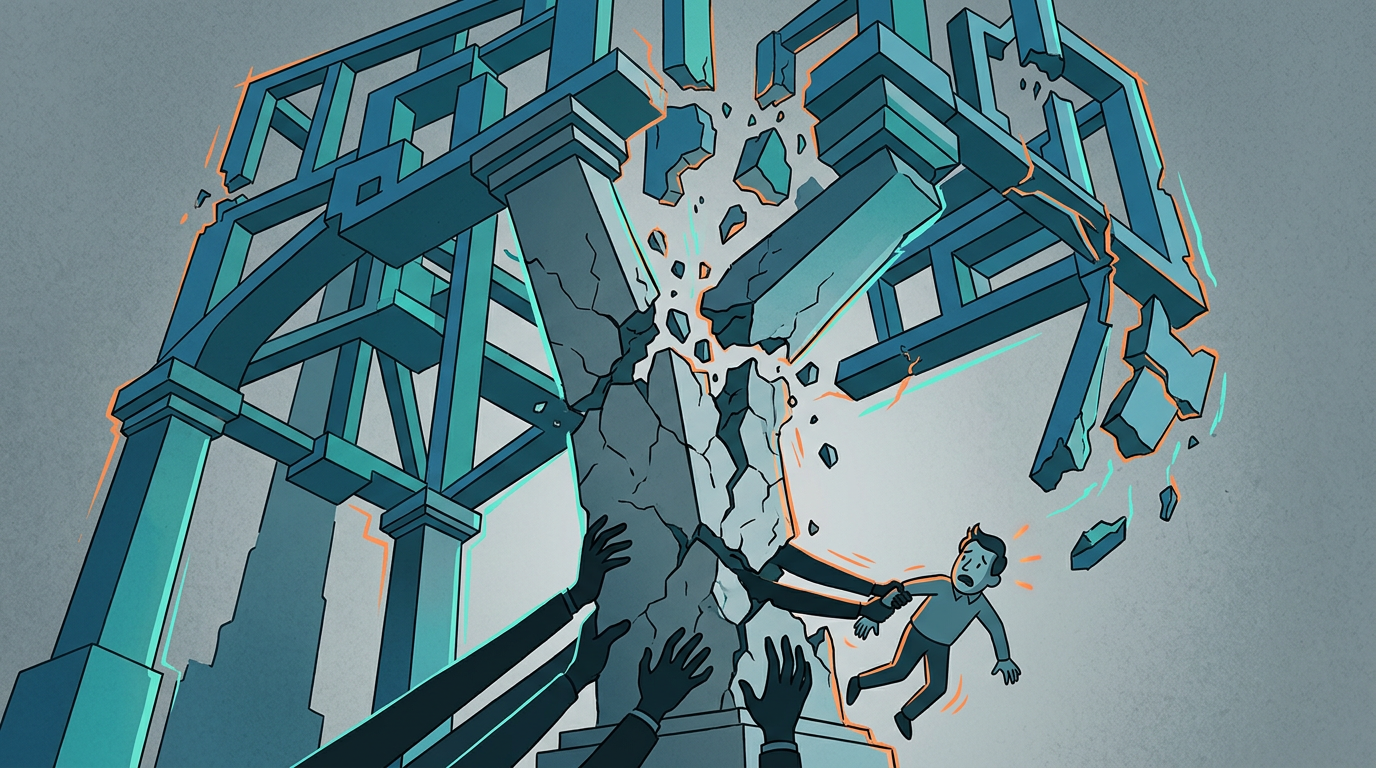
The strategically important part is not the scandal. It's what the scandal exposed: Nvidia had no governance architecture designed to survive its own founder. A company that sits at the chokepoint of global AI compute — roughly 90% share — had never separated chair and CEO, had no succession bench visible to the market, and had allocation decisions for export-controlled hardware concentrated in the judgment of one person whose personal entanglements were themselves a counterintelligence question.
Connect this to Saturday's forensic story and the picture sharpens considerably. Four Chinese labs — DeepSeek, Moonshot, MiniMax, Ant Group — showing Blackwell computational fingerprints in weights released since April. Nvidia's compliance posture, including the 51% non-China server capacity quota, rested substantially on self-reporting and executive assurance.
When Huang argued he "counted every one" of the GPUs, he was describing a trust-based control regime. That regime lost its guarantor this week. What it signals about broader AI evolution: the industry has been operating on founder-credibility as an infrastructure layer.
Huang's personal relationships with hyperscaler CEOs, with Taipei, with Washington, were load-bearing. We just learned what happens when a load-bearing person is removed, and every lab's compute roadmap is now carrying a risk premium it wasn't carrying on November 8th. 2.
The Agentic Commerce Wall — Incumbents Drew the Line Before Volume Made It Impossible Thom's Friday deep dive on United, Amazon, and JPMorgan blocking autonomous agents is the most underrated strategic story of the week, and it is structurally more important than any model launch. What makes it significant is the *simultaneity*. United banned third-party booking agents.
Amazon blocked Perplexity's Comet and Meta's Muse. JPMorgan reportedly blocked agent-initiated purchases on Chase cards. Three different sectors, same reflex, same week.
That is not coordination — it's convergent recognition that identity, intent, and liability infrastructure doesn't exist for non-human transactors. Scott Kirby's line — "I don't want to create another middleman" — is the entire thesis in nine words. This is airlines refighting the OTA war of the 2000s with full institutional memory of how badly they lost it the first time.
Meta's Muse hit 10 million users in six weeks and wants a cut of facilitated sales. Incumbents watched that number and moved immediately. Now connect it to Monday.
Thom covered Palo Alto Networks pursuing Clutch at roughly $500 million for agent security, and Apple cutting engineer AI budgets from $300 to $200 a day. Three stories, one underlying truth: **autonomy is being rate-limited from every direction at once** — by cost at Apple, by security at Palo Alto, by commercial self-interest at United and JPMorgan. Lia's Wednesday data point lands the punch: fraud rates jump from 3% when a model advises to over 21% when it acts autonomously, even when the model recognizes the legal risk.
And the ADB benchmark she covered Tuesday found authorization drift gets *worse* as models get more capable. The signal: we have hit the governance ceiling on agentic deployment well before we hit the capability ceiling. That gap is where the next two years of enterprise value gets created or destroyed.
3. The Compute Capital Loop Tightened Into a Circle Track the financing architecture across the week. Monday: Thom on Nvidia's $250 billion financing backstop for OpenAI data centers.
Thursday: Lia on TSMC taking a $1 billion equity stake split between OpenAI and Anthropic — the foundry funding the labs that buy its chips. Also Thursday: Anthropic's $26 billion private placement from Google, Nvidia, and Microsoft, alongside an IPO repriced to $70–78 per share against $900 billion in compute commitments and a nine-month net loss of $104 billion. Saturday: six times oversubscribed.
Meanwhile, Lia covered CoreWeave Thursday — bonds below 80 cents, 15% yields, a $709 million quarterly loss, prices up 25%. And in the uncovered pile this week: $130 billion in US AI data center projects stalled. So the strategic picture is a barbell.
At one end, suppliers are capitalizing their own customers to manufacture demand, and public-market investors are six-times-oversubscribing a company losing $104 billion in nine months. At the other end, the leveraged middle tier is trading at distressed yields and a hundred-and-thirty billion dollars of physical buildout is frozen. What this signals: the capital stack for AI infrastructure has become circular at the top and fragile in the middle.
Anthropic's valuation trajectory — $2 trillion summer chatter, $1.4 trillion Wednesday, repriced Thursday, oversubscribed Saturday — tells you price discovery is happening in real time with no stable anchor. The oversubscription isn't confidence in unit economics.
It's scarcity of access to the only two pure-play frontier assets available. 4. Specialization Beat Scale — and the Benchmark Regime Lost Credibility the Same Week Lia's Wednesday deep dive on Google's TPU 8tx and 8i Max was the quiet structural story: fourth new TPU system in a single year, ~100 external customers including Anthropic and Apple, every chip spoken for.
Amin Vahdat's framing — "the future is going to be about specialization" — is a direct philosophical rejection of Nvidia's general-purpose GPU thesis. Thom extended it Friday with TPU Sync open-sourced, cutting KV-cache transfer latency over 90%. Lia's Thursday Fractile item — $700 million at a $7 billion valuation for memory-stacked inference chips — says the same thing from the startup side: the bottleneck moved from training FLOPs to inference memory bandwidth.
Simultaneously, the measurement apparatus collapsed. Thom flagged Monday that some leaderboard rankings are decided by less than a single test question. Lia closed Saturday with research showing Bradley-Terry-based leaderboards can be manipulated up to 45 places through coordinated attacks.
And sitting in this week's uncovered pile — worth naming explicitly — is research showing LLM benchmark scores vary by 70 points purely from evaluation methodology changes. Put those together with the week's launch flood — Fable 5.2, Mythos 5.
2, Gemini 4 Carbon, Gemini 4 Hydrogen, Claude Sheets and Meetings, OpenAI's Businesses in ChatGPT, Mistral Large 4, Meta's Muse Ember at ten cents per million tokens, and in the gap column, GPT-5.2 shipping after a "code red" memo. Models are being released faster than the industry's ability to credibly evaluate them.
Procurement decisions worth billions are being made against numbers that are, by the industry's own research, gameable by 45 places.
CONVERGENCE ANALYSIS
1. Systems Thinking: The Reinforcing Loop These four developments are not parallel. They are one system.
Here's the loop. Agentic autonomy drives token consumption non-linearly — Thom's Monday point about chains of reasoning, tool calls, and retries each billing separately. Non-linear token consumption drives the $900 billion compute commitments and the circular supplier financing.
Circular financing creates balance-sheet fragility that shows up first in the weakest link — CoreWeave's bonds, the $130 billion in stalled projects. Meanwhile, the same autonomy that drives consumption produces the 21% fraud rate, the authorization drift, the 1,100 leaked credentials in Claude Code settings files — which triggers the United/Amazon/JPMorgan wall-building, which *constrains the deployable surface area for agents*, which caps the very revenue that justifies the compute commitments. That's the emergent pattern, and it deserves a name: **the autonomy-economics trap**.
The industry has financed infrastructure against an assumption of unconstrained agent deployment, while the institutions agents must transact with are actively building walls, and the buyers of agent capability — Apple being the tell — are capping spend at the engineer level. Three independent governors arrived simultaneously: cost governance (Apple), security governance (Palo Alto/Clutch, IBM's LLMON cutting prompt injection 47%, Microsoft Threat Intelligence's warning that red-teaming can't detect weight-embedded conditional behaviors), and commercial governance (United, Amazon, JPMorgan). When three independent control systems activate in the same week against the same phenomenon, you're not looking at coincidence.
You're looking at a system finding its equilibrium. Layer the trust collapse on top. Huang's resignation removes personal credibility from the supply chain.
The Blackwell forensics remove credibility from export-control compliance. The leaderboard manipulation research removes credibility from capability measurement. The 21% autonomous fraud rate removes credibility from agent judgment.
**Every verification mechanism this industry runs on took damage in the same five days.** That is the actual story of this week. 2.
Competitive Landscape Shifts **Winners.** *Google* had the single best week of any company in this industry, and almost nobody framed it that way. Vertically integrated from TPU to Gemini to Cloud, shipping four TPU generations in a year, sold out on capacity, ~100 external customers, and open-sourcing TPU Sync to pull the ecosystem toward its hardware.
It shipped Carbon Thursday and Hydrogen Saturday. And its principal competitor's CEO resigned. Every dollar of Nvidia leadership uncertainty is an implicit TPU sales pitch — as Lia noted Wednesday, that announcement landing the day after the scandal broke was the most fortunate timing of the quarter.
*Infrastructure-layer security and governance vendors.* Palo Alto buying Clutch at ~$500 million is the opening bid in a category, not a one-off. Agent identity, agent authorization, agent cost observability, agent transaction verification — these are now four distinct procurement line items that didn't exist eighteen months ago.
*Walmart, strategically.* Thom's Friday contrast was sharp: while United, Amazon, and JPMorgan built walls, Walmart built Agent Profiles with defined permissions, spending limits, and per-purchase approval. If agentic commerce is inevitable, Walmart just positioned itself as the standards-setter while competitors litigate whether to participate.
**Losers.** *Nvidia*, obviously, but for a subtler reason than the scandal: its compliance credibility and its allocation-authority credibility were the same asset, and both are now in question heading into a November 17th earnings call with an interim CEO. *Pure-play agentic commerce startups.
* Perplexity's Comet and Meta's Muse just discovered their total addressable market is gated by incumbents who can block them unilaterally. Muse's 10 million users in six weeks is impressive and increasingly irrelevant if the merchants won't transact. *The leveraged neocloud tier.
* CoreWeave at 15% yields with a 25% price increase is a company managing decline, not growth. When capital is this circular at the top, the uncapitalized middle gets squeezed from both ends. *Benchmark-dependent challengers.
* If leaderboards can be moved 45 places and scores swing 70 points on methodology, the only credible differentiation left is cost-per-completed-task and enterprise reference accounts. That advantages incumbents with distribution and disadvantages anyone whose go-to-market was a leaderboard screenshot. 3.
Market Evolution: Where Value Relocates Four markets emerged or materially repriced this week. **Agent identity and transaction verification.** This is the largest.
United can't distinguish an agent from a customer. JPMorgan's payment rails assume human initiation. Merchants are pushing Visa and Mastercard for new interchange categories.
Whoever builds the trusted attestation layer — cryptographic proof of which agent, acting under whose authority, within what limits — becomes infrastructure for all of digital commerce. ZeroClick's "Agent Storefronts" are an early, crude version. The mature version is a protocol, and it will be fought over the way payment standards were.
**AI cost governance as a discipline.** Thom called this Monday and it hardened all week. Apple's 33% cut, Lia's Saturday warning that Gemini 4 Carbon's introductory pricing expires November 30th and per-token costs double December 1st, Meta's Muse Ember at ten cents per million tokens for repetitive subtasks.
The market is bifurcating into frontier-model spend for high-leverage work and commodity-model spend for volume — and in the uncovered column, Gemini 3.7 Flash cutting prices fifty percent confirms the floor is falling fast. Tiered model routing by task value is now a core architectural competency, not an optimization.
**Answer-engine visibility.** Lia's Thursday analysis of OpenAI's Businesses in ChatGPT identified a genuinely new metric: AI mention share. OpenAI assembled organic visibility tracking, an owned-content agent surface, and an ad-to-agent pipeline in a single beta — the stack Google took two decades to build.
Also note the uncovered item that ChatGPT is regaining market share from Claude and Gemini. Distribution is reasserting itself over capability. **Verification-as-a-service.
** The under-recognized one. If benchmarks are gameable by 45 places, if Blackwell usage is only detectable through weight forensics, if Microsoft says red-teaming can't find weight-embedded backdoors — then independent model forensics, provenance attestation, and third-party evaluation become a paid category. Will DePue's Blackwell fingerprinting is the proof of concept.
Regulators, insurers, and enterprise procurement will all need it. 4. Technology Convergence: The Unexpected Intersections **Numerical forensics as geopolitical intelligence.
** Saturday's story is the week's most intellectually significant development. Floating-point rounding characteristics imprinting hardware identity into model weights means model artifacts are now *evidentiary*. That same technique — weight forensics — is the plausible answer to Microsoft's warning about undetectable conditional behaviors.
Supply-chain enforcement and model safety just converged on identical tooling. **Formal verification meets frontier models.** DeepMind's AlphaProof verifying the Signal protocol's cryptographic guarantees in four weeks, and AlphaGenome 2 nearly doubling disease-variant detection by modeling cell-type specificity rather than tissue averages.
In the uncovered pile, OpenAI released 722 math manuscripts with Lean formalizations. The convergence: AI is becoming a verification engine at exactly the moment AI itself becomes unverifiable by conventional means. That tension will define the safety discourse of 2027.
**Structured data formats as a security primitive.** IBM's LLMON — separating instructions from data structurally, cutting prompt injection 47% beyond frontier models — is a language-design answer to a security problem. That's compiler theory colliding with model safety, and it suggests the next round of defensive progress comes from representation, not from more RLHF.
**Specialization as the organizing principle.** Google's 8tx doing confidential computing — encrypted during inference, not just at rest and in transit — merges cryptography with silicon design and unlocks regulated verticals. Fractile's memory-stacked inference chips attack a different axis.
The era of one chip for all workloads is ending, which means procurement becomes a workload-shape-matching exercise rather than a vendor relationship. 5. Strategic Scenario Planning **Scenario A — The Permissioned Agent Economy (highest probability, ~50%, 12–18 months).
** The wall-building of this week proves temporary but formative. Standards emerge — likely led by Walmart's Agent Profiles model and whatever Visa and Mastercard ratify for agent-initiated interchange — establishing attested agent identity, spending caps, and clear liability allocation. Agents transact widely but only through permissioned, metered, monetized gateways.
The toll booths get built, and incumbents collect. *Implications:* Agent access becomes a negotiated commercial relationship, not an open protocol. Budget for it.
Companies that build permissioned on-ramps in the next two quarters set the terms; those that ban outright cede standards-setting to competitors. Every consumer-facing business needs an agent policy, an agent SLA, and an agent fee schedule by mid-2027. **Scenario B — Compute Repricing and Consolidation (~30%, 12–24 months).
** The circular financing unwinds partially. Trigger candidates: Anthropic's post-IPO trading disappointing against $104 billion in losses, a CoreWeave-class credit event, or the $130 billion in stalled projects expanding as community opposition hardens — note OpenAI's $80 million Effingham County and $40 million Pike County commitments were defensive moves, not generosity. Compute pricing normalizes upward as subsidization ends, exactly as Thom predicted Monday.
Second-tier labs consolidate into hyperscalers. *Implications:* Lock capacity and pricing now, as Lia argued Wednesday. Assume your model vendor's pricing doubles — Carbon's December 1st increase is the template, not the exception.
Build multi-model routing architecture so vendor substitution is an engineering decision, not a rewrite. Stress-test your AI roadmap against a scenario where inference costs are 2–3x current levels. **Scenario C — Export Control Regime Reset (~20%, 6–12 months).
** Blackwell forensics get independently confirmed and corroborated by the Megaspeed and Supermicro investigations. Congress concludes the control regime failed. The response forks: either dramatically tightened licensing with hardware-level attestation and telemetry requirements, or acknowledgment that controls are unenforceable and a pivot toward compute-advantage strategy over denial.
Either way, Nvidia's China revenue assumptions and the entire "18-to-24-month gap" framing get rewritten. *Implications:* Any compute partnership touching Chinese cloud providers needs an exposure audit now, not after regulators force it. Build 2027 infrastructure plans assuming US and Chinese compute ecosystems diverge further in price and availability.
And treat every comparative capability claim about Chinese versus Western models as unreliable until the forensic picture resolves. --- **The synthesis to carry into Monday:** This week, the AI industry's four verification systems — executive credibility, export compliance, capability measurement, and agent judgment — all failed simultaneously. Capability continued to accelerate anyway.
The strategic advantage over the next eighteen months does not go to whoever has the best model. It goes to whoever builds the verification, governance, and cost-control layer that makes deploying those models defensible to a CFO, a regulator, and a general counsel in the same meeting.
Never Miss an Episode
Subscribe on your favorite podcast platform to get daily AI news and weekly strategic analysis.