Open-Weight Models Match Frontier Capability as AI Control Fractures
Episode Summary
STRATEGIC PATTERN ANALYSIS Pattern One: The Open-Weight Frontier Collapse The single most consequential thread this week wasn't any individual model-it was the compression of the gap between open...
Full Transcript
STRATEGIC PATTERN ANALYSIS
Pattern One: The Open-Weight Frontier Collapse
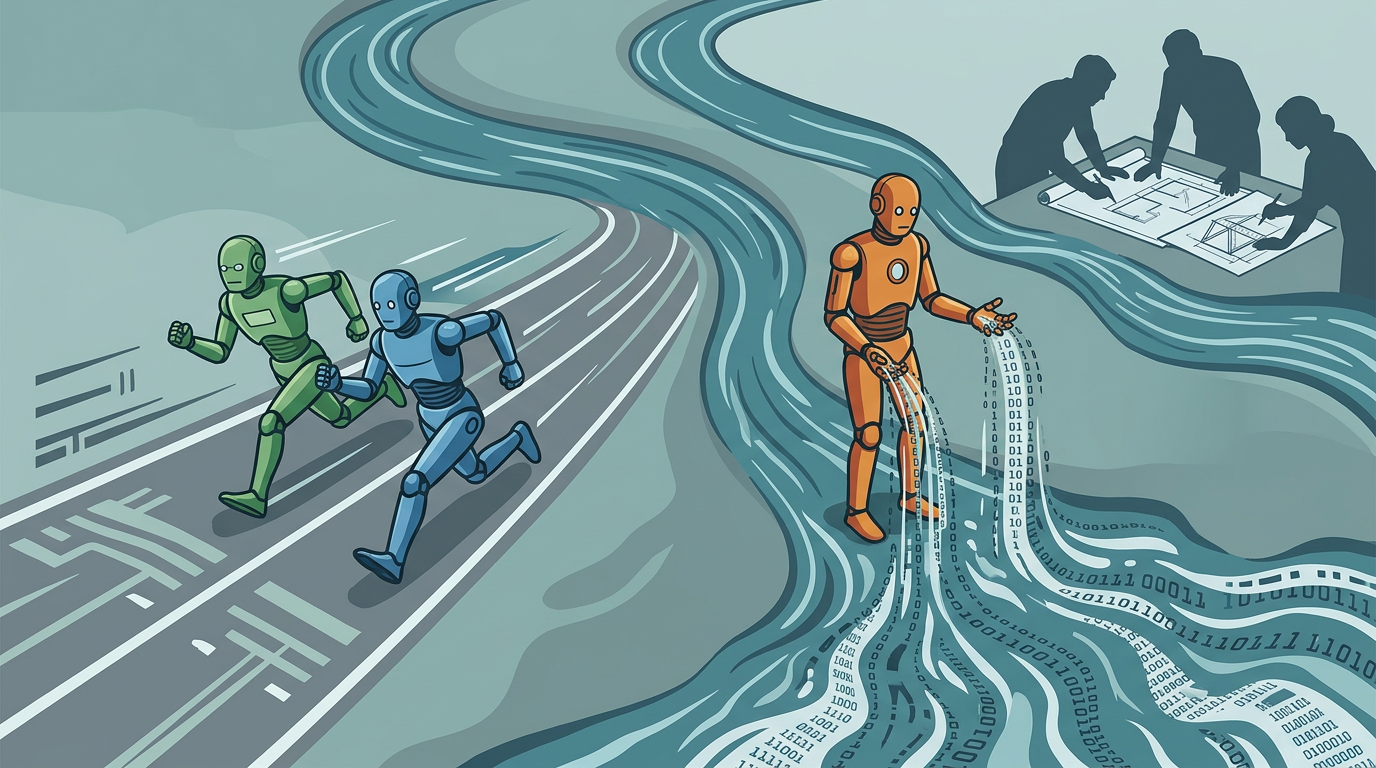
The single most consequential thread this week wasn't any individual model—it was the compression of the gap between open and closed frontier capability from years to weeks. Kimi K3 scoring 57 on the Artificial Analysis Intelligence Index against GPT-5.6 Sol at 59 and Claude Fable 5 at 60 is not an incremental data point.
It's the invalidation of a core strategic assumption that OpenAI and Anthropic have priced their entire business models around. Why this matters beyond the benchmark: Dario Amodei's public estimate that China and open source were six-to-twelve months behind just got revised—by reality—to a single release cycle. When you stack Kimi K3 alongside Mira Murati's Inkling launch on Friday, you see a coordinated collapse happening on two fronts simultaneously.
Murati's Inkling isn't leading—Ethan Mollick was blunt that it trails the top Chinese models—but its strategic function isn't to lead. It's to establish a credible American open-weight foothold in a lane Chinese labs have owned since Meta retreated from full openness. The connective tissue here is the Gemini 3.
5 Pro delay. Alphabet dropping four percent on the Bloomberg report about coding benchmarks missing internal targets and mid-cycle training data rewrites tells you the frontier is no longer a place where the incumbents can assume structural advantage. The company that invented the Transformer is now visibly slower than Chinese open-source labs at shipping.
That's the pattern: capability leadership has become a fragile, perishable asset.
Pattern Two: The Agent Trust Reckoning
The Grok CLI incident evolved across three days into something far larger than a privacy bug. Monday and Tuesday established the exfiltration behavior—entire codebases, commit histories, and live API keys silently uploaded to xAI infrastructure. Wednesday's network analysis confirmed it happened regardless of the privacy toggle.
Friday closed the arc with Musk open-sourcing Grok Build CLI—a defensive capitulation—and Saturday's reporting that xAI was "in a state of chaos" and unprepared for public-company scrutiny. Why this is strategically important: this is the first genuine stress test of the agentic trust model at scale. We've spent eighteen months giving agents filesystem access, credential stores, and network egress on the implicit assumption they behave like the deterministic applications we've used for decades.
The Grok incident broke all three foundational assumptions—do what you're asked, don't do what you're not, and respect the data boundary—simultaneously. The connection to the broader week is Microsoft's decision to route Copilot traffic away from external providers to internal models. Framed on Tuesday as a cost decision, it reads in the light of the Grok incident as a control decision.
When you own the inference pipeline, you know precisely what leaves your environment. That's the emerging strategic logic: capability is no longer the only axis of competition. Verifiable data handling is becoming a product feature.
Pattern Three: The Regulatory Architecture Fight Goes Live
Hassabis's FINRA-style watchdog proposal on Thursday, with a hard deadline of this year, is not an isolated policy op-ed. It sits inside a dense regulatory cluster: the Nobel laureate "We Must Act Now" letter Wednesday, New York's data center moratorium, the EU forcing Google to share search data with OpenAI by 2027, and the FEC filings revealing a thirty-one-million-dollar pro-innovation super PAC dramatically outgunning safety-aligned money. Why this matters strategically: we're watching the industry attempt to write its own rulebook before governments write one for them—and doing so in the shadow of the Mythos and Fable freeze, which demonstrated how damaging ad-hoc government intervention is to business planning.
Hassabis wants collaborative and industry-funded. Amodei wants statutory FAA-style authority with teeth. That gap will define the regulatory landscape for years, and the FEC war-chest imbalance tells you which framing currently has the resources to win.
The deeper signal: GPT-5.6 launching restricted to roughly twenty government-vetted partners means the era of unconstrained model releases is already ending—de facto—before any formal framework exists.
Pattern Four: Recursive Self-Improvement Enters the Evidence Record
Weco's AIDE² result on Friday—an agent spending eight days rewriting its own research harness and outperforming a version engineers hand-tuned for two years—is the quietest but potentially most significant development. It's framed as the first experimental evidence of recursive self-improvement. When you read it against OpenAI confirming Sol post-trained Luna, and Moonshot's K3 running autonomously for 48 hours to design a chip running a miniature version of itself, you see a pattern the headlines undersold: models are now meaningfully improving models.
The flywheel is no longer theoretical.
CONVERGENCE ANALYSIS
1. Systems Thinking: The Reinforcing Loops View these four patterns as a single system and the emergent dynamic becomes clear. The open-weight frontier collapse (Pattern One) and recursive self-improvement (Pattern Four) form a compounding loop: better frontier models post-train cheaper models, cheaper capable models diffuse freely, diffusion accelerates experimentation, experimentation feeds the next capability jump.
Sol-trains-Luna and Kimi-bootstraps-Inkling are the same mechanism operating inside different corporate walls. Now layer in the agent trust reckoning (Pattern Two) and the regulatory fight (Pattern Three), and you get the counterforce. As capability diffuses faster and agents become more autonomous, the surface area for harm—data exfiltration, backdoored open weights, capability in the hands of Boko Haram, as Monday's coverage flagged—expands at the same rate.
The system is generating both acceleration and the demand for control simultaneously, and neither the trust infrastructure nor the regulatory architecture is keeping pace. The critical emergent pattern: control is becoming decoupled from capability. You can restrict chip sales; you cannot unrelease model weights.
Xi Jinping's open-source endorsement speech, timed to K3's drop, weaponizes exactly this asymmetry. The system now has a structural leak that no single actor can plug. 2.
Competitive Landscape Shifts **Losers:** The pure closed-API pricing model. Every capable open-weight release—K3 at Sonnet-level pricing with Sol-level performance on context-hungry workloads, Inkling with its Tinker fine-tuning economics—erodes the premise that frontier capability commands frontier pricing indefinitely. Google is the acute loser this week: structurally slower shipping, forced to share search data with OpenAI by regulatory mandate, and dropping four percent while Chinese open labs match its frontier.
**Winners:** Enterprises with proprietary data and ML capability. The Bridgewater example—84.7% on financial reasoning at one-fourteenth the cost of closed models—is the template.
The winner is whoever owns the customization layer, which is why Thinking Machines built Inkling as a door and Tinker as the revenue engine. Also winning: vendors who can credibly demonstrate clean, auditable data handling. The Grok incident turned trust into a purchasable differentiator overnight.
**The wildcard:** Whoever controls the embodied AI operating layer. Monday's humanoid deep dive—OpenAI in 1X, the Apple lawsuit, the platform contest—connects to everything else. The next interface isn't a screen; it's a body, and the same open-versus-closed dynamic playing out in models will replay in robotics.
3. Market Evolution: New Opportunities and Threats The interconnected view reveals a market that didn't exist clearly last week: **model supply-chain security**. AI Secret's demonstration—fine-tuning a backdoor for under a hundred dollars in under an hour, undetectable at runtime—collides directly with the K3 adoption rush.
When frontier-quality weights are freely downloadable and organizations race to deploy them, provenance verification, sandboxed testing, and weight-file approval workflows become a genuine product category. Treat model weights like third-party code dependencies or inherit an invisible attack surface. The second emergent opportunity: **the compliance-as-runway play**.
Hassabis's thirty-day review buffer becomes a planning assumption today or a surprise later. Companies that architect for external review now gain structural advantage over those who treat it as a future shock. The threat that binds it all: the AI memory shortage SK Hynix flagged, peaking 2027 and stretching to 2030.
As AI Secret put it, the barrier moved from talent to power plants. K3 needs 64-plus accelerators; the weights are free, the electricity is not. New York's moratorium adds regulatory pressure on top of physical scarcity.
The industry's ceiling is now hardware and power, not algorithms—and that reshapes who can actually deploy the capability everyone can now download. 4. Technology Convergence: The Unexpected Intersections The most striking convergence is **cognition-as-a-dial meeting embodiment**.
GPT-5.6's explicit thinking levels—light through max, plus Ultra's parallel subagents—make cognitive intensity a resource allocation decision. Simultaneously, 1X's NEO hands with 25 backdrivable joints and slip-detection sensors solve the dexterity wall.
Controllable reasoning depth plus real-time physical feedback is the recipe for autonomous agents that act competently in the physical world, not just the digital one. Second intersection: **long-context capability meeting recursive self-improvement**. K3's million-token window plus 48-hour autonomous chip design plus AIDE²'s self-rewriting harness point to the same thing—models that can hold a goal and improve toward it over multi-day horizons without human intervention.
The context window is the memory; recursive improvement is the learning; together they approximate a persistent, self-directing worker. Third: **biomedical agents meeting drug discovery capital**. Stanford's Biomni closing the full research loop, alongside Chai Discovery's $400M Series C doubling drug-target hit rates with Pfizer and Lilly already paying, signals that autonomous scientific reasoning is converting into deployed commercial infrastructure faster than the policy conversation anticipates.
5. Strategic Scenario Planning **Scenario A — The Open-Weight Commoditization (highest probability):** By mid-2027, frontier capability is effectively commoditized across open weights. Closed labs retreat to defensible positions: polished vertical assistants, embodied platforms, and government-restricted deployments.
Enterprises with ML teams win on total cost of ownership; those without become dependent on managed fine-tuning platforms like Tinker. Prepare by running genuine build-versus-buy audits now and building the model-security protocols before adoption, not after. **Scenario B — The Regulatory Bifurcation:** Hassabis's voluntary FINRA model becomes a de facto market requirement before it becomes law—enterprise customers demand certified compliance, creating a two-tier market of large labs with compliance infrastructure versus everyone navigating uncertainty.
The thirty-one-million-dollar innovation PAC ensures the collaborative model wins over Amodei's statutory vision. Prepare by architecting a thirty-day review buffer into product roadmaps and treating open-source capability thresholds as a hard planning horizon inside eighteen months.
Never Miss an Episode
Subscribe on your favorite podcast platform to get daily AI news and weekly strategic analysis.