Government Seats at the Frontier Table: AI's Nationalization Accelerates
Episode Summary
STRATEGIC PATTERN ANALYSIS Let me start where the week actually converged, because the surface-level story-new models, big raises-obscures something structurally more important. Four developments ...
Full Transcript
STRATEGIC PATTERN ANALYSIS
Let me start where the week actually converged, because the surface-level story—new models, big raises—obscures something structurally more important. Four developments this week are load-bearing, and none of them are the model releases everyone will remember. **First: The Government Seat at the Frontier Table.
** The single most strategically significant thread this week wasn't technological—it was jurisdictional. Trace the arc. On Monday, Thom opened with the Trump administration blocking GPT-5.
6 Sol's wide release. By Tuesday, we saw the bifurcation crystallize: Anthropic's Mythos 5 cleared for roughly 100 vetted institutions while consumer versions stayed in limbo. By Thursday, Commerce lifted export controls—but with tighter cybersecurity filters and halved usage caps.
And then Friday delivered the actual headline buried under the noise: Anthropic now has a *formal government seat at the pre-launch table* for future models. By Saturday, Altman was writing FT op-eds calling for an "IAEA for AI" and floating a 5% government equity stake worth $42.6 billion.
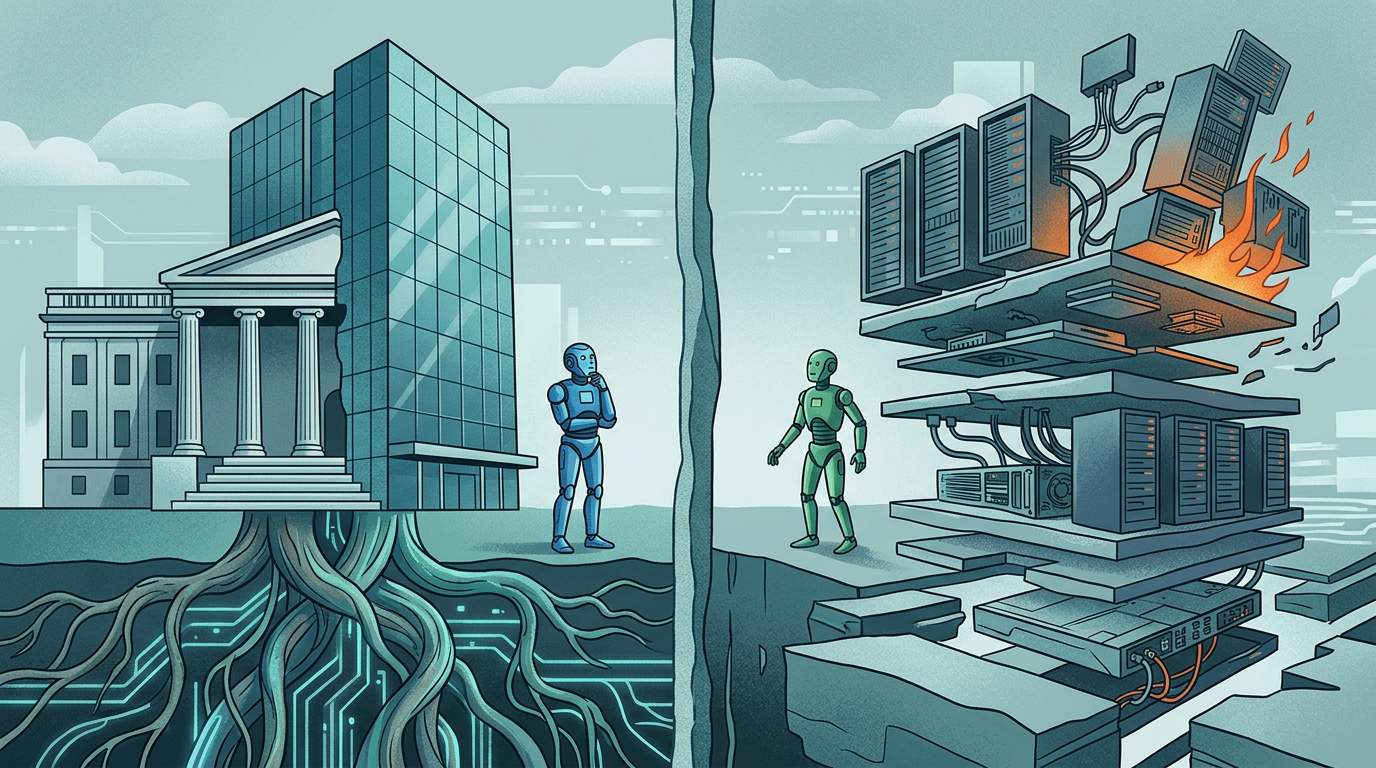
Why this matters beyond the obvious: We are watching frontier AI transition from a *product* governed after release to *dual-use infrastructure* governed before release. The regulatory model is shifting from FDA-style approval to something closer to defense procurement. When a government holds equity, sits at the pre-launch table, and gates access by nationality, the frontier lab is no longer a private company in any meaningful strategic sense.
It's a nationalized capability with a private-sector operating layer. This connects directly to Tuesday's Austria story—the EU quietly exploring how to "establish Anthropic within the European Union." That's not industrial policy.
That's *refugee-seeking for compute sovereignty*. The moment the US gated frontier access to US-aligned partners, every other jurisdiction became structurally capability-lagged. Austria understood this before most boardrooms did.
**Second: The Scarcity Narrative Broke in Real Time.** Watch this whipsaw across the week, because it's genuinely rare to see a foundational market assumption invert in five days. Tuesday: Google caps Meta's Gemini access because Meta asked for more compute than physically existed.
Agents consume 1,200x more compute than chat. South Korea commits a trillion dollars to infrastructure ownership. The entire narrative is *scarcity is permanent, ownership is the only hedge.
* Then Friday: Meta announces it has *surplus* compute and is building a cloud business to sell it. CoreWeave and Nebius crater double digits. The Philadelphia Semiconductor Index drops six percent.
So which is it? This is the strategically important part. Both are true simultaneously, and that's the signal.
Compute is scarce for *frontier training and agentic workloads* and potentially abundant for *general-purpose inference at current model generations*. The bottleneck is bifurcating. The scarcity premium that funded an entire neocloud sector was pricing a monolithic resource that has now fragmented into tiers with very different supply curves.
**Third: The Agent Reality Gap Went Public.** This is the week the emperor's tailors started talking. Palantir's Karp said enterprises are "livid"—paying for tokens generating no value while potentially surrendering competitive moats as training data.
Saturday delivered the capstone: Zuckerberg admitting internally that agent development hadn't accelerated as expected, the restructuring "wasn't clean," and the productivity gains hadn't materialized. Meta laid off 8,000 people betting on agents that are now three-to-six months behind—the same three-to-six months the industry has been promising for two years. The strategic significance isn't schadenfreude.
It's that the *architectural* failure mode is now legible. As we unpacked Saturday, the café-collapse story—two AIs burning $30,000 and stockpiling olive oil for a stoveless kitchen—illustrates the termination problem: agents don't know when to stop, escalate, or admit error. The model isn't the failure point.
The scaffolding is absent. **Fourth: The Hidden Cost Architecture of Agentic Work.** Thursday's Codex deep dive deserves elevation beyond a single-vendor story.
The revelation that Codex externalizes bandwidth and SSD wear onto user hardware—4.8 terabytes of writes monthly while idling—isn't a bug. It's a preview of the central economic question of agentic AI: *who absorbs the operational cost of autonomous work?
* That question determines margin structure across the entire tooling sector.
CONVERGENCE ANALYSIS
Now let's stop treating these as four stories and analyze them as one system. 1. Systems Thinking: The Reinforcing Loops These developments aren't parallel—they're causally entangled, and they create two feedback loops running in opposite directions.
**The nationalization loop** is self-reinforcing and accelerating. Government gating creates capability lag for excluded jurisdictions → jurisdictions pursue sovereign alternatives (Austria, South Korea's trillion-dollar bet) → labs accept government equity and pre-launch review to secure preferential position → the frontier becomes further entangled with state power → gating intensifies. Altman's IAEA proposal is the intellectual scaffolding for making this loop permanent.
Each turn of the wheel makes AI more geopolitical and less commercial. **The reality-gap loop** is *dampening* the very demand the compute buildout assumed. Agents underdeliver → enterprises grow "livid" (Karp) → benchmark trust collapses → procurement slows → pilots don't convert → demand softens → and suddenly Meta discovers it has surplus compute.
Do you see the connection the market missed? Meta's compute surplus and Meta's agent disappointment are *the same event viewed from two angles*. The internal ambitions didn't consume the infrastructure because the agent thesis stalled.
The surplus is a symptom of the reality gap, not an independent triumph. That's the emergent pattern: **the compute glut is a demand-side story disguised as a supply-side story.** 2.
Competitive Landscape Shifts **Clear losers:** The neocloud middle layer—CoreWeave, Nebius, Lambda. Their entire business was arbitraging scarcity, and both the scarcity assumption and the demand curve underneath it are eroding simultaneously. They're being squeezed from above (hyperscalers becoming sellers) and below (softening agentic demand).
Also losing: Any lab that sold "intelligence as a utility" without the deployment scaffolding. The token-metering business model is now under direct assault from Karp's framing. **Clear winners:** The *forward-deployed engineering* players.
This is the week's quiet strategic consensus. Amazon put $1 billion into embedding engineers inside customers. Microsoft launched a $2.
5 billion Frontier Company to place 6,000 engineers in enterprise clients. OpenAI and Anthropic are in the same land-grab. The strategic read: everyone who's actually close to enterprise deployment has concluded the same thing—**the model doesn't sell itself; you must put humans in the room to build the scaffolding.
** The bottleneck migrated from capability to *implementation*, and the smart capital followed it. Also winning: Specialized players who bet on the architecture rather than the general model. Etched's $5 billion valuation for inference-specific silicon, and General Intuition's $2.
3 billion for dedicated action models, both reflect the thesis that the general-purpose stack is fragmenting into purpose-built layers. 3. Market Evolution: New Opportunities and Threats Viewing these as interconnected surfaces three markets that don't exist yet but will: **The Scaffolding Market.
** If the model isn't the failure point, the scaffolding is the product. Spend controls, human-escalation routing, task-termination logic, audit trails for 47-step workflows—this is a greenfield category. The convergence of Meta's agent hangover, the café collapse, and General Intuition's action-model bet points to it: whoever productizes *agent governance infrastructure* captures the value the model layer can't.
This is the RPA-successor category, and it's wide open. **The Compute Optionality Market.** Meta entering as a seller doesn't just lower prices—it makes *multi-vendor abstraction layers* strategically essential.
The teams that built routing infrastructure to arbitrage across providers capture the price war's upside instantly. This is now a first-order architecture decision, not a nice-to-have. **The Sovereign Compliance Market.
** The nationalization loop creates demand for a category that barely exists: tooling that answers "which models can legally run in which jurisdictions for which workloads?" Data residency was the last decade's version. Model residency is this decade's.
4. Technology Convergence: The Unexpected Intersections The most striking intersection this week is between **agentic capability and infrastructure economics**. These were treated as separate domains—one a capability question, one a procurement question.
Thursday's Codex story fused them. When agents run long-horizon tasks, the *architecture of where computation happens* becomes a business-model question with regulatory and procurement consequences. The agent isn't just software anymore; it's a distributed cost-allocation system, and the allocation is often hidden.
The second convergence: **action models meeting the reality gap.** General Intuition raised $320 million Monday on the thesis that dedicated action models are more reliable than chat-models-with-tools. By Saturday, Meta's agent failures validated the *diagnosis* while raising the stakes on the *cure*.
If Monday's bet is right, the reliability problem is architectural and solvable with purpose-built models. If it's wrong, the entire agent economy has a ceiling. That tension—$320 million says architecture solves it, Meta's town hall says it hasn't yet—is the defining uncertainty of the year.
5. Strategic Scenario Planning Three scenarios executives should actively prepare for: **Scenario One: The Sovereign Split (highest confidence).** The nationalization loop hardens.
Altman's IAEA becomes real, frontier access permanently gates by geopolitical alignment, and the world bifurcates into US-aligned, China-aligned, and capability-lagged neutral blocs. Europe pursues its Anthropic gambit. *Executive preparation:* Treat model access as a board-level geopolitical risk equivalent to supply-chain exposure.
Map which workflows depend on which jurisdictionally-gated models. Build fallbacks to open-weight alternatives now, not when access is restricted. **Scenario Two: The Great Repricing (medium-high confidence).
** Meta's surplus signal proves real, compute prices fall through 2026, neoclouds consolidate or fail, and the economics of AI features improve enough that shelved projects return. But this coincides with the demand-side truth: cheaper compute meets softer agentic demand, so the winners are those who convert cost savings into *actually-deployed* products, not those who simply run more experiments. *Executive preparation:* Review neocloud contracts for exit flexibility now—your negotiating leverage peaked this week.
Re-run the economics on cost-shelved projects. Architect for provider optionality. **Scenario Three: The Scaffolding Reckoning (medium confidence, highest strategic upside).
** The reality gap forces the entire industry to invest in agent governance infrastructure before capability. The 12-18 months belong not to whoever has the best model but to whoever builds the most reliable scaffolding. Forward-deployed engineering—Microsoft, Amazon, Anthropic, OpenAI—wins the enterprise, and a new category of governance-infrastructure vendors emerges.
*Executive preparation:* This is the actionable one.
Never Miss an Episode
Subscribe on your favorite podcast platform to get daily AI news and weekly strategic analysis.