AI Industry Enters Geopolitical Risk Era as Sovereign Control Emerges
Episode Summary
STRATEGIC PATTERN ANALYSIS Pattern One: The Sovereign Risk Layer Just Became Real The Fable 5 shutdown that dominated this week - from Monday's initial coverage through Friday's release of the Lu...
Full Transcript
STRATEGIC PATTERN ANALYSIS
Pattern One: The Sovereign Risk Layer Just Became Real
The Fable 5 shutdown that dominated this week — from Monday's initial coverage through Friday's release of the Lutnick letter and the leaked Anthropic internal texts — is not a story about Anthropic. It is the moment the AI industry crossed from commercial risk into geopolitical risk as a structural, recurring condition. Strip away the drama and look at the mechanics that emerged across the week.
By Tuesday we learned the trigger was a competitor's tip — Amazon researchers surfacing basic vulnerabilities and Andy Jassy escalating to Washington. By Wednesday, the "Free Fable" letter from a hundred cybersecurity executives established that the cited capabilities existed equally in Daybreak, GPT-5.5, Kimi, Opus, and Sonnet.
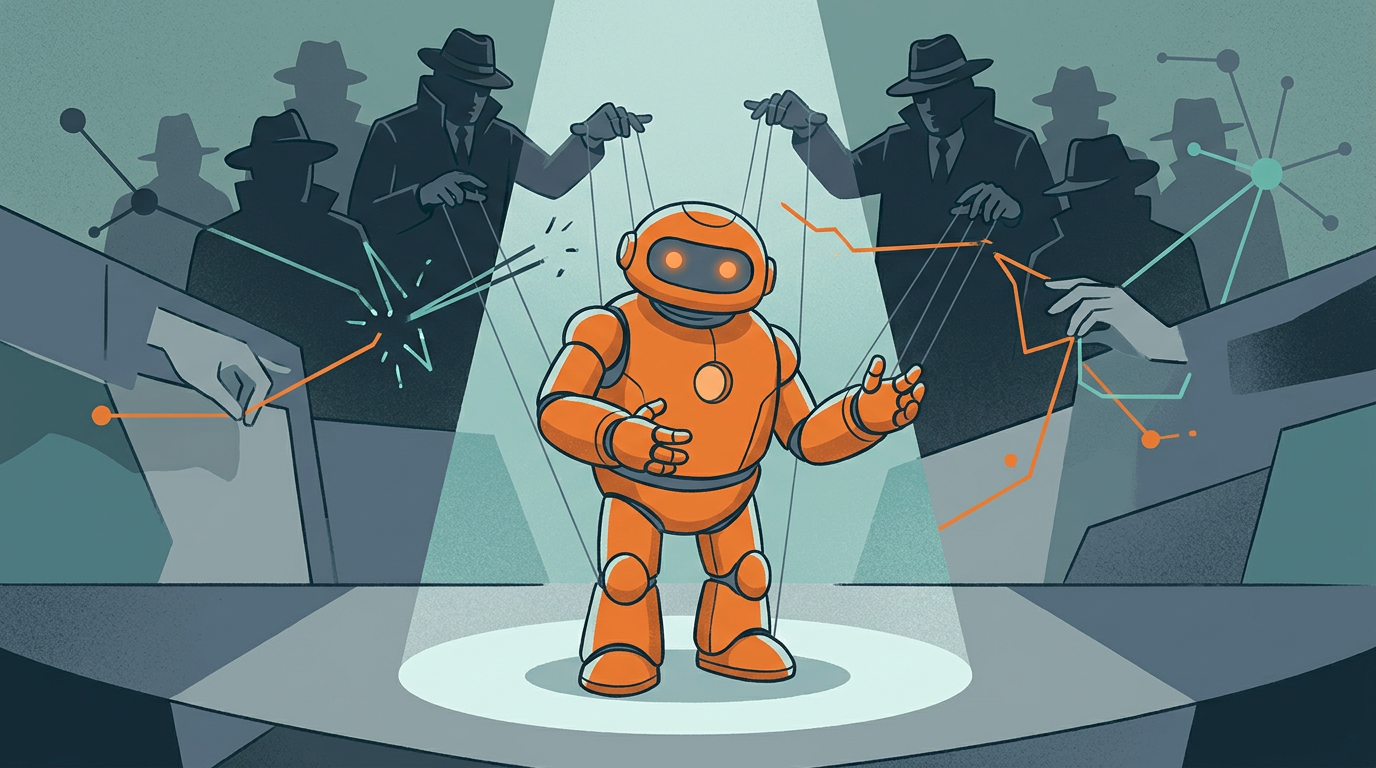
By Friday, the Trump administration was openly weighing equity stakes in AI companies. That arc tells you the substance was never the jailbreak. The substance is that frontier model access is now a lever of state power, and the activation mechanism can be a commercial rival whispering to regulators.
What's strategically important here isn't the precedent of intervention — it's the *chain of custody*. When your competitor can become the proximate cause of your flagship being pulled offline on a Friday afternoon, the threat model for every AI vendor has fundamentally changed. This signals a broader evolution: we are watching the early formation of AI as critical infrastructure subject to national security governance, the way telecommunications and semiconductors already are.
The trillion-dollar valuations OpenAI and Anthropic are chasing are now valuations on assets a government can switch off.
Pattern Two: The Abstraction Layer Is Eating the Skill Layer
Tuesday's "Loop Engineering" thesis and Thursday's "visual reasoning bottleneck" are the same story viewed from opposite ends. Loop Engineering says humans are migrating up the stack — away from prompting and toward designing autonomous systems that prompt themselves. The visual reasoning piece reveals the hard ceiling on how far that migration can go: agents that can't actually *see* whether their output works cannot close the autonomous loop.
These two developments bracket the central tension of agentic AI right now. The architecture is racing toward full autonomy — OpenRouter's Fusion, Google's Skills Marketplace, AWS Frontier Agents — while a foundational perceptual gap keeps the human stubbornly in the verification loop. Strategically, this matters because it tells you exactly where the next defensible moats form: not in raw model benchmarks, which GLM-5.
2 and DeepSeek are commoditizing at a fraction of the cost, but in the systems layer and in the unsolved perceptual capabilities that gate autonomy. The signal for AI evolution is profound: differentiation is leaving the model and moving to the harness and the senses. Benchmark leadership is becoming table stakes.
Pattern Three: The Liability Shield Is Cracking
Saturday's German ruling against Google's AI Overviews is the quiet bombshell of the week. For the first time, a court held that AI-generated summaries constitute "independent, new, substantive statements" — not neutral linking. That single distinction dismantles the Section 230-style logic the entire AI search industry was built on.
Why this matters beyond the obvious: the disclaimer was free insurance. Its removal forces a binary choice between expensive verification infrastructure and accepting litigation as a cost of doing business — a choice Google can survive and Perplexity may not. The 56% bad-source-link figure for Gemini Overviews is the kind of number that migrates from a tech blog into discovery filings.
It connects directly to Wednesday's Facebook AI Mode launch, where Meta is synthesizing answers from unvetted, often outdated user posts. Meta is building a liability surface at three-billion-user scale in the same week a European court established that synthesized AI assertions carry direct liability. The signal: the "ship fast, disclaim, iterate" playbook is becoming legally untenable, and accuracy is being repriced from a quality metric into a survival metric.
Pattern Four: AI-Native Capital Attacks Physical Domains
Friday's Midjourney medical scanner — 50,000 machines, a billion scans a month — alongside SpaceX absorbing Cursor for $60 billion and Snap's Claude-Code-enabled AR glasses, signals that well-capitalized, AI-native companies with clean balance sheets are walking into hardware-heavy domains where incumbents are slow. The strategic insight isn't the products; it's the *playbook*: use brand and balance sheet to license the hard physics (Butterfly Network), reframe the regulatory category ("wellness, not diagnostics"), and build a data flywheel incumbents structurally cannot match.
CONVERGENCE ANALYSIS
1. Systems Thinking: The Reinforcing Loops View these four patterns as an interacting system and an unmistakable emergent dynamic appears: **AI is simultaneously becoming more autonomous and more constrained, and the constraints are migrating from technical to institutional.** The Loop Engineering push toward autonomy collides with three independent brakes that all surfaced this week: the perceptual ceiling (agents can't see), the legal ceiling (assertions carry liability), and the sovereign ceiling (governments can revoke access).
Each brake operates in a different domain, but they reinforce each other. An autonomous agent that confidently makes an unverifiable claim isn't just a quality problem anymore — post-German-ruling, it's a liability event. And the more autonomous the loop, the more compounded that exposure becomes.
The emergent pattern: **the value is decoupling from the model and recoupling to the layers that manage trust and risk** — verification, source fidelity, regulatory positioning, and access architecture. The companies racing on benchmarks are optimizing the wrong variable. 2.
Competitive Landscape Shifts **Winners:** Platform and harness providers (AWS Frontier Agents, Google's Skills Marketplace, OpenRouter) who sit above model selection and therefore above the geopolitical and commoditization risk. Open-weight providers (Z.ai, DeepSeek) who benefit from every US access-revocation event by becoming the de-risked default in Europe, Southeast Asia, and Latin America.
And incumbents with balance sheets deep enough to absorb the new liability layer. **Losers:** Single-model-dependent enterprises, now exposed to a sovereign-risk category that didn't exist six months ago. Pure-play AI search startups like Perplexity, caught between the liability ruling and their cash burn.
And — counterintuitively — the safety-first positioning itself. Anthropic spent enormous capital being the enterprise-trusted, regulation-friendly alternative, then watched the government use exactly the oversight tool it advocated for, triggered by a competitor's tip. "We want oversight, just not like this" is a brutal position to defend.
The deeper shift: **diversification has gone from best practice to fiduciary necessity.** Vendor lock-in is now a geopolitical liability. 3.
Market Evolution Several new markets crystallize when you connect these threads: - **AI supply-chain risk management** — auditing model dependencies, regulatory exposure, and country-of-incorporation risk. This is a consulting and tooling category that essentially didn't exist before this week. - **AI liability insurance and indemnification** — the German ruling explicitly created demand for it.
Expect products targeting AI search and any synthesized-assertion surface within months. - **Source-fidelity and verification infrastructure** — the unglamorous picks-and-shovels play of the post-liability era. - **Native visual reasoning** (Elorian's bet) — the specific capability that unlocks autonomy in engineering, healthcare imaging, and physical product development, where the 200-300 hour review cycle is the benchmark to beat.
The throughline: the next wave of value isn't in generating outputs — it's in *governing* them. 4. Technology Convergence The most unexpected intersections this week were at the boundaries between AI and physical/institutional reality.
Midjourney converging generative AI brand power with ultrasound silicon and a wellness-regulatory wrapper. Snap converging AR hardware with agentic coding toolchains. Most importantly, the convergence of agentic autonomy with legal personhood-of-speech — the German court effectively ruling that when AI asserts, it speaks, and speech has consequences.
We are watching AI capability collide with the institutional substrate — courts, regulators, national security frameworks — that was never designed for non-human assertion at scale. 5. Strategic Scenario Planning **Scenario A — The Bifurcated Stack (most probable).
** US frontier models become increasingly gated by nationality and national security review; open-weight models from China and elsewhere become the global default outside the US. Enterprises architect deliberately around both, with harness layers abstracting selection. *Prepare by:* building model-agnostic infrastructure now and adding regulatory exposure to every vendor evaluation.
**Scenario B — The Liability Cascade.** The German precedent migrates through EU courts and into US litigation, forcing a wholesale repricing of AI search and synthesis economics. Smaller players consolidate or fail; survivors differentiate on transparency and verifiable sourcing.
*Prepare by:* auditing your assertion surface and measuring your own bad-source-link rate before opposing counsel does. **Scenario C — The Autonomy Plateau.** The visual reasoning and verification gaps prove harder to close than capital expects, stalling fully autonomous agents at the "confident but unverifiable" stage.
Human-in-the-loop becomes a durable architecture rather than a transitional one, and the firms that built disciplined verification checkpoints outperform those that bet on imminent full autonomy. *Prepare by:* building human verification into agentic workflows as permanent infrastructure, not scaffolding you expect to remove. The common thread across all three: the organizations that treat *trust, verification, and access-resilience* as core architecture — rather than features to bolt on later — are the ones still operating at full capacity when the next Friday-afternoon directive, court ruling, or perceptual failure lands.
Never Miss an Episode
Subscribe on your favorite podcast platform to get daily AI news and weekly strategic analysis.