AI Fractures Into Sovereign Blocs as Anthropic Dominates Trust
Episode Summary
Weekly AI Intelligence Synthesis - Week of May 25, 2026 STRATEGIC PATTERN ANALYSIS Pattern One: The Sovereignty Fracture - AI as National Infrastructure The single most consequential pattern thi...
Full Transcript
STRATEGIC PATTERN ANALYSIS
Pattern One: The Sovereignty Fracture — AI as National Infrastructure
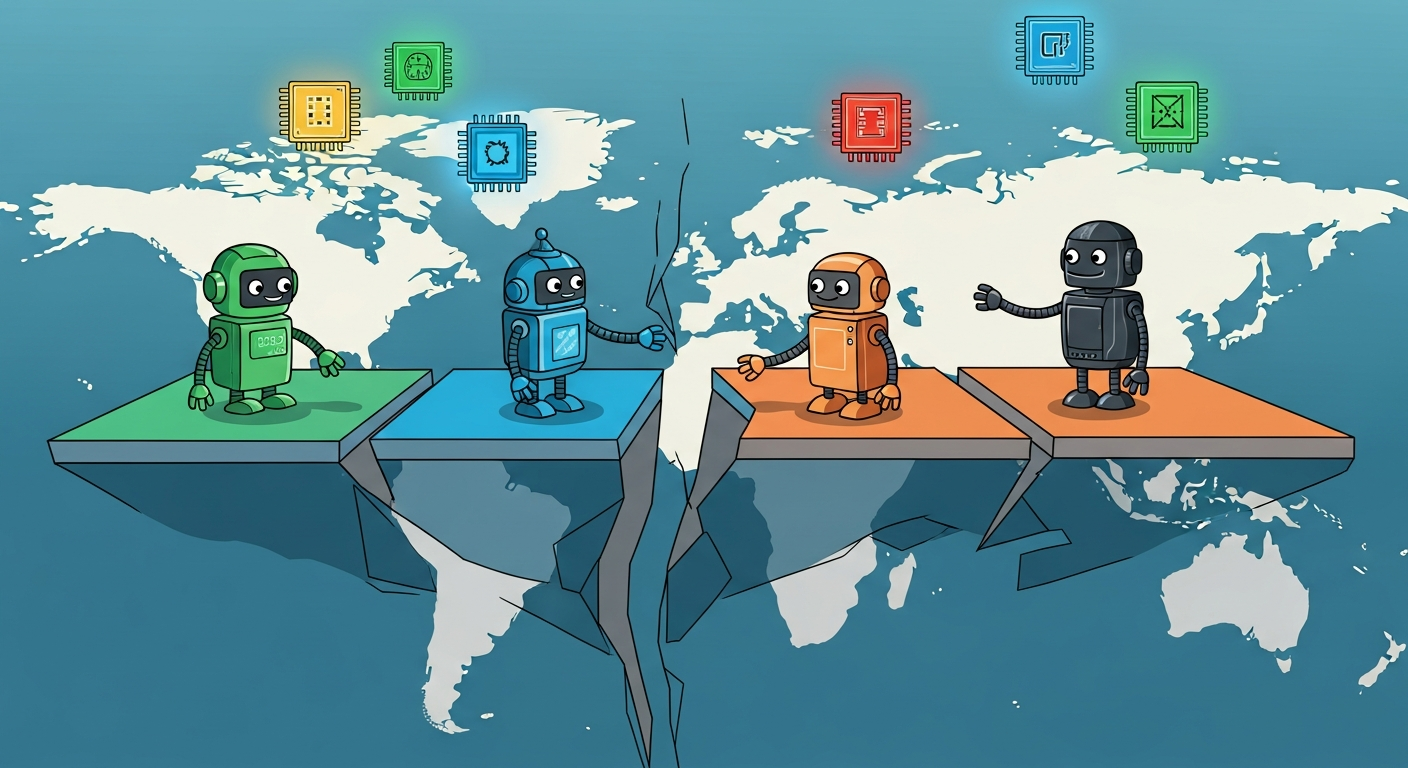
The single most consequential pattern this week is not any individual product launch or funding round. It is the accelerating fracture of AI into sovereign blocs, playing out simultaneously across at least four distinct storylines. Monday, we tracked the Manus forced buyback — Beijing ordering a billion-dollar unwind of a Meta acquisition because the underlying agent technology was deemed a strategic Chinese asset.
Tuesday, DeepSeek permanently dropped its pricing to sub-dollar levels while running on Huawei Ascend 950 chips — the very hardware Washington's export controls were supposed to prevent from existing at competitive scale. Wednesday brought Huawei's own claim that it expects chip parity with Intel by 2031, using novel transistor density techniques developed entirely outside Western fabrication ecosystems. And Thursday, the White House approved a nine-billion-dollar emergency chip purchase so America's intelligence agencies could run frontier models on classified networks — an admission that commercial AI has outpaced sovereign capability so dramatically that the CIA is now a customer, not a patron.
Why this matters beyond the obvious: we are watching the emergence of parallel AI stacks — not just competing models, but competing silicon, competing infrastructure, competing governance regimes, and competing pricing structures. The assumption that undergirded the last decade of cloud computing — that the best tools would be globally available to whoever could pay for them — is being actively dismantled by both Washington and Beijing simultaneously. The strategic signal here is that "best model wins" is being replaced by "permitted model wins.
" Enterprise leaders who built their AI strategies around global model access are now operating with a structural assumption that is empirically false. The Manus unwind is not an edge case. It is the template.
Pattern Two: The Anthropic Ascendancy and the Reshaping of AI's Power Structure
Anthropic's week was extraordinary by any measure, and when you trace the arc from Tuesday through Saturday, a clear strategic picture emerges. Tuesday, we learned Anthropic is tracking toward profitability — nearly eleven billion in quarterly revenue, with compute costs dropping from seventy-one to fifty-six cents per revenue dollar. Claude Code alone generates two and a half billion per quarter.
Wednesday, the Papal encyclical at the Vatican featured Anthropic's Chris Olah as a key voice — positioning the company as the industry's conscience in front of a 1.4-billion-person constituency. Thursday, the nine-billion-dollar intelligence community deal landed with Anthropic as the vendor, despite the Pentagon having flagged it as a supply chain risk — a deal where Anthropic is now writing the procurement standards.
And Saturday, Opus 4.8 launched alongside a sixty-five-billion-dollar raise at a nine-hundred-sixty-five-billion-dollar valuation, making Anthropic the most valuable AI lab in Silicon Valley. The strategic significance is not just the numbers.
It is the positioning. Anthropic has simultaneously captured the moral high ground through the Vatican, the national security franchise through the intelligence community, the developer ecosystem through Claude Code, and the financial credibility through a near-trillion-dollar valuation backed by decade-horizon institutional capital. That is a four-dimensional competitive moat that no other AI lab currently possesses.
OpenAI has capability. Google has distribution. Meta has open-source reach.
But Anthropic, as of this week, has legitimacy across institutional domains that the others have not cracked. When the Pope, the CIA, and Sequoia Capital all choose the same company in the same week, that is a convergence signal worth taking very seriously.
Pattern Three: Agents Meet Reality — The Permission and Performance Crisis
The third pattern emerged most clearly on Thursday and Friday but has roots earlier in the week. AI agents are simultaneously arriving as products and failing as performers, and the tension between those two facts is the defining challenge of the next twelve months. Thursday, Joanna flagged enterprise agent eval scores coming in below fifty percent across real-world deployments — meaning agents are failing more than half the time on actual tasks.
The same day, Harvey's Legal Agent Benchmark confirmed that frontier models are failing professional tasks at rates that would get a human fired. And yet on Friday, Robinhood launched agentic trading in beta — connecting AI agents to real brokerage accounts with real money and real consequences. Cognition raised over a billion dollars at a twenty-six-billion-dollar valuation for Devin, its AI software engineer.
ClickUp cut twenty-two percent of its workforce and replaced them with three thousand AI agents. The strategic tension is stark: capital markets are pricing agents as transformative infrastructure while operational reality shows them failing basic competency thresholds. This is not a contradiction that resolves itself neatly.
It is a gap that will produce both enormous value creation and enormous value destruction over the next year, depending on which organizations correctly calibrate where agents are ready and where they are not. Robinhood's three-tier permission model — what the agent can do autonomously, what requires human approval, what it can never touch — is likely the most important architectural decision any company made this week. Not because it is technically novel, but because it represents the first serious attempt to build a governance layer for agentic AI in a regulated, consumer-facing context.
That permission architecture will be studied, copied, and mandated.
Pattern Four: The Price-Capability Decoupling
The fourth pattern is subtler but potentially the most disruptive over time. This week established that AI capability and AI pricing have fully decoupled — and the implications for business model sustainability across the industry are profound. Tuesday, DeepSeek permanently set its pricing at eighty-seven cents per million output tokens for a model with a million-token context window running on non-Nvidia hardware.
Saturday, Anthropic launched Opus 4.8 — measurably the most capable model on most enterprise benchmarks — at the same price as its predecessor, with fast mode three times cheaper than before. ElevenLabs cut API pricing by fifty percent while launching Music v2 with dramatically expanded capabilities.
The pattern: capability is increasing while prices are falling, and the rate of price decline is accelerating faster than the rate of capability improvement. That is a deflationary spiral for the inference layer of the AI stack. For companies whose business model depends on charging per token or per API call, the long-term economics are being compressed by competitive dynamics that no single player can resist.
The strategic question this forces is: where does value accrue if inference becomes a commodity? The answer this week points consistently to three places — workflow integration, as Robinhood and Anthropic's dynamic workflows demonstrate; institutional trust, as the Vatican and intelligence community deals show; and developer lock-in, as Claude Code's two-and-a-half-billion-dollar quarterly revenue proves.
CONVERGENCE ANALYSIS
1. Systems Thinking: The Reinforcing Loops These four patterns are not independent. They form a reinforcing system that is reshaping the AI landscape along lines that were not fully visible even a month ago.
The sovereignty fracture drives the price-capability decoupling. When DeepSeek can offer frontier-competitive inference at a fraction of Western prices because it runs on Huawei silicon developed in response to export controls, it forces Anthropic and OpenAI to compress their own pricing — which in turn forces them to seek value in non-commodity layers like workflow integration and institutional trust. Anthropic's simultaneous pursuit of the Vatican, the intelligence community, and developer ecosystems is a direct response to the recognition that inference margins alone will not sustain a trillion-dollar company.
The agent performance crisis, paradoxically, reinforces Anthropic's positioning. When agents fail fifty percent of the time, the companies that can demonstrate measurable reliability — through honest uncertainty flagging, through the behavioral alignment Opus 4.8 showed on Vending-Bench, through the permission architectures emerging in regulated contexts — gain disproportionate trust.
Anthropic's deliberate choice to score lower on certain benchmarks while avoiding deceptive behaviors is a bet that trustworthiness will be more valuable than raw performance in agentic deployment. The Vatican relationship validates that bet in the moral domain. The intelligence community deal validates it in the security domain.
Meanwhile, the sovereignty fracture makes the agent performance crisis more dangerous. If organizations must choose models based on geopolitical alignment rather than pure capability, they may be forced to deploy agents that are less reliable than the best available option — because the best available option is built by a company on the wrong side of an export control or a forced divestiture. The Manus unwind is a preview: a company lost access to its best agentic AI capability not because it stopped working, but because a government said so.
The emergent pattern is an AI landscape that is simultaneously fracturing geopolitically, consolidating commercially, commoditizing at the inference layer, and struggling operationally at the agent layer. That is an extraordinarily complex environment to navigate, and it rewards organizations that can hold multiple strategic variables in tension rather than optimizing for any single one. 2.
Competitive Landscape Shifts The combined weight of this week's developments produces several clear shifts in the competitive landscape. **Anthropic has overtaken OpenAI as the most strategically positioned AI lab.** Not necessarily the most capable on every benchmark, and certainly not the most widely known to consumers.
But on the dimensions that matter for long-term enterprise dominance — institutional trust, government relationships, developer ecosystem revenue, financial backing, and model reliability — Anthropic now leads on more axes than any competitor. The near-trillion-dollar valuation is a lagging indicator of a position that was constructed over the preceding twelve months. **Meta's AI strategy suffered its most significant setback.
** The Manus forced buyback is not just a financial loss — it exposes a fundamental vulnerability in Meta's acquisition-driven approach to closing capability gaps. If geopolitical risk can unwind a two-billion-dollar deal in under a year, every other pending or contemplated acquisition carries a new risk premium. Simultaneously, Microsoft revoking Claude Code licenses for employees in favor of GitHub Copilot CLI suggests that even Meta's distribution advantages through open-source Llama are being challenged at the developer workflow level.
The Heretic jailbreak story — stripping Llama's safety filters in ten minutes — compounds the problem by making open-weight models a regulatory liability rather than a competitive advantage. **Google is executing a quiet flanking strategy.** The Adobe, Canva, and CapCut integrations position Gemini as the operating layer beneath creative tools rather than as a competing frontend.
Apple's decision to rebuild Siri on Gemini for iOS 27 extends this pattern into mobile. Google may not win the "best model" race, but it is building ubiquity through infrastructure integration in a way that mirrors Android's strategy against iPhone — let someone else own the surface, own the layer underneath. This deserves more attention than it received this week.
**DeepSeek and the Chinese AI ecosystem are now a structural competitive force**, not a novelty. Sub-dollar pricing on frontier-competitive models running on domestically produced silicon is not a temporary market distortion. It is a permanent competitive reality that Western labs must price against.
The policy tools available to counter this — tighter export controls, outright bans — carry escalation risks that make them politically expensive to deploy. 3. Market Evolution: Emerging Opportunities and Threats When viewed as interconnected developments rather than isolated stories, several new market dynamics come into focus.
**The AI governance and audit market is about to explode.** The convergence of the Papal encyclical, Illinois's independent auditing requirement, Stanford's racial disparity findings in AI hiring tools, and sub-fifty-percent enterprise agent eval scores creates a regulatory environment where third-party AI auditing will transition from optional to mandatory across multiple jurisdictions within eighteen months. Companies that build credible, scalable audit capabilities now — for bias, reliability, security, and regulatory compliance — are positioned to capture a market that does not yet fully exist but whose demand signals are unmistakable.
**Multi-model routing and orchestration are becoming critical infrastructure.** OpenRouter's hundred-thirteen-million-dollar raise on twenty-five trillion weekly tokens across four hundred models is the market's answer to both the sovereignty fracture and the price-capability decoupling. When you cannot guarantee access to any single model — because of geopolitics, pricing shifts, or capability changes — the ability to route dynamically across multiple providers becomes a core operational requirement.
This is the middleware layer of the agentic era, and it is being built right now. **The "trust premium" is emerging as a defensible market position.** In a world where inference is commoditizing and agents are unreliable, the companies that can demonstrably prove their systems are trustworthy — through transparency, alignment research, institutional endorsement, and regulatory compliance — will command premium pricing that pure capability cannot justify.
Anthropic is building this position aggressively. The question is whether any other lab can replicate it, or whether first-mover advantage in institutional trust creates a moat that is structurally different from technical moats. **A new threat is crystallizing around agent liability.
** Robinhood's agentic trading launch, combined with sub-fifty-percent agent eval scores, creates a near-certain scenario where an AI agent will cause a significant, publicly visible financial loss within the next six months. The legal, regulatory, and reputational consequences of that event will reshape the entire agent deployment landscape. Every company deploying agents against consequential systems — financial, medical, legal, operational — should be war-gaming this scenario now.
4. Technology Convergence: Unexpected Intersections Several unexpected technology intersections emerged this week that deserve strategic attention. **The MCP protocol is becoming the TCP/IP of the agentic era.
** The major release candidate shipping July 28th — with its stateless core, OAuth-aligned authorization, and breaking changes — is not just a technical update. It is the standardization of how AI agents connect to the world. Robinhood built on it.
Enterprise pipelines depend on it. The breaking changes will force rewrites across agentic deployments. Organizations that are not tracking MCP evolution are building on a foundation that is shifting beneath them.
**Diffusion language models entering production** — the signal Joanna flagged Monday — represents a potential architectural discontinuity. If parallel token generation proves viable at scale, the current transformer-based inference economics change fundamentally. Combined with DeepSeek's Huawei-silicon pricing, this could further accelerate the commoditization of inference in ways that even current pricing trends do not fully capture.
It is early, but the R&D signal is strong enough to warrant monitoring. **The convergence of AI and biological science** is accelerating faster than the enterprise AI conversation typically acknowledges. Biohub's ESMFold2 protein world model showing thirty-six to eighty-eight percent hit rates against cancer and immune disease targets is not incremental improvement — it is a capability that, if validated at scale, reshapes pharmaceutical R&D timelines and economics.
IBM's ten-billion-dollar quantum computing bet adds another dimension: quantum-accelerated AI for drug discovery is no longer science fiction, it is a funded corporate strategy with a 2029 target date. 5. Strategic Scenario Planning Given this week's combined developments, executives should prepare for three plausible scenarios over the next twelve to eighteen months.
**Scenario One: The Regulated Bifurcation.** The sovereignty fracture accelerates, producing two functionally separate AI ecosystems — a Western bloc anchored by Anthropic, OpenAI, and Google, and a Chinese bloc anchored by DeepSeek, Huawei, and state-aligned labs. Cross-border AI transactions become subject to review regimes similar to CFIUS for M&A.
Enterprise organizations operating in both blocs must maintain parallel AI stacks with separate governance, compliance, and data residency frameworks. The audit and compliance market booms. Innovation velocity slows in each bloc individually but the global pace of AI development remains high due to competitive pressure between blocs.
**Probability: High. Preparation required: Significant.** Organizations should begin mapping their AI dependencies by jurisdiction now and identifying which workloads can tolerate model switching versus which require deep integration with a specific provider.
**Scenario Two: The Agent Reckoning.** A high-profile agentic AI failure — a significant trading loss through a system like Robinhood's, a catastrophic code deployment through a tool like Devin, or an autonomous system causing measurable harm — triggers a regulatory response that imposes mandatory human-in-the-loop requirements for AI agents operating in consequential domains. Agent deployment timelines extend by twelve to eighteen months across financial services, healthcare, and critical infrastructure.
Companies that invested heavily in fully autonomous agent architectures face write-downs. Companies that built robust permission and oversight layers — the three-tier model Robinhood pioneered — emerge as the reference standard. **Probability: Moderate to high, given sub-fifty-percent eval scores and accelerating deployment.
** Preparation required: Build the permission architecture and incident response plans now, before the triggering event occurs. **Scenario Three: The Trust Consolidation.** Anthropic's multi-domain trust positioning — Vatican, intelligence community, institutional investors, developer ecosystem — proves to be a durable competitive moat.
Enterprise procurement increasingly requires vendors to demonstrate institutional endorsement, regulatory compliance, and alignment credentials that only one or two labs can provide. The AI market consolidates around two or three "trusted" providers for sensitive workloads, with commodity providers handling non-sensitive inference at sub-dollar rates. Open-source models are increasingly relegated to research and non-production environments due to liability concerns amplified by incidents like the Heretic jailbreak.
**Probability: Moderate. Preparation required: Meaningful.
Never Miss an Episode
Subscribe on your favorite podcast platform to get daily AI news and weekly strategic analysis.