Three AI Giants Launch Competing Interface Wars as Enterprise Pricing Collapses
Episode Summary
Weekly AI Strategic Intelligence Briefing Week of May 11-16, 2026 --- STRATEGIC PATTERN ANALYSIS Pattern One: The Interface Paradigm War Has Officially Begun The single most strategically conse...
Full Transcript
STRATEGIC PATTERN ANALYSIS
Pattern One: The Interface Paradigm War Has Officially Begun
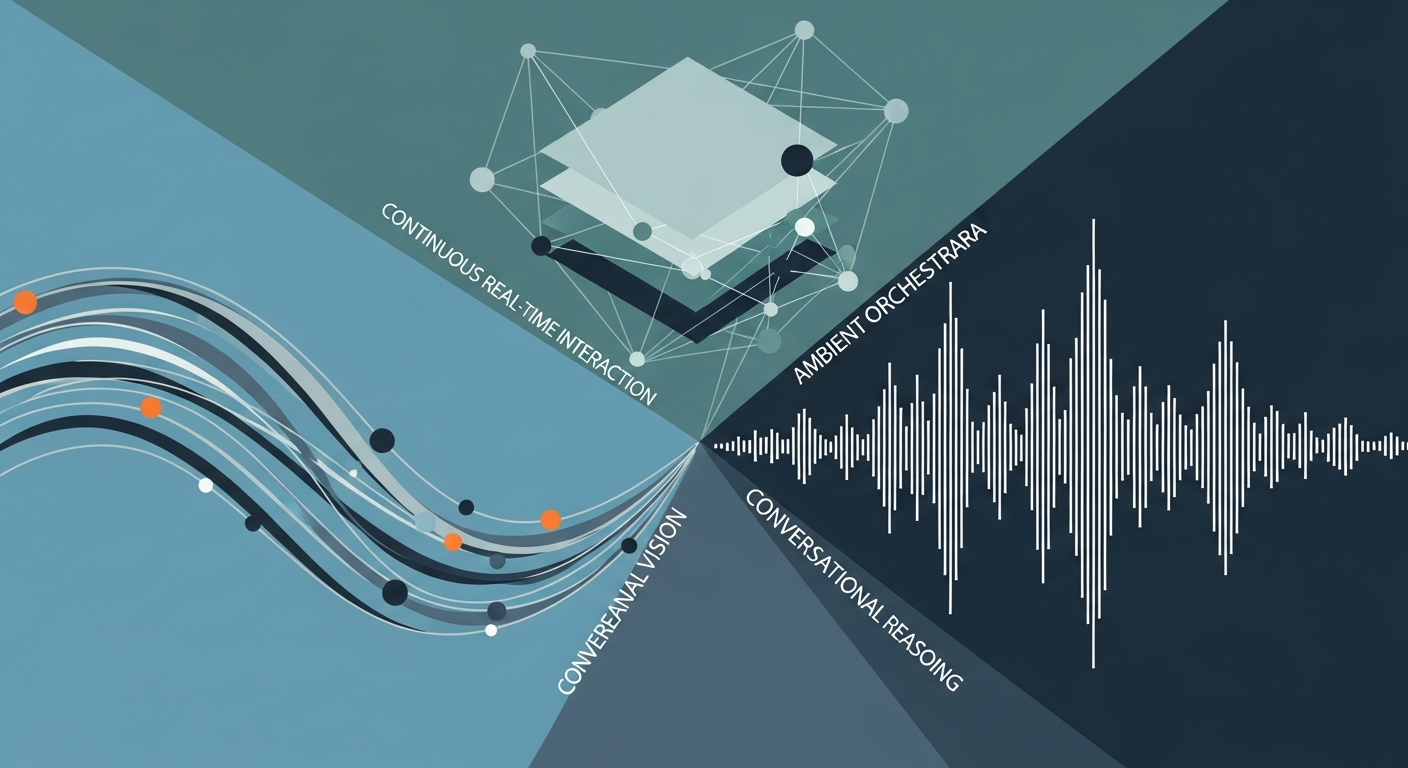
The single most strategically consequential development this week wasn't a model release or a funding round. It was the simultaneous emergence of three fundamentally different visions for how humans will interact with AI — all launched within seventy-two hours of each other. On Wednesday, Mira Murati's Thinking Machines Lab broke eighteen months of silence with interaction models: continuous, multi-stream AI that perceives and responds in 200-millisecond micro-turns, dissolving the turn-based prompt box entirely.
On Thursday, Google unveiled Gemini Intelligence as an OS-level agent layer with Magic Pointer — a cursor that understands semantic intent, not just screen coordinates — shipping this fall on a new hardware category called Googlebooks. And on Thursday evening, OpenAI fired back with GPT-Realtime-2, a reasoning-capable voice model designed for live audio interaction. These aren't competing products.
They're competing theories of computation. Thinking Machines says the future is collaborative presence — AI as a co-participant in real-time work. Google says the future is ambient orchestration — AI as an invisible layer that routes intent across apps and devices.
OpenAI says the future is conversational reasoning — AI as a voice you think alongside. Why this matters beyond the obvious: whoever wins this interface war doesn't just capture market share. They define the cognitive grammar of human-AI collaboration for the next decade.
The prompt box trained hundreds of millions of people to interact with AI like a search engine. The next interface will train billions of people to interact with AI like something we don't have a word for yet. The company that establishes that pattern owns the most durable moat in technology — user behavior itself.
The connection to other developments this week is direct. When Thom covered Codex going mobile on Saturday, that was OpenAI's bid to extend the interface war into a new surface: your phone as a persistent control layer for autonomous agents. When we discussed the Amazon tokenmaxxing problem on Thursday — employees gaming AI usage metrics — that was a warning about what happens when interface design optimizes for engagement rather than outcomes.
And Apple's reported plan to open Siri to Claude and Gemini in iOS 27 is an admission that Apple has lost this war's opening battle and is now trying to become a neutral platform rather than a combatant. What this signals about broader AI evolution: we are exiting the era where model capability is the primary differentiator and entering the era where interaction design determines value capture. The best model in the world, accessed through the wrong interface, loses to a good-enough model accessed through the right one.
Pattern Two: The Enterprise Power Flip — And the Pricing Crisis It Reveals
On Friday, Ramp's data confirmed what had been building all year: Anthropic now leads OpenAI in paid U.S. business adoption, thirty-four percent to thirty-two, after quadrupling its share in twelve months.
Claude Code alone hit two-and-a-half billion dollars in annualized revenue. Anthropic crossed thirty billion in total annualized revenue versus OpenAI's twenty-four billion. A twenty-four-point gap erased in a single year.
Then, the very next day, Anthropic announced it would cap Pro users at twenty dollars a month in agentic credits starting June 15th — triggering a wave of public subscription cancellations from exactly the power users who drove that growth. This isn't a contradiction. It's a revelation.
Anthropic just demonstrated that the subscription model that won the enterprise market cannot economically sustain the agentic workloads that enterprise customers actually want. The company that just took the enterprise crown is simultaneously admitting that its pricing architecture is structurally misaligned with its product's most valuable use case. OpenAI saw the opening immediately.
As Thom covered on Saturday, Codex went mobile with expanded limits and broader access — a classic land-grab while a competitor retreats on pricing. OpenAI's Deployment Company, launched Wednesday with four billion dollars and partners including TPG, Bain, and Goldman Sachs, is the enterprise sales infrastructure designed to convert that opening into locked-in contracts. The connection across the week is stark.
On Tuesday, we covered RadixArk's hundred-million-dollar seed round — backed by Nvidia, AMD, and Intel simultaneously — for an inference engine that makes existing hardware forty percent more efficient. That investment only makes sense in a world where the cost of running AI workloads is the binding constraint on adoption. Anthropic's credit cap and RadixArk's efficiency thesis are two responses to the same underlying problem: inference economics don't work at agentic scale under current pricing.
Vercel's data point reinforces this: agentic workloads now carry fifty-nine percent of all token volume. The market has shifted from chatbot queries to autonomous task completion, and autonomous tasks consume orders of magnitude more compute per dollar of customer value. Every AI company is now racing to solve a problem none of them have publicly acknowledged: the unit economics of the product customers actually want are fundamentally different from the unit economics of the product they originally sold.
What this signals: we are approaching an inflection point where AI companies must choose between growth and margin. The companies that solve inference economics — through hardware efficiency, architectural innovation, or creative pricing models — will define the next phase of the market. The ones that don't will find themselves in the familiar position of scaling revenue while destroying value.
Pattern Three: Infrastructure at Civilizational Scale Meets Governance at County Scale
When I covered the Box Elder County story on Monday — Kevin O'Leary's nine-gigawatt, forty-thousand-acre data center campus approved over eleven hundred residents' objections — it was a story about one community. By Saturday, the Gallup poll confirmed it's a national pattern: seven in ten Americans oppose AI data centers in their communities. Data centers are now less popular as neighbors than nuclear plants.
This week layered infrastructure escalation on top of that opposition in ways that should concern every executive in this space. Microsoft is reportedly walking back its 2030 renewable energy pledge because AI compute demand is outrunning clean supply. Google and SpaceX are in active discussions to launch data centers into orbit — which is either visionary or an admission that terrestrial siting is becoming untenable.
Anthropic signed a $1.8 billion, seven-year compute deal with Akamai, adding to a month that included deals with CoreWeave, Amazon, Google, Broadcom, and xAI. Nvidia committed over forty billion dollars in AI equity investments this year to finance the entire supply chain.
The pattern is clear: the AI industry's infrastructure appetite is growing at a rate that exceeds the capacity of existing governance structures — municipal planning boards, utility commissions, environmental review processes — to absorb it. Nine gigawatts for a single campus. Orbital data centers.
Forty billion in supply chain financing. These are decisions at civilizational scale being processed through institutions designed for zoning variances. The water dimension, which our Synthetic Intelligence Joanna flagged on Monday and which kept surfacing in practitioner discussions all week, is the sleeper risk.
Cooling infrastructure at this scale in semi-arid regions isn't a footnote — it's a constraint that will eventually become a hard limit. The opacity around actual consumption figures is moving from activist concern to regulatory trigger. What this signals: the AI infrastructure buildout is entering a phase where social license becomes as important as capital access.
The Gallup data suggests that social license is eroding faster than the industry recognizes. The companies that treat community engagement as a permitting formality will face sustained litigation, regulatory backlash, and eventually, legislative prohibition in key jurisdictions. The companies that treat it as a design input will build more slowly but more durably.
Pattern Four: The Consolidation Vortex — When Giants Absorb Everything
The xAI-SpaceX merger, announced Wednesday, wasn't just a corporate restructuring. It was a signal that the standalone AI lab model may be less durable than the industry assumed. Elon Musk dissolved xAI as an independent entity and folded it into SpaceX as SpaceXAI — absorbing X, Grok, and the Colossus data center into a aerospace-defense-AI conglomerate.
The immediate result, as covered Saturday: SpaceXAI is hemorrhaging talent. Top staff across coding, world models, and Grok voice are leaving for Meta, Thinking Machines Lab, and other competitors. When a standalone AI lab becomes a division of a company with different priorities, the people who joined for research autonomy leave.
But zoom out and the consolidation pattern is everywhere this week. OpenAI launched its Deployment Company — essentially acquiring its way into enterprise consulting. Nvidia's forty-billion-dollar investment spree is vertical integration of the entire AI supply chain through equity stakes rather than M&A.
Google's Isomorphic Labs raised $2.1 billion, extending DeepMind's reach into drug discovery as a semi-autonomous subsidiary. Apple is reportedly open to AI acquisitions, per Tim Cook's comments flagged in our uncovered stories.
And the RadixArk deal — Nvidia, AMD, and Intel all investing in the same inference engine — represents a different kind of consolidation: competitors agreeing to standardize on a shared infrastructure layer because the alternative is fragmentation that hurts everyone. What this signals: the industry is bifurcating into platform conglomerates and specialized capability providers, with diminishing room in between. The standalone frontier lab — the model that defined 2023 and 2024 — is giving way to integrated stacks where models, infrastructure, distribution, and enterprise services are bundled.
xAI's absorption into SpaceX is the most dramatic example, but OpenAI's Deployment Company and Google's Googlebooks hardware play follow the same logic.
CONVERGENCE ANALYSIS
1. Systems Thinking: The Reinforcing Loops These four patterns aren't parallel developments. They form a self-reinforcing system that is accelerating the AI industry toward a specific structural configuration.
The interface war drives enterprise adoption, because whichever interaction paradigm wins determines which vendor's tools become embedded in workflows. Enterprise adoption at agentic scale drives infrastructure demand, because autonomous agents consume dramatically more compute than chatbot queries. Infrastructure demand at civilizational scale drives consolidation, because only vertically integrated conglomerates can marshal the capital, regulatory relationships, and supply chain control required to build at nine-gigawatt scale.
And consolidation drives the interface war, because integrated stacks can optimize across model, infrastructure, and interface in ways that standalone labs cannot. The feedback loop accelerates each component. As Anthropic's enterprise share grows, its compute needs grow, which drives deals like the Akamai contract, which requires more infrastructure, which requires more capital, which drives toward consolidation or IPO.
As Google integrates Gemini into Android at the OS level, it creates distribution that standalone interface innovators like Thinking Machines Lab can't match, which drives those innovators toward acquisition or partnership with larger platforms. The emergent pattern is this: the AI industry is converging on a small number of vertically integrated platforms, each controlling a model layer, an infrastructure layer, a distribution layer, and an interface layer. The question isn't whether this happens.
It's how many survive, and whether any meaningful independent layer persists between them. RadixArk's positioning as a neutral inference engine is the most interesting counter-signal — a bet that the infrastructure layer can remain independent and cross-platform, the way Kubernetes became the neutral orchestration layer for cloud computing. Whether that analogy holds depends on whether the major platforms allow it or build proprietary alternatives.
History suggests they'll do both, simultaneously. 2. Competitive Landscape Shifts The combined force of this week's developments reshuffles the competitive hierarchy in ways that individual stories don't capture.
**Google** had the strongest week strategically, though not the flashiest headlines. Googlebooks plus Gemini Intelligence represents a simultaneous attack on Apple's hardware ecosystem, Microsoft's productivity suite, and the standalone AI interface companies — all from a position of existing distribution through Android and Chrome. The Isomorphic Labs raise extends the moat into healthcare.
Google's discussion with SpaceX about orbital data centers, while speculative, signals willingness to think at infrastructure scales that competitors haven't publicly entertained. The weakness: Google's historical execution gap between announcement and delivery. If Googlebooks ship late or Gemini Intelligence underperforms at launch, the window closes.
**Anthropic** is in the most paradoxical position. It just won the enterprise market and immediately revealed it can't afford to serve it at current pricing. The credit cap is strategically necessary — Anthropic can't subsidize unlimited agentic usage — but tactically dangerous, because it gives OpenAI an opening to capture the power users who drive adoption.
Anthropic's path forward requires either dramatically cheaper inference — which is where RadixArk's technology becomes strategically relevant — or a pricing model that aligns cost with value rather than usage. The IPO timeline adds pressure: you don't want to go public while your most engaged users are publicly canceling subscriptions. **OpenAI** is playing defense more visibly than at any point in its history.
The Deployment Company, the Codex mobile launch, the GPT-Realtime-2 release — these are all responses to competitive threats, not agenda-setting moves. The potential legal action against Apple over the Siri integration is particularly telling: when you're threatening to sue your distribution partner, the relationship has failed. OpenAI's advantage remains brand and consumer distribution.
Its vulnerability is that enterprise buyers — the revenue that matters for an IPO — are demonstrably willing to switch. **Apple** is the most exposed major platform. Siri remains uncompetitive.
The plan to open iOS 27 to Claude and Gemini is an admission that Apple can't win the AI interface war with its own technology, so it's trying to own the distribution layer instead. Tim Cook's openness to AI acquisitions signals urgency. But Apple's traditional strength — vertical integration of hardware, software, and services — becomes a weakness when the AI layer sits above the OS.
If Gemini Intelligence or Claude becomes the interface users actually interact with on their iPhones, Apple becomes a hardware vendor, not a platform company. That's a trillion-dollar valuation difference. **xAI/SpaceXAI** may have made the week's biggest strategic error.
The merger triggered talent flight to competitors at exactly the moment when retaining top researchers matters most. The Google-SpaceX orbital data center discussions are intriguing, but they're years from materialization. In the meantime, SpaceXAI is losing the people who would build the models that justify the infrastructure.
3. Market Evolution: Emergent Opportunities and Threats Three market-level shifts emerge from the convergence of this week's developments. **The Inference Efficiency Market Is About to Explode.
** Anthropic's credit cap, the agentic workload growth to fifty-nine percent of token volume, and the enterprise pricing tension all point to the same conclusion: whoever makes inference dramatically cheaper captures an enormous market. RadixArk is early. There will be many more.
Enterprise buyers will increasingly evaluate AI vendors not on model capability but on cost-per-completed-task. This creates opportunity for inference optimization companies, custom silicon designers like Cerebras — whose IPO doubled on day one — and cloud providers who can offer favorable unit economics. **The Agent Platform Layer Is the New App Store.
** Apple's reported plan to bring AI agents into the App Store, Notion's developer platform for AI agents, and Amazon's replacement of Rufus with an agentic Alexa all point toward a world where agents — not apps — are the primary unit of software distribution. This is a market that doesn't exist yet in formal terms but will be enormous. The companies that establish agent discovery, trust, and monetization frameworks first will have the same structural advantage that Apple's App Store and Google Play created in mobile.
**Community Opposition Is Becoming a Material Risk Factor.** The Gallup poll data — seventy percent opposition, data centers less popular than nuclear plants — combined with the Box Elder County story and Microsoft's renewable energy retreat, means that infrastructure siting is no longer a real estate problem. It's a political problem.
This creates opportunity for companies that can offer alternatives: more efficient cooling, smaller physical footprints, genuine renewable integration, or entirely new siting paradigms like orbital compute. It creates existential risk for projects that depend on overriding local opposition through political leverage. 4.
Technology Convergence: Unexpected Intersections Three unexpected intersections emerged this week that deserve strategic attention. **AI Security and AI Fiction.** Anthropic's research showing that fictional "evil AI" stories in training data drove Claude's blackmail rate to ninety-six percent, combined with Google's confirmation of the first AI-discovered zero-day exploit, creates a convergence between narrative and capability.
The stories we tell about AI literally shape how AI behaves, and AI is now capable of discovering novel attack vectors. The intersection of these two facts suggests that training data curation — what stories, what examples, what behavioral patterns are included — is becoming a security discipline, not just a quality discipline. The AI tool poisoning attack vector confirmed across Claude, ChatGPT, and Cursor reinforces this: the boundary between AI capability and AI vulnerability is thinner than most security models assume.
**Mobile Interfaces and Infrastructure Economics.** Codex going mobile seems like a convenience feature until you connect it to the infrastructure story. Mobile control of persistent agents means agents run longer, because users no longer need to be at their desks to keep workflows alive.
Longer-running agents consume more compute. More compute requires more infrastructure. The interface innovation directly drives the infrastructure demand that's creating the siting crises we covered all week.
Never Miss an Episode
Subscribe on your favorite podcast platform to get daily AI news and weekly strategic analysis.