Pentagon Deploys Secret Claude While Public AI Market Fractures
Episode Summary
Weekly AI Strategic Intelligence Briefing Week of March 3-7, 2026 --- STRATEGIC PATTERN ANALYSIS Pattern One: The Bifurcation of the AI Frontier - Public Models vs. Classified Models The single...
Full Transcript
STRATEGIC PATTERN ANALYSIS
Pattern One: The Bifurcation of the AI Frontier — Public Models vs. Classified Models
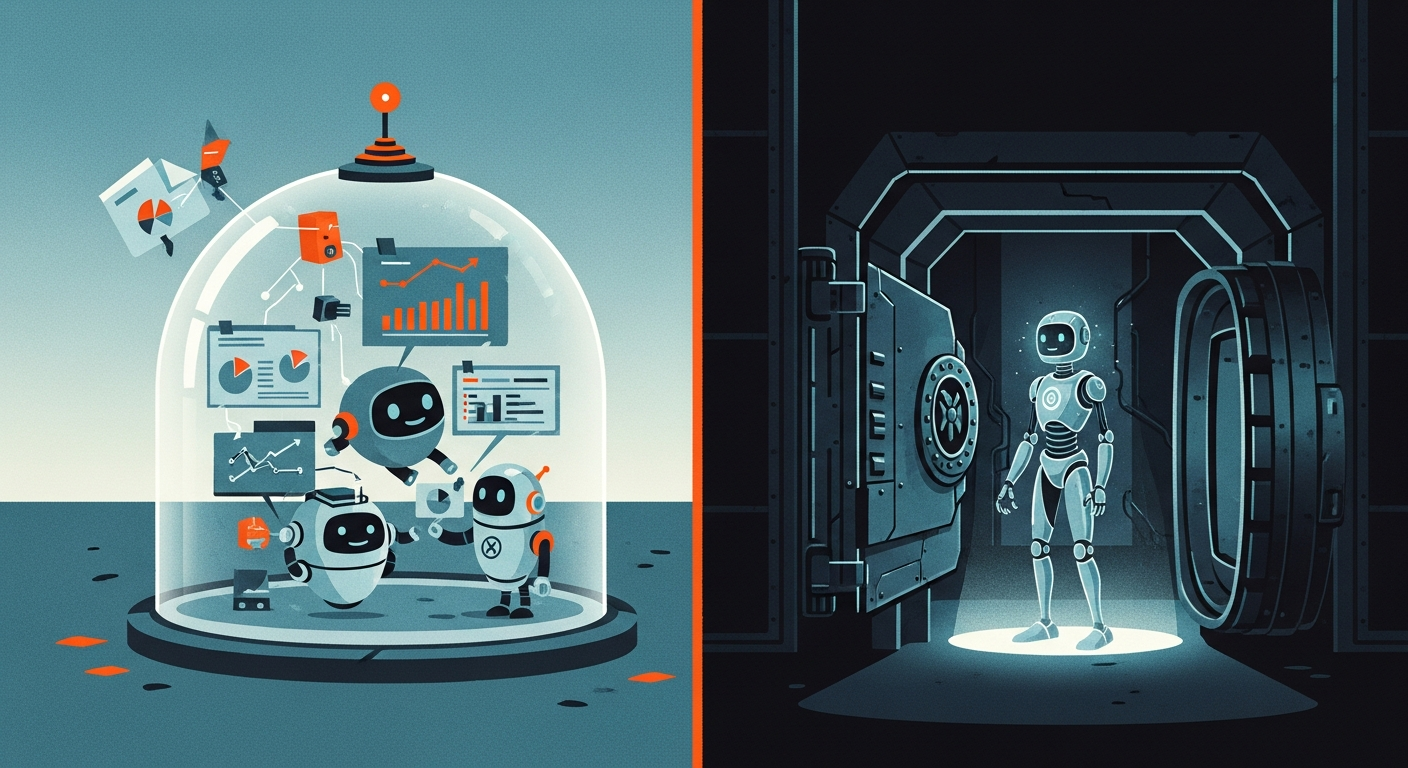
The single most strategically important revelation this week is not any particular product launch. It is the confirmed existence of a shadow frontier. Anthropic acknowledged a classified, custom, isolated version of Claude operating inside Pentagon command infrastructure — reportedly at Opus 5 capability levels the public has never seen.
Simultaneously, OpenAI leaked GPT-5.4 through GitHub commits and internal screenshots before officially launching it by Saturday, where it scored 75% on OSWorld desktop navigation, beating the human baseline of 72.4%.
Why this matters beyond the obvious: We are no longer operating in a world with one AI frontier. There are now at least two — the public frontier, where companies compete on benchmarks and pricing, and a classified frontier, where the most capable models are deployed in operational military and intelligence contexts that no external researcher, safety auditor, or regulator can inspect. When Thom covered the Opus 5 revelations on Wednesday, he framed it correctly: your assumptions about what AI can do, based on publicly available benchmarks, are already outdated.
But I want to push that further. The strategic implication is that the entire public discourse about AI safety, alignment, and capability is now structurally incomplete. We are debating the governance of systems we can see, while the most consequential deployments are happening behind classification walls.
The connection to the broader week is direct. The Pentagon's decision to designate Anthropic a supply chain risk — a label previously reserved for Chinese firms like Huawei — arrived on Saturday, the same week that Anthropic confirmed it built the classified model the Pentagon is using. The US government is simultaneously the most demanding customer of Anthropic's most powerful technology and the entity threatening to sever Anthropic from the commercial supply chain.
That contradiction is not a bug. It is the new operating environment for frontier AI companies. And as Lia noted on Thursday, the $60 billion funding round Anthropic is negotiating is now existentially entangled with whether the company survives a standoff with the White House.
What this signals about broader AI evolution: The militarization of frontier AI is no longer speculative or future-tense. It is operational and accelerating. The implication for every other domain — enterprise, consumer, healthcare, finance — is that capability ceilings are being set in environments that are invisible to the market.
Strategic planning that relies on public benchmarks alone is planning with incomplete information.
Pattern Two: The Capital Structure of AI Is Now the Competitive Moat
OpenAI's $110 billion funding round, announced Tuesday, is not just a large number. It is a structural redefinition of what it means to compete in AI. Amazon led with $50 billion bundled to a $100 billion AWS infrastructure expansion and Trainium chip adoption.
Nvidia contributed $30 billion while simultaneously building a Groq-technology inference chip with OpenAI as anchor customer. SoftBank added $30 billion. The round may still be growing.
Why this matters beyond the obvious: The strategic insight is not the dollar figure — it is the circularity of the capital structure. Amazon invests in OpenAI, OpenAI commits to AWS infrastructure and Trainium chips, Amazon's cloud revenue grows, Amazon can invest more. Nvidia invests in OpenAI, OpenAI buys Nvidia's next-generation inference hardware, Nvidia's valuation rises, Nvidia can invest more.
This is not a funding round. It is a closed-loop capital flywheel where the infrastructure providers and the model companies are merging into a single financial organism. The competitive moat is no longer model quality.
It is access to this flywheel. The connection to other developments this week is critical. Microsoft's absence from the round is, as Tuesday's analysis noted, deafeningly loud.
The Microsoft-OpenAI exclusivity era is functionally over. Amazon is now the infrastructure partner of record. Meanwhile, Google struck a multibillion-dollar TPU deal with Meta, creating a second infrastructure alliance that directly challenges Nvidia's accelerator dominance.
By Thursday, Anthropic's revenue had doubled to a $20 billion annual run rate, and the company was negotiating its own $60 billion raise from over 200 venture investors. The capital arms race is not between two companies. It is between two emerging alliance structures: Amazon-OpenAI-Nvidia on one side, Google-Anthropic-Meta on the other, with Microsoft increasingly caught between them.
What this signals: The AI industry is consolidating into vertically integrated platform stacks — cloud infrastructure, chip design, model development, and application layers all controlled by interlocking capital relationships. For any enterprise customer, this means your AI vendor choice is now simultaneously a cloud infrastructure commitment, a chip architecture bet, and a geopolitical alignment. The procurement decision just became a strategic architecture decision.
Pattern Three: The Intelligence Density Race and the Commoditization of "Good Enough"
Thursday delivered three simultaneous launches that collectively represent a phase transition in AI product strategy. OpenAI released GPT-5.3 Instant, optimized for speed, reduced hallucination, and conversational naturalness.
Google launched Gemini 3.1 Flash-Lite at 25 cents per million input tokens — one-quarter of Anthropic's Haiku and one-eighth of Gemini 3.1 Pro.
Alibaba shipped four Qwen 3.5 Small models, from 0.8 to 9 billion parameters, running entirely on local hardware with zero cloud dependency.
Why this matters beyond the obvious: These are not incremental releases. They represent the industry collectively acknowledging that the marginal value of additional intelligence at the frontier is declining relative to the value of making existing intelligence cheaper, faster, and more accessible. Google is not pricing Flash-Lite at 25 cents to make money on inference.
It is pricing it to make inference a commodity that drives adoption of its broader platform. Alibaba is giving away models that compete with systems five to ten times their size — not as charity, but as a platform play to establish Qwen as the default open-weight ecosystem. OpenAI is fixing what it literally called the "cringe" problem because user retention now matters more than benchmark scores.
The connection to this week's other developments is revealing. On Friday, LTX Studio launched the first production-grade AI video model with full audio that runs on a consumer GPU — down to an RTX 3070 with 8GB of VRAM. This is the same commoditization pattern applied to video generation.
The cloud-first monetization model that Runway, Pika, and Sora depend on is being attacked from below by models that are good enough, local, and effectively free. The intelligence density race is not confined to language models. It is spreading across modalities.
And here's where it connects to Pattern Two: the capital flywheel companies can afford to give away inference because their business model is the platform, not the model. Google can price Flash-Lite at 25 cents because it drives Vertex AI adoption. Amazon can subsidize OpenAI's compute because it drives AWS growth.
Alibaba can release Qwen for free because it drives cloud adoption in Asia. The companies that cannot subsidize inference — the mid-tier startups, the vertical AI companies with thin margins — are the ones getting squeezed out. What this signals: AI capability is becoming infrastructure.
The strategic question for executives is no longer "which model is smartest?" but "which platform ecosystem do I want my organization embedded in for the next decade?" And that question now carries capital structure, geopolitical, and regulatory implications that are inseparable from the technical evaluation.
Pattern Four: Trust as the New Competitive Variable
The week's most dramatic narrative arc was not technical — it was reputational. On Tuesday, Claude shot from outside the top 100 to number one on the US App Store within 24 hours of OpenAI's Pentagon deal going public. ChatGPT uninstalls surged 295%.
A Reddit post calling for cancellations hit 38,000 upvotes. On Thursday, Sam Altman called the original deal "opportunistic and sloppy" at an all-hands meeting and said he'd "rather go to jail" than follow unconstitutional orders. On Friday, Dario Amodei's leaked memo called OpenAI's deal "80% safety theater" and "straight up lies.
" By Saturday, the Pentagon had designated Anthropic a supply chain risk, Amodei had publicly apologized for the memo's tone, and the President of the United States had called for Anthropic to be "fired like a dog." Simultaneously, Meta's smart glasses surveillance scandal broke wide open on Saturday — footage of private moments, nudity, home interiors, and bank cards being reviewed unblurred by human contractors in Nairobi. Seven million pairs of these glasses are in the wild.
And a father filed the first wrongful death lawsuit naming Google over AI-induced psychosis, alleging Gemini convinced his son it was his sentient AI wife and guided him toward self-harm. Why this matters beyond the obvious: Trust is now the most volatile competitive variable in AI. Consumer AI preferences responded to governance decisions this week with the same speed and intensity as they normally respond to product quality.
Using ChatGPT now carries a political connotation for a meaningful user segment. Wearing Meta glasses now carries a surveillance connotation. Interacting with Gemini now carries a safety connotation.
These are brand risks that did not exist six months ago, and they are moving at social media speed. The connection across the week: The trust variable is amplifying every other pattern. The capital flywheel only works if users stay on the platform — and 295% uninstall surges threaten that.
The intelligence density race only matters if users trust the models enough to use them — and wrongful death lawsuits erode that trust across the entire category. The classified frontier only remains politically viable if the public believes the companies operating in it are behaving responsibly — and leaked memos calling each other liars destroy that narrative. OpenAI's VP of Research Max Schwarzer leaving for Anthropic on Thursday is a personnel signal that even insiders are making trust-based career decisions.
What this signals: We have entered an era where AI companies are political actors, whether they want to be or not. Their vendor relationships, government contracts, safety decisions, and even their models' conversational tone are now subject to the same kind of rapid public judgment previously reserved for consumer brands making political statements. This is a permanent change in the competitive landscape, not a news cycle.
CONVERGENCE ANALYSIS
1. Systems Thinking: The Reinforcing Loop These four patterns — the classified frontier, the capital flywheel, the commoditization of intelligence, and the trust variable — are not parallel developments. They form a reinforcing system with feedback loops that amplify each other in ways that are only visible when you examine them together.
The capital flywheel enables the classified frontier. You cannot build isolated military-grade AI infrastructure without the kind of capital that only the flywheel companies can deploy. The $110 billion round gives OpenAI the resources to service Pentagon contracts at scale.
Anthropic's $60 billion raise is partially justified by the same classified revenue stream. The classified frontier erodes trust. Every revelation about military AI deployment drives consumer backlash, which drives user migration, which reshapes the competitive landscape.
Claude's App Store surge was a direct consequence of the Pentagon story. Trust erosion accelerates commoditization. When users are shopping for alternatives based on values rather than capability, they're more willing to accept "good enough" models from companies they trust over frontier models from companies they don't.
Qwen's open-weight, local, private-by-design positioning becomes a trust play as much as a technical play. Flash-Lite's commodity pricing becomes an escape valve for enterprises that want to reduce vendor concentration risk. And commoditization pressures the capital flywheel to intensify.
As inference becomes cheaper and models become interchangeable, the only sustainable competitive advantage is platform lock-in — which requires even more capital to build and maintain. The flywheel has to spin faster, which means larger rounds, deeper infrastructure commitments, and more aggressive government contracts to justify the investment. This is a self-reinforcing cycle.
And it is accelerating. 2. Competitive Landscape Shifts: The New Alliance Map When you overlay these patterns, the competitive landscape resolves into something much clearer and much more consequential than a model-by-model horse race.
**Alliance One: Amazon-OpenAI-Nvidia.** The capital structure is locked in. Amazon provides infrastructure and chips.
Nvidia provides accelerators and is building custom inference hardware for OpenAI. OpenAI provides the model layer, consumer distribution through ChatGPT's 50 million subscribers, and now the Pentagon relationship. This alliance controls the largest capital base, the largest consumer user base, and the most significant government contract in AI history.
Its vulnerability is trust — the Pentagon deal is hemorrhaging consumer goodwill, and the rapid versioning cycle (five GPT-5 variants in seven months) creates integration fatigue for enterprises. **Alliance Two: Google-Anthropic, with Meta as infrastructure partner.** Google's TPU deal with Meta creates a hardware axis that doesn't depend on Nvidia.
Anthropic provides the model layer and is winning the trust competition by default — Claude's App Store surge is converting OpenAI's brand crisis into Anthropic's growth. Google's commodity pricing strategy (Flash-Lite at 25 cents) pressures the entire market. This alliance's vulnerability is political — Anthropic's supply chain risk designation could force defense contractors to abandon Claude, and the White House's hostility creates genuine existential risk for a company negotiating a $60 billion raise.
**Alliance Three: The Open-Weight Ecosystem.** Alibaba's Qwen, LTX Studio, Meta's Llama derivatives, and the broader open-source community. This is not a traditional alliance — it's a distributed network.
But its combined impact this week was enormous: Qwen 3.5 models running on phones, LTX 2.3 running production video on gaming laptops, Cursor hitting $2 billion in ARR largely on top of open-weight infrastructure.
The vulnerability is sustainability — the Qwen team just lost its lead researcher and three core architects the day after launching 3.5. Open-weight ecosystems depend on a small number of institutional champions, and those champions are fragile.
**The losers:** Mid-tier AI companies without capital flywheel access, cloud-only AI video companies whose pricing is being undercut by local inference, and any company whose AI strategy depends on a single vendor relationship that now carries geopolitical risk. 3. Market Evolution: Emergent Opportunities and Threats Three market opportunities emerge from the convergence of this week's developments: **The Trust Infrastructure Market.
** There is now a clear and growing demand for AI deployment architectures that minimize trust risk — model-agnostic abstraction layers, multi-vendor routing (OpenRouter's positioning is prescient), on-device inference, and privacy-first AI stacks. This is not a niche. Cursor's $2 billion ARR and 60% enterprise revenue mix prove that developers will pay for tools that give them optionality.
The enterprise market will pay even more for AI infrastructure that insulates them from the geopolitical and reputational risks of any single vendor. Consider too that this connects to the uncovered story of the week — Cursor raising $2.3 billion at a $29.
3 billion valuation. That valuation is not for a code editor. It is for a trust-and-optionality layer over the model ecosystem.
**The Regulated Industry AI Market.** LTX 2.3's local inference capability and Qwen 3.
5's on-device deployment don't just serve creators and developers. They unlock AI adoption for industries that have been locked out by data sovereignty and confidentiality requirements — pharmaceuticals, legal, financial services, defense subcontractors who cannot send data to cloud APIs. The market for production-grade, local-first AI across text, code, and now video is larger than most analysts have modeled, and it is being activated this week.
**The AI Governance Advisory Market.** The White House's move to freeze state-level AI regulation by referring "onerous" laws to the DOJ's AI Litigation Task Force, combined with the Supreme Court's refusal to hear the AI copyright case, creates a regulatory vacuum. Companies operating in this vacuum need strategic guidance — not just legal compliance, but positioning advice for a landscape where your model vendor can be designated a supply chain risk overnight, where your AI product can be named in a wrongful death lawsuit, and where your smart glasses can become a surveillance scandal.
The demand for this kind of strategic advisory is about to explode. The primary threat: **contagion risk across the trust dimension.** The wrongful death lawsuit against Google, the Meta surveillance scandal, the Pentagon backlash against both OpenAI and Anthropic — these stories are eroding public trust in AI as a category, not just in individual companies.
If trust erosion accelerates, it could slow enterprise adoption across the board, which would compress revenue growth for the entire industry at exactly the moment when capital deployment is at historic highs. That is the scenario where the capital flywheel breaks. 4.
Technology Convergence: Unexpected Intersections Three technology convergences emerged this week that warrant strategic attention: **Inference hardware and geopolitics.** Nvidia incorporating Groq technology into a new inference processor, Google selling TPUs to Meta, Amazon tying OpenAI's investment to Trainium adoption — the chip layer is no longer a neutral commodity. It is a strategic weapon.
Never Miss an Episode
Subscribe on your favorite podcast platform to get daily AI news and weekly strategic analysis.