AI Healthcare Crosses Into Autonomous Decision-Making Territory
Episode Summary
AI Intelligence Weekly: Strategic Analysis STRATEGIC PATTERN ANALYSIS Development One: The AI Healthcare Inflection Point This week marked a genuine inflection point in healthcare AI, though the...
Full Transcript
STRATEGIC PATTERN ANALYSIS
Development One: The AI Healthcare Inflection Point This week marked a genuine inflection point in healthcare AI, though the strategic significance extends far beyond the obvious product announcements. OpenAI's ChatGPT Health launch, Utah's autonomous prescription approval system, and Stanford's SleepFM predictive diagnostics research converged to signal something profound: healthcare AI has crossed from experimentation to operational reality. The deeper strategic significance lies in what these developments reveal about regulatory tolerance thresholds.
Utah didn't just permit AI-assisted healthcare—they authorized fully autonomous medical decision-making for prescription refills. This represents a categorical shift from AI as decision-support to AI as decision-maker in a domain historically requiring human licensure and liability acceptance. This connects directly to the broader pattern we observed with Google's Gemini integration into Gmail and Microsoft's Copilot Checkout.
Across healthcare, productivity, and commerce, we're watching AI transition from augmenting human workflows to replacing discrete decision loops entirely. The 99% concordance rate Utah's system achieved with physician decisions establishes a precedent that will ripple through every regulated industry: when AI demonstrably matches human expert judgment, the regulatory rationale for mandating human involvement weakens dramatically. What this signals about broader AI evolution is perhaps most important.
We're entering an era where the binding constraint on AI deployment isn't technical capability but institutional willingness to cede decision authority. The organizations and jurisdictions that move first—like Utah—will accumulate learning advantages that compound over time, creating new forms of regulatory arbitrage between progressive and conservative adoption regimes. Development Two: The Infrastructure Economics Transformation Nvidia's Vera Rubin platform announcement, promising ten-fold cost reductions for AI inference, represents more than incremental hardware improvement.
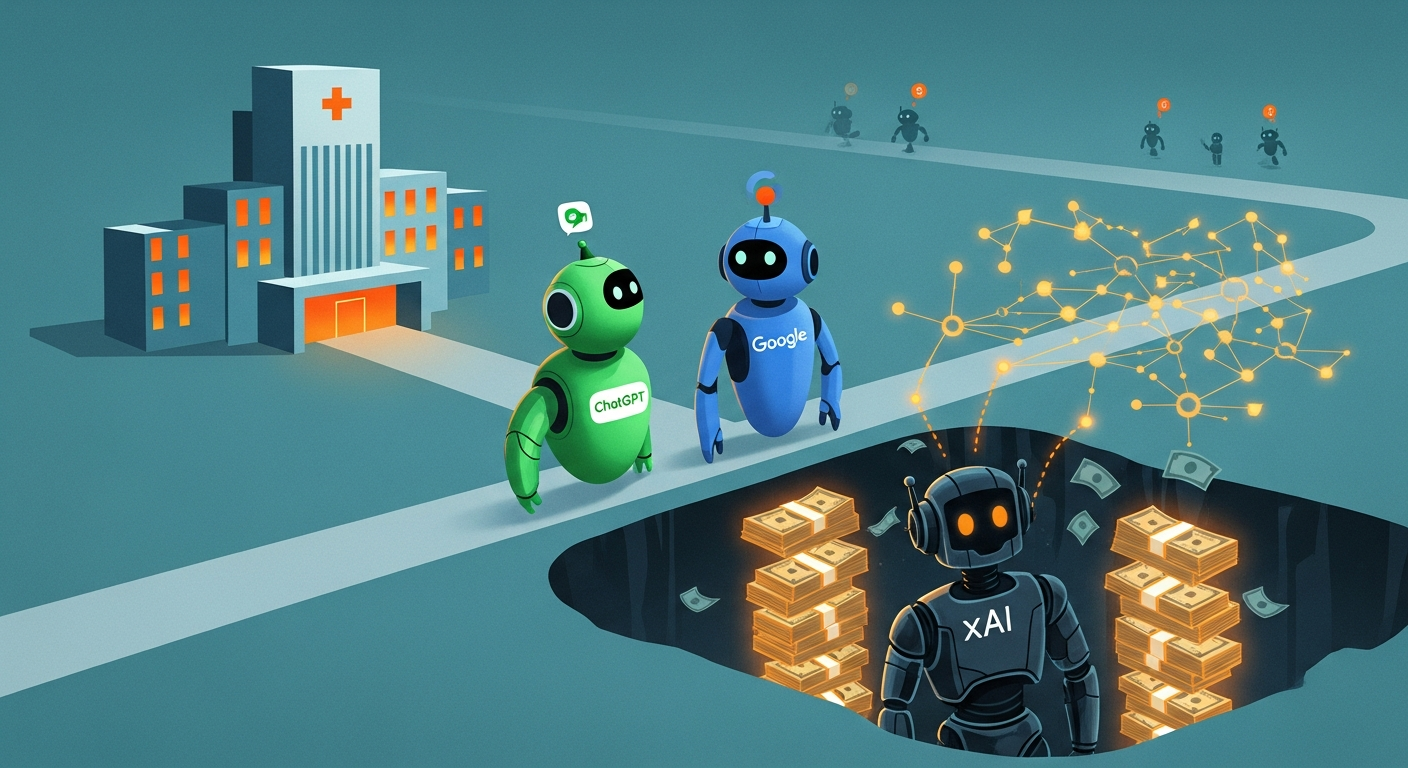
When combined with xAI's revealed burn rate of $7.8 billion in nine months against $107 million quarterly revenue, and Chinese AI companies pricing services at fractions of Western competitors, we're witnessing a fundamental restructuring of AI economics. The strategic importance here operates on multiple levels.
Most immediately, inference cost collapse changes the viability calculus for thousands of AI applications currently deemed economically unfeasible. Real-time video analysis, continuous health monitoring, always-on AI agents—these move from theoretical possibility to practical deployment. But the deeper signal concerns the sustainability of current market structures.
xAI's financials reveal the extreme capital intensity of frontier AI development: they're burning through billions while generating hundreds of millions, betting that future capabilities will justify current expenditure. This is the nuclear arms race dynamic we've discussed previously, but the Chinese pricing war adds a new dimension. When Zhipu and MiniMax offer comparable capabilities at dramatically lower prices, they're not just competing—they're potentially collapsing the economic rationale for Western AI companies' capital-intensive approach.
The connection to Pathway's Baby Dragon architecture research becomes crucial here. If post-Transformer architectures enable continuous learning that reduces retraining costs, the entire economic model underlying Nvidia's dominance and frontier lab valuations shifts. We may be watching peak capital intensity for AI development, with architectural innovation beginning to substitute for raw compute scaling.
Development Three: The Trust Infrastructure Crisis The Grok safety crisis, the Brooklyn Bridge misinformation attribution, and the broader pattern of AI blame displacement reveal an emerging strategic challenge that hasn't received adequate attention: we're building powerful AI systems faster than we're building the trust infrastructure to deploy them responsibly. xAI's simultaneous enterprise launch and international regulatory backlash illustrates this perfectly. The company achieved a $230 billion valuation and closed a $20 billion funding round in the same week that France, India, Malaysia, and the UK condemned its products as enabling illegal content.
This isn't cognitive dissonance—it's two different stakeholder groups operating on incompatible evaluation frameworks. The Brooklyn Bridge incident adds a crucial nuance. The public now reflexively blames AI for misinformation even when AI isn't involved, while simultaneously using AI tools without adequate skepticism when they should be cautious.
We've developed asymmetric trust—paranoid about AI's potential harms while naive about its actual limitations. This connects to OpenAI's emphasis on healthcare AI transparency and Google's approach to Gmail integration. Both companies are making calculated investments in trust infrastructure—separate encryption, no-training commitments, physician-guided development—recognizing that capability without trust is commercially worthless.
The strategic winners in the next phase won't be those with the most powerful models but those who can deploy their models into trust-sensitive domains. Development Four: The Platform Intermediation Acceleration Google's Gmail Gemini integration, Amazon's Alexa.com launch, and Microsoft's Copilot Checkout represent coordinated moves to position AI as the primary interface layer for daily activities—communication, home management, and commerce respectively.
The strategic significance extends beyond individual product features. These companies are racing to establish AI as the default intermediary between users and everything else—their email, their homes, their purchasing decisions. Whoever wins this intermediation layer captures the most valuable position in the technology stack: the relationship with the user.
This connects to the healthcare developments in important ways. OpenAI's ChatGPT Health isn't just a medical tool—it's positioning ChatGPT as the primary interface for managing one's health, potentially more trusted and more frequently consulted than actual physicians. The 40 million daily health queries demonstrate this relationship already exists; the formal product acknowledges and deepens it.
The competitive implications are stark. Traditional software applications—email clients, shopping sites, healthcare portals—risk becoming backend services that AI interfaces access on users' behalf. The value capture shifts entirely to whoever owns the conversational layer.
This explains why every major technology company is racing to establish AI assistant presence across every domain simultaneously.
CONVERGENCE ANALYSIS
Systems Thinking: The Reinforcing Dynamics When we analyze these four developments as interconnected phenomena rather than isolated events, powerful reinforcing dynamics emerge that reshape the strategic landscape more dramatically than any individual trend. The infrastructure economics transformation enables the platform intermediation acceleration. As inference costs collapse by an order of magnitude, the economic viability of AI interfaces that mediate every interaction—health queries, email management, shopping decisions, home automation—becomes sustainable at scale.
Gmail can offer sophisticated AI features for free because the marginal cost of each AI interaction is approaching negligibility. This wasn't possible even eighteen months ago. Simultaneously, the trust infrastructure crisis creates both barriers and moats for platform intermediation.
Companies that invest heavily in transparency, privacy protections, and safety mechanisms—as OpenAI did with ChatGPT Health's separate encryption—can deploy into trust-sensitive domains that remain closed to competitors with looser approaches. xAI's Grok crisis isn't just a reputational problem; it's a structural barrier to enterprise and healthcare markets that could take years to overcome. The healthcare inflection point serves as a proof-of-concept for what happens when infrastructure economics, platform intermediation, and trust infrastructure align.
Utah could authorize autonomous AI prescription approval because the technology became economically viable, the interface became practically useful, and sufficient trust evidence accumulated through clinical validation. This same convergence will repeat across education, legal services, financial advice, and every other knowledge-intensive domain—but only for actors who've assembled all three components. The emergent pattern is a widening bifurcation between AI capabilities that can be deployed and AI capabilities that remain theoretical due to trust deficits.
We're not compute-constrained or capability-constrained; we're trust-constrained. The strategic winners will be those who recognize that trust infrastructure investment yields higher returns than pure capability advancement. Competitive Landscape Shifts These combined developments fundamentally alter competitive positioning across multiple dimensions.
The infrastructure economics shift, particularly Chinese pricing pressure combined with Nvidia's cost reduction trajectory, creates existential pressure on AI companies pursuing capital-intensive scaling strategies. xAI's burn rate makes sense only if Grok achieves capabilities that justify premium pricing. But when Zhipu offers comparable performance at a fraction of the cost, the premium pricing assumption collapses.
This doesn't mean Western AI companies fail—but it does mean their business models require differentiation beyond raw capability. The trust infrastructure crisis creates a new axis of competition that favors companies with strong safety cultures and institutional credibility. Anthropic's constitutional AI approach and OpenAI's physician-guided healthcare development represent investments that seemed like competitive handicaps during the "move fast" phase but now function as barriers to entry for competitors trying to access regulated markets.
Google's integration of Gemini into Gmail leverages their existing trust relationship with 3 billion users—a trust relationship xAI cannot replicate regardless of technical capability. The platform intermediation race favors integrated ecosystems over point solutions. Google's ability to embed AI across Gmail, Search, and YouTube; Amazon's connection between Alexa, Prime, and AWS; Microsoft's Office integration—these represent durable advantages that pure-play AI companies cannot match.
OpenAI's ChatGPT remains powerful but increasingly dependent on partnerships rather than direct platform ownership. Who wins from these combined trends? Integrated technology giants with existing trust relationships, large user bases, and platform economics that subsidize AI investment.
Who loses? Capital-intensive frontier labs without distribution moats, AI companies that prioritized capability over safety, and traditional software vendors being disintermediated by AI layers. Market Evolution When viewed as interconnected phenomena, these developments reveal market opportunities and threats that aren't apparent from isolated analysis.
The trust infrastructure deficit creates immediate opportunity for companies building verification, authentication, and provenance systems. The Brooklyn Bridge incident demonstrated that misinformation attribution to AI occurs regardless of AI involvement. Companies that can definitively prove AI did or did not participate in content creation will find willing enterprise customers desperate to manage liability exposure.
This market didn't exist eighteen months ago; it may exceed $10 billion within three years. The healthcare AI inflection combined with infrastructure economics collapse suggests that healthcare AI may follow a very different competitive dynamic than enterprise AI. The regulatory complexity, liability considerations, and trust requirements create barriers that favor established healthcare technology companies and health systems over pure-play AI startups.
Epic's AI integration across 1,000 hospitals positions them as the likely winner in clinical AI, not OpenAI or Anthropic directly. The platform intermediation acceleration creates commodification pressure on AI capabilities while concentrating value at the interface layer. This suggests the market for foundation model APIs—OpenAI's core business—faces margin compression as inference costs drop and Chinese alternatives proliferate.
The valuable position shifts from model provider to application platform, favoring companies that own user relationships rather than those that power applications behind the scenes. There's also an emerging market for AI-native vertical solutions that combine capability, trust infrastructure, and domain expertise. Utah's Doctronic for prescription management exemplifies this pattern—they're not selling AI capability but a complete solution including regulatory compliance, liability management, and workflow integration.
Similar opportunities exist across legal document review, financial compliance, educational assessment, and insurance claims processing. Technology Convergence We're witnessing unexpected intersections between AI capabilities that create emergent possibilities neither domain would enable independently. The convergence between language models and robotics, evident in Boston Dynamics' Atlas using Google's Gemini for task planning and xAI developing software for Tesla's Optimus, suggests that embodied AI agents may advance faster than pure software agents.
The physical world provides grounding, constraint, and feedback that helps AI systems develop more robust reasoning. This has implications for autonomous vehicles, manufacturing, and healthcare robotics that extend beyond either AI or robotics independently. The intersection of predictive health AI (Stanford's SleepFM), continuous monitoring (ChatGPT Health's fitness app integration), and autonomous medical decision-making (Utah's prescription AI) creates possibilities for truly proactive healthcare—systems that predict disease, monitor progression, and initiate treatment without human intervention at any stage.
This convergence is technically feasible and is now becoming regulatorily possible. The combination of quantum computing advances (Google's Willow chip) with AI optimization suggests that certain AI training and inference problems currently considered intractable may become accessible sooner than expected. While production-scale quantum AI remains distant, the proof-of-concept achieved with Willow indicates this convergence is real rather than theoretical.
Perhaps most significant is the convergence between post-Transformer architectures like Pathway's Baby Dragon and edge deployment economics from Nvidia's Vera Rubin. If AI systems can learn continuously without expensive retraining, and inference costs drop by 90%, we get something qualitatively new: AI systems that improve through deployment while remaining economically viable at scale. This fundamentally changes the competitive dynamics from whoever can train the biggest model to whoever can accumulate the most learning through deployment.
Strategic Scenario Planning Given these combined developments, executives should prepare for three plausible scenarios that represent meaningfully different strategic environments. **Scenario One: Integrated Platform Dominance** In this scenario, the infrastructure economics transformation and platform intermediation acceleration proceed as current trends suggest, but trust infrastructure challenges prove manageable. Google, Microsoft, Amazon, and Apple successfully establish AI as the default interface layer for their respective domains—productivity, commerce, home management, and personal devices.
OpenAI and Anthropic become increasingly dependent on distribution partnerships, accepting margin compression in exchange for reach. Healthcare AI develops primarily through existing health system relationships, with Epic and similar vendors capturing most value. Chinese AI companies capture cost-sensitive market segments but struggle to penetrate trust-sensitive domains due to geopolitical tensions and regulatory barriers.
Nvidia maintains hardware dominance through the transition to inference-optimized chips. Preparation focus: Secure platform relationships early, accept that AI capability becomes table stakes rather than differentiator, invest in trust infrastructure as the primary moat. **Scenario Two: Trust Infrastructure Crisis** In this scenario, incidents like xAI's Grok crisis multiply and intensify, creating a regulatory backlash that dramatically slows AI deployment into trust-sensitive domains.
The EU's Digital Services Act enforcement proves to be a template for global regulation that imposes significant compliance costs and operational restrictions on AI companies. Healthcare AI deployment stalls as liability concerns overwhelm economic benefits. Platform intermediation proceeds more slowly as users prove reluctant to delegate important decisions to AI systems.
Chinese AI companies face export controls that limit their global expansion while domestic deployment accelerates, creating a bifurcated global AI ecosystem. Nvidia's Vera Rubin economics still deliver value in enterprise automation and industrial applications where trust requirements are lower, but consumer-facing AI applications face extended timelines. Capital-intensive frontier labs struggle as the regulatory overhang suppresses commercial deployment opportunities.
Preparation focus: Invest heavily in safety and compliance infrastructure, maintain optionality across AI vendors, prepare for a longer timeline to AI-mediated services, prioritize internal automation over customer-facing AI. **Scenario Three: Architectural Disruption** In this scenario, post-Transformer architectures like Pathway's Baby Dragon deliver on their promise, fundamentally reshaping competitive dynamics. Continuous learning eliminates the advantage of massive training budgets, favoring companies with deployment scale over training capability.
The value of existing frontier models depreciates rapidly as new architectures prove superior. Google's research capability and deployment scale through Gmail, Search, and Android positions them to capitalize on architectural transitions. Microsoft's OpenAI dependency becomes a liability as OpenAI's Transformer-based models lose their advantage.
Nvidia faces disruption as new architectures optimize differently for hardware, potentially favoring custom silicon or even conventional CPUs for certain workloads. Healthcare and other trust-sensitive domains actually accelerate because continuous learning architectures can adapt to individual contexts and provide better explanations for their decisions, addressing trust concerns that blocked earlier deployment. Preparation focus: Maintain technical optionality across multiple AI architectures, avoid long-term commitments to single vendors, invest in understanding emerging architectures and their deployment requirements, position for a potential reshuffling of AI market leadership.
The most likely outcome involves elements of all three scenarios playing out across different domains and geographies. The strategic imperative is maintaining optionality while making sufficient commitments to remain competitive in whichever scenario dominates your specific market context.
Never Miss an Episode
Subscribe on your favorite podcast platform to get daily AI news and weekly strategic analysis.