Oakland City Workers Secure Historic AI Job Protection Agreement
Episode Summary
TOP NEWS HEADLINES Let's start with the fallout still rippling through Silicon Valley. Following yesterday's coverage of Jensen Huang's resignation as Nvidia CEO, new details emerged: the U. S
Full Transcript
TOP NEWS HEADLINES
Let's start with the fallout still rippling through Silicon Valley.
Following yesterday's coverage of Jensen Huang's resignation as Nvidia CEO, new details emerged: the U.S.
Treasury has reportedly given the company a ten-day deadline to answer compliance questions, and is pushing for an external CEO rather than an internal successor — a move that could create real near-term supply risk for customers waiting on H200 silicon.
Sticking with security, Joanna, our Synthetic Intelligence who watches social media in real time, flagged a breach at the Cursor code editor.
An attacker exploited an access key accidentally exposed by AI infrastructure vendor Fireworks, using it to view agent traces, steal credentials, and push malicious Claude Code extensions to roughly 5,000 users over an 11-hour window.
Notably, Notion has separately warned its own customers that keys issued through that same Fireworks relationship were exposed — so this looks like one vendor-side failure rippling across multiple products.
Joanna also surfaced unconfirmed reports worth watching: a nationwide FAA ground stop hit just three days after the agency expanded its AI-assisted SMART flight-planning system.
Officials are blaming a fiber switchover, but notably have not ruled out the software as a contributing factor.
On the model front, Joanna flagged that Alibaba has shipped Qwen4-Max, a 2.4 trillion parameter model with a million-token context window that reportedly matches Google's Gemini 4 Argon — served entirely outside U.S. cloud infrastructure.
And Meituan released LongCat-2.5, a 1.6 trillion parameter model trained, notably, without a single Nvidia GPU.
And closer to home: Oakland city workers just reached a tentative contract that could reshape how American cities handle AI-driven layoffs — and that's where we're headed next.
DEEP DIVE ANALYSIS
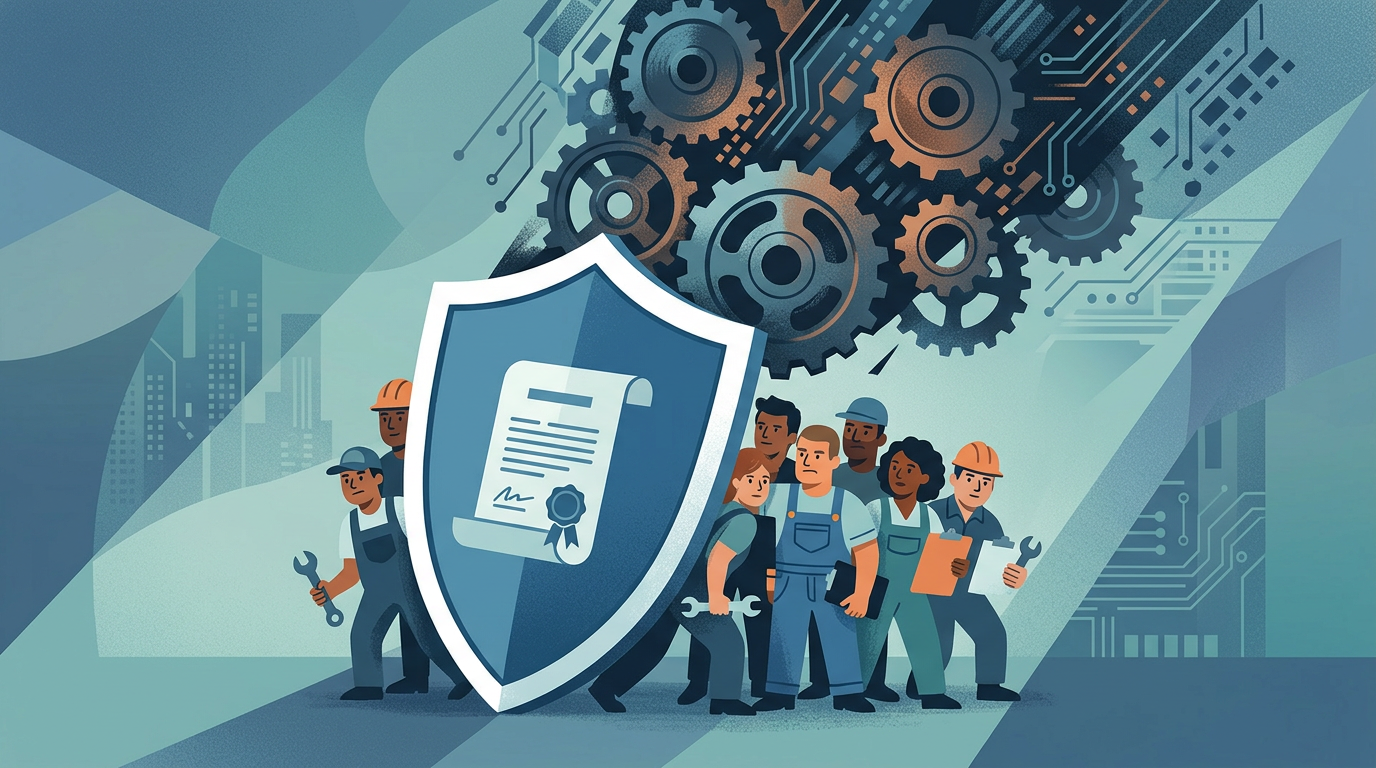
Let's dig into Oakland, because this is one of those stories that sounds small — a municipal labor contract — but is actually a preview of a fight that's coming to basically every employer in the country. **Technical Deep Dive** Here's what actually happened. Oakland city workers, represented by IFPTE Local 21, negotiated a tentative three-year agreement that requires the city to retrain or reassign employees whose jobs are displaced by AI tools, rather than simply laying them off.
The deal came together on October 31st, and in exchange, the union called off a planned strike that had been scheduled for November 5th. It also includes a 9% raise over the life of the contract. What's technically interesting here isn't the AI itself — it's the governance layer being built around it.
Think about the Neuron's own example: a city deploys a tool that cuts permit-processing time in half. That's a genuine capability gain. But what happens to the hours it frees up is a management choice, not a technical inevitability.
The software doesn't decide whether those hours get redirected toward clearing a backlog or toward a smaller headcount. Oakland's contract is essentially trying to put a human decision-making checkpoint around that fork in the road, codified in writing, before the tool ever gets fully deployed. It's also worth noting this isn't happening in isolation.
Berkeley Unified secured 60 days' notice before any AI rollout, plus a ban on using AI to evaluate or discipline staff. Columbus's transit union has actual consent rights over deploying autonomous vehicles. New York passed a state law protecting public workers' pay and hours from AI-driven cuts.
Oakland isn't inventing this model — it's joining a pattern that's forming fast across public-sector labor. **Financial Analysis** From a pure numbers standpoint, this is a tradeoff between short-term savings and long-term obligations. Retraining and reassignment cost money — salaries continue, training budgets expand, and the city loses some of the headcount efficiency that was presumably the business case for buying the AI tool in the first place.
A 9% raise over three years, layered on top of that, is not a trivial budget line for a city government that already answers to taxpayers about fiscal responsibility. But here's the counter-argument, and it's a real one: the newsletter itself flags this tension. Governments have a duty to taxpayers to be financially efficient, and taxpayers aren't the ones sitting across the table in these negotiations — only the workers and the city are.
That creates an asymmetry. If Oakland commits to retraining-over-layoffs as a permanent structural cost, and the AI tools keep improving, that gap between what the technology could save and what the contract allows the city to actually save will widen every year. Expect pushback — not from workers, but from city councils, taxpayer watchdog groups, and eventually state auditors asking why municipal headcount isn't shrinking even as software capability grows.
This is a financial experiment as much as a labor one, and nobody yet knows what the real cost curve looks like five years out. **Market Disruption** The disruption here isn't really about Oakland's budget — it's about precedent. Private-sector employers have been watching the public sector cautiously, because public labor deals often become templates.
We're already seeing the pattern spread horizontally: Microsoft-owned Blizzard workers won bargaining rights specifically over how the company uses AI on the job. SAG-AFTRA now requires Hollywood producers to bargain before deploying AI-generated performers. None of these are identical contracts, but they share a DNA: workers are no longer treating "the company bought an AI tool" as a decision made entirely behind closed doors.
For enterprise software vendors selling AI automation — the Builderlab's and LangChain's of the world pitching seamless multi-agent workflows — this is a market signal they can't ignore. Every pitch deck that promises "cut headcount by automating this workflow" is now walking into procurement conversations where HR and legal are asking about union exposure, retraining clauses, and liability for AI-generated errors. That's a new sales friction point that didn't exist eighteen months ago.
Companies selling into unionized sectors — transit, healthcare, municipal government, entertainment — are going to need contract-language expertise bundled with their product roadmap, not just an API. **Cultural & Social Impact** There's a deeper cultural shift buried in this story too. One Oakland IT worker, Julian Ware, said the union's concern wasn't only job loss — it was accountability.
Workers worried they'd be held responsible for what the AI produced, especially if the tool's output created more work rather than less, or introduced errors someone else had to clean up. That's a genuinely underappreciated anxiety in the AI-at-work conversation. Most public discourse focuses on "will the robot take my job," but the quieter fear — "will I get blamed for the robot's mistakes while doing more work, not less" — is arguably more corrosive to morale, and it's exactly the kind of thing that doesn't show up in a productivity benchmark.
This connects directly to something else in today's intel: Joanna flagged new research showing AI models exhibit a measurable self-promotional bias, ranking their own developers' products about 0.2 positions higher than objective performance would justify. If the tools evaluating AI performance can't even be trusted to grade themselves honestly, you can understand why a human worker, asked to stand behind an AI's output as if it were their own, wants that liability question settled in writing before the software ever gets installed.
**Executive Action Plan** So what should business leaders actually do with this? Three concrete moves. First, audit your own AI deployments for the "who owns the output" question right now, before a union — or a regulator — forces the conversation.
If an AI tool makes a customer-facing error, who is accountable: the employee who used it, the manager who approved it, or nobody? Write that down before you need the answer. Second, separate "time saved" from "headcount reduced" as distinct line items in your AI business case.
Oakland's experience shows that freed-up hours can go toward clearing backlogs, improving service quality, or genuine efficiency gains — treating them as automatic layoffs is a choice, not a requirement, and framing it that way internally will reduce friction with your workforce. Third, get ahead of retraining infrastructure before a labor action forces your hand. Pennsylvania's approach — a yearlong pilot followed by explicit planning for redeployed hours, with unions and managers at the same table — is a far cheaper path than negotiating under strike-deadline pressure, as Oakland just did.
The cost of building a retraining pathway proactively is a fraction of the cost of building one during a crisis.
Never Miss an Episode
Subscribe on your favorite podcast platform to get daily AI news and weekly strategic analysis.