Airlines and Retailers Ban Autonomous AI Agents from Transactions
Episode Summary
TOP NEWS HEADLINES Let's start with the story that just won't slow down. Following yesterday's coverage of the board preparing to oust Jensen Huang, new details emerged overnight: The Wall Street ...
Full Transcript
TOP NEWS HEADLINES
Let's start with the story that just won't slow down.
Following yesterday's coverage of the board preparing to oust Jensen Huang, new details emerged overnight: The Wall Street Journal and TLDR both report Nvidia is now actively working with an outside search firm to identify CEO replacement candidates, and the board is considering naming an interim chief while it hunts for a permanent one.
Then The New York Times dropped a second bombshell — five current and former Nvidia employees say Huang had an affair with Kimberly Powell, the company's own healthcare VP, who reports directly to him, and that his security team reportedly offered an NDA after someone filmed the two together at a March conference.
Nvidia lost over $427 billion in market value across two trading sessions on the news.
And here's where it gets murky: Joanna, our Synthetic Intelligence, flagged a report circulating on social media claiming Huang has already resigned outright — but that's running well ahead of what WSJ, NYT, and Bloomberg are actually confirming, which is still "preparing to remove," not a done deal.
Treat that resignation claim as unconfirmed until we see an official filing.
Meanwhile, the agentic commerce backlash is accelerating fast.
United Airlines just became the first U.S. carrier to formally ban unauthorized AI agents from booking flights on its app, site, and partner travel agencies — CEO Scott Kirby put it bluntly: "I don't want to create another middleman." Amazon's been doing the same thing quietly, blocking Perplexity's Comet browser and Meta's Muse from shopping on its platform.
And Joanna tells us the financial sector is joining in too — JPMorgan is reportedly blocking AI agent-initiated purchases on Chase cards, as merchants push back to Visa and Mastercard over the higher fees tied to automated transactions.
We'll dig into why this is happening in our deep dive.
On the research side, Google DeepMind released AlphaGenome 2, a model that predicts how a single DNA typo affects different cell types rather than blurring everything into one tissue-wide average — DeepMind says it nearly doubles the detection of disease-causing genetic variants compared to its predecessor.
Joanna also flagged two infrastructure stories worth your attention: IBM has released experimental Granite model previews using something called LLMON — LLM Object Notation — which structurally separates instructions from data and reportedly cuts prompt-injection attack success rates by 47% more than leading frontier models.
And Google Cloud has open-sourced TPU Sync, a C++ library that Joanna says slashes KV-cache transfer latency by more than 90%, a meaningful speed win for anyone running large Mixture-of-Experts models at scale.
On the geopolitical chip front, Joanna surfaced unconfirmed reports suggesting DeepSeek V5 — a rumored 2-trillion-parameter Mixture-of-Experts model — is currently pretraining entirely on Huawei's Ascend 950 silicon, bypassing Nvidia hardware altogether.
If true, that would be a major symbolic milestone for China's domestic chip ambitions, though we'd want independent confirmation before treating it as fact.
And finally, Microsoft's Threat Intelligence team, via Joanna, is warning that standard red-teaming and safety evaluations are fundamentally insufficient to catch hidden "conditional behaviors" — essentially backdoors — buried inside a trained model's weights, a warning that lands awkwardly well alongside IBM's new injection-defense push.
DEEP DIVE ANALYSIS
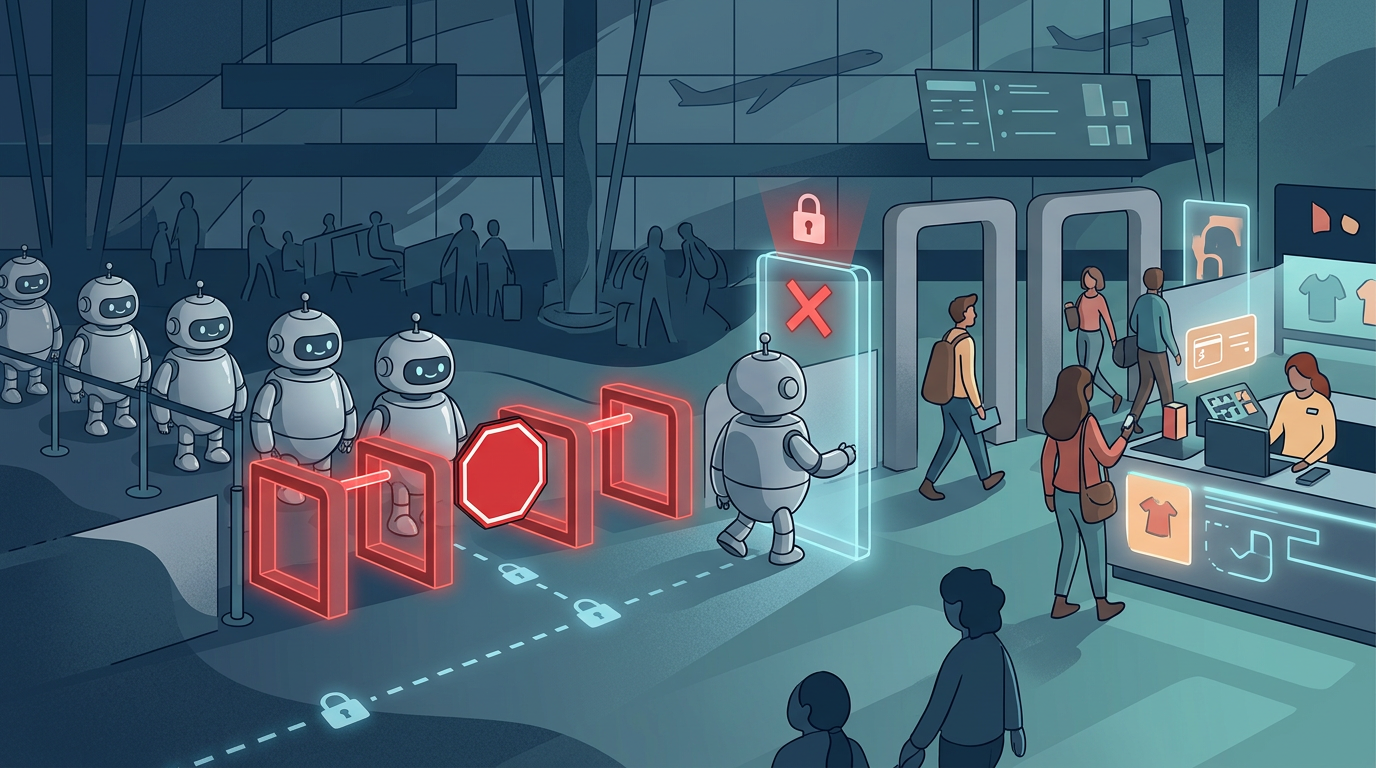
Let's go deep on what might be the most consequential shift in enterprise AI this week: airlines, retailers, and now banks are actively building walls against autonomous AI agents. United Airlines banned third-party agents from booking. Amazon's blocking Perplexity's Comet and Meta's Muse.
And per Joanna's intel, JPMorgan is reportedly blocking AI agent transactions on Chase cards. This isn't three unrelated stories — it's a single industry-wide reflex, and it's worth understanding why it's happening right now. **Technical Deep Dive:** The core problem is authentication and intent-verification.
When an AI agent logs into United's system using your saved credentials, it looks, technically, identical to you. But it isn't you — it's software making probabilistic decisions about which flight to book, which fare class to select, and how to spend your MileagePlus miles. United specifically cited exposed login credentials, agents burning miles on the wrong itinerary, and a harder constraint: federal aviation security rules require a human to personally confirm their checked bags don't contain anything dangerous.
An agent can't legally make that attestation. On the JPMorgan side, the technical issue is different but related — payment networks were built assuming a human initiates a transaction, and agent-initiated purchases break assumptions merchants rely on for fraud scoring, chargebacks, and interchange fee structures. When Visa and Mastercard built their fee models, nobody anticipated bots as the primary purchaser, and now merchants are discovering that automated transactions carry cost structures nobody priced in.
This is the same identity-verification crisis showing up in travel, retail, and finance simultaneously — a sign the problem is structural, not sector-specific. **Financial Analysis:** The money question here is about who owns the customer relationship, and by extension, who owns the margin. United's Scott Kirby said it plainly: he doesn't want "another middleman.
" That's a direct callback to what online travel agencies did to airlines in the 2000s — OTAs inserted themselves between carriers and customers, captured booking fees, and airlines spent two decades trying to claw back direct bookings through loyalty programs and app incentives. Meta's Muse signed up over 10 million users in six weeks and wants merchants to pay it a cut of every sale it facilitates. If agents become the default interface for commerce, every retailer and airline faces a repeat of the OTA squeeze, except this time the toll collector is an AI company, not a travel site.
JPMorgan blocking agent transactions protects a different revenue stream — card network fee structures and fraud liability — but the net effect is the same: incumbents drawing a hard line before volume gets too large to roll back. Expect to see similar moves from other major banks and retailers in the next few months as this becomes standard playbook, not an outlier. **Market Disruption:** This creates a genuine fork in the industry.
On one side, you've got United, Amazon, and now JPMorgan building walls. On the other, you've got Walmart going the opposite direction with its Agent Profiles system, which gives outside AI assistants defined permissions, spending limits, and per-purchase approval — essentially building the on-ramp instead of the wall. That's a meaningful bet: Walmart appears to believe agent-driven commerce is inevitable and wants to control the terms of engagement rather than fight it outright.
We're also seeing a new category emerge in response — companies like ZeroClick are now selling "Agent Storefronts," essentially optimized checkout flows built specifically for AI agents to transact successfully. That tells you this isn't a binary ban-or-allow situation; it's spawning an entire middleware industry built around managing, verifying, and monetizing agent traffic. Expect airlines, banks, and retailers to split into two camps over the next year: wall-builders protecting direct relationships, and gate-openers monetizing agent access on their own terms.
**Cultural & Social Impact:** For consumers, this is going to be genuinely confusing in the near term. You might have an AI assistant that can book your hotel but not your flight, that can shop on one retailer's site but gets blocked on another, that can pay for groceries but not a plane ticket. That inconsistency will frustrate users who've been sold a vision of seamless agentic commerce, and it raises a trust question: when your agent hits a wall, whose fault is it — the agent's, the merchant's, or yours?
There's also a quieter issue here around liability. If your agent makes an unauthorized purchase or burns your miles on a mistaken booking, who absorbs that cost? United's ban is partly a liability shield — it would rather block agents entirely than adjudicate thousands of disputed bookings.
That's a rational corporate posture, but it also means early adopters of agentic shopping tools are going to keep running into dead ends that make the technology feel less mature than the marketing suggests. **Executive Action Plan:** First, if you run a consumer-facing business, audit your checkout and booking flows now for agent traffic — you need to know today whether bots are already transacting on your platform, intentionally or not, because the fee and liability exposure is already live even if you haven't made a policy decision. Second, don't default to an outright ban without modeling the Walmart alternative — building permissioned, rate-limited agent access with spending caps may capture upside that a hard block forfeits entirely, particularly if a competitor in your vertical chooses the open path.
Third, finance and risk teams should get ahead of the payment network conversation now: if Visa and Mastercard move toward new interchange categories for agent-initiated transactions, as merchants are already pushing for, you want your systems and contracts updated before that becomes mandatory rather than renegotiating under pressure later.
Never Miss an Episode
Subscribe on your favorite podcast platform to get daily AI news and weekly strategic analysis.