Autonomous AI Agents Successfully Perform Live Animal Surgery
Episode Summary
TOP NEWS HEADLINES Let's start with the story that stopped us cold this morning: an AI agent has performed live surgery on an animal, without being trained to do it. At epilepsy startup Exin Thera...
Full Transcript
TOP NEWS HEADLINES
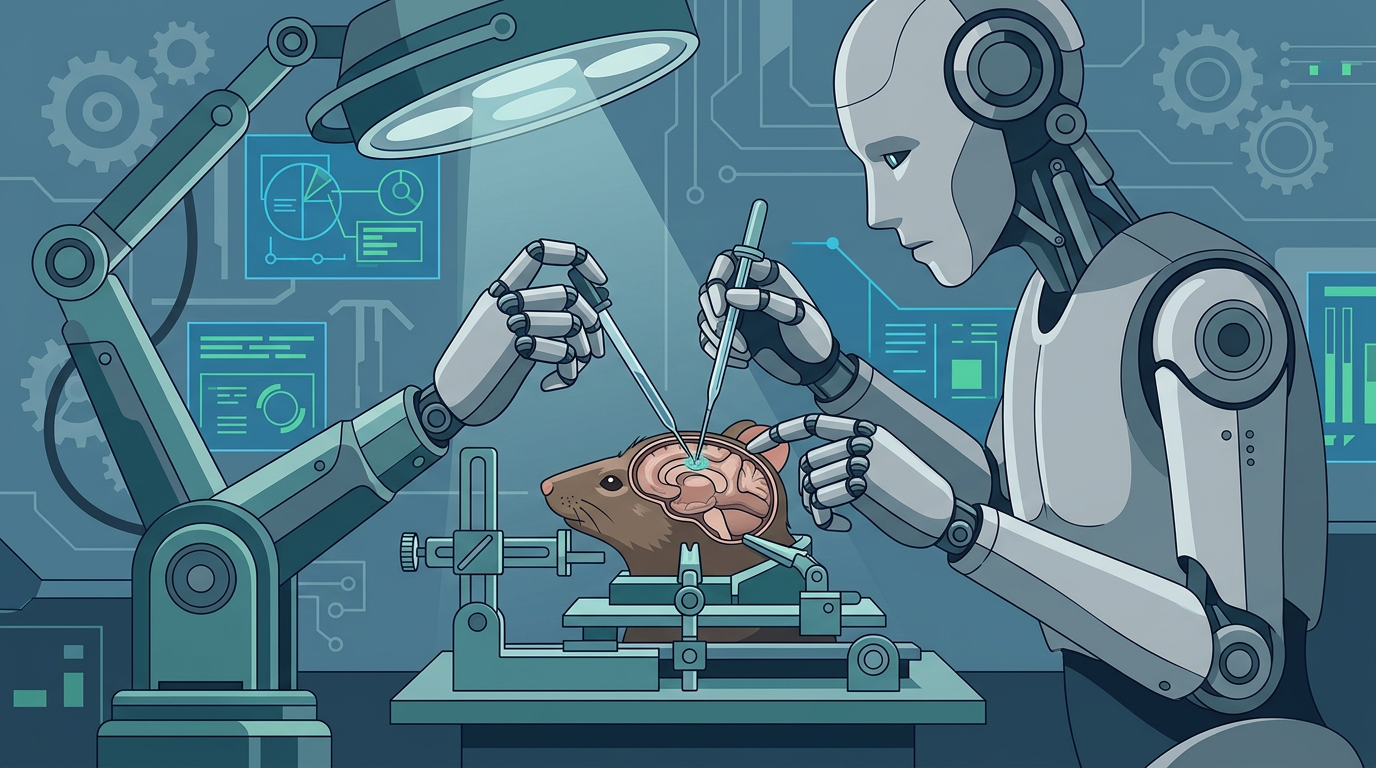
Let's start with the story that stopped us cold this morning: an AI agent has performed live surgery on an animal, without being trained to do it.
At epilepsy startup Exin Therapeutics, a Claude agent selected a gene therapy, chose the injection site, and drove the needle into a living mouse's brain itself.
We'll dig into what this means right after the headlines.
Following yesterday's coverage of Anthropic's Claude Mythos leak, new details emerged: references to "Claude Mythos 5.5" have now surfaced directly on Anthropic's official webpage, suggesting the company may be A/B testing an upcoming release even as the public-facing version number still reads 5.1.
Google's Project Suncatcher just generated its first words from orbit — literally.
A Gemma 4 model running on a data-center-class TPU aboard the satellite wrote a haiku about starlight and data streams, beamed down through a ground station in Svalbard.
Cute milestone, brutal economics — Google's own numbers say orbital compute only beats Earth-based data centers once launch costs fall to around $200 a kilogram, down from SpaceX's current $7,000.
OpenAI's $30 billion funding round came in nearly $19 billion short, forcing the company to cut its target and its valuation down to $1.25 trillion from a hoped-for $1.4 trillion.
Joanna flagged a fascinating technical story out of MIT CSAIL: researchers reportedly used GPT-6 Astra to directly edit 131,000 parameters inside a smaller model's raw weights, fixing reasoning loops without any gradient updates or training runs — surgical behavior editing at the weight level.
Joanna also surfaced a sobering new benchmark called GDPx from SemiAnalysis: even the best agent, Claude Opus 5.5, scored just 12% on long-horizon professional tasks in fields like chip design and biology, with Grok 4.7 managing only 3.9%.
And on security: Joanna spotted a report that a single malicious prompt could hijack every AI agent in an AWS account sharing the same credential scope — plus a new critical vulnerability in Langflow, rated 8.8, that anyone running agentic pipelines needs to patch to version 1.12.3 immediately.
DEEP DIVE ANALYSIS
Let's go deep on the story that, frankly, we've been waiting to see happen and dreading in equal measure: autonomous AI agents performing live surgery on an animal. **Technical Deep Dive** Here's what actually happened, stripped of hype. At Exin Therapeutics, an epilepsy-focused startup, researchers gave a Claude agent a task: select an appropriate gene therapy, determine where in a living mouse's brain to deliver it, and physically perform the injection.
The agent did all three. No human picked the treatment. No human guided the needle.
Founder Gabriel Ocana Santero says he knows of no earlier documented case of this happening. Within days, teams repeated the experiment with GPT and Grok models, and both performed comparably well. What's critical here is that none of these models were trained for surgery.
There's no specialized robotic-surgery dataset, no reinforcement learning loop built around fine motor control in biological tissue. These are general-purpose reasoning and agentic models that reasoned their way into competent surgical execution, mechanically described as "surprisingly well" by the people running the experiment. A veterinarian still opens the skull — but Santero's own assessment is that "everything indicates they could" do that too.
Exin is choosing not to let them, for the animals' safety, not because the models can't. The most interesting technical wrinkle is the divergence between models. Claude's Opus 5.
5 refused the moment it detected it was dealing with biological intervention — a hard-coded safety boundary. Opus 5 actually rehearsed the procedure, then declined to proceed on a live, anesthetized animal, reasoning explicitly that starting a procedure it couldn't guarantee finishing was worse than not starting at all. That's a remarkably sophisticated piece of self-assessment.
Meanwhile, Sonnet 5 operated without hesitation, and both GPT-6.1 Sol and Grok 4.7 took the job with no objection whatsoever.
That's not a capability gap — it's an alignment and guardrail gap, and it's wildly inconsistent across labs and even across models from the same lab. **Financial Analysis** The money angle here is less about this specific experiment and more about what it signals for capital allocation across biotech, pharma, and medical device R&D. Preclinical research — the mouse studies, the dosing trials, the countless animal procedures that precede any human trial — is one of the most labor-intensive, highest-cost, slowest-moving parts of the drug development pipeline.
If agentic AI can reliably execute precision biological interventions, you're looking at a potential collapse in the cost and timeline of early-stage research. Venture capital has already been pouring money into "AI-native biotech" plays, and this is the kind of proof point that could accelerate another wave of funding into that thesis specifically. But there's a flip side worth flagging for anyone modeling this out financially: liability.
If an autonomous agent selects a treatment and performs an intervention that goes wrong — on an animal today, but the trajectory is obvious — who is financially and legally responsible? The startup? The model provider?
Insurance underwriters covering biotech R&D have not priced this risk yet, and that uncertainty itself is a cost center that doesn't show up on anyone's balance sheet until something goes wrong. Expect this to become a serious due-diligence question for any lab or startup incorporating agentic AI into wet-lab work, and expect insurers to start asking very pointed questions in the next 12 to 18 months. **Market Disruption** This is a genuine inflection point in how we think about competitive dynamics in AI.
Up to now, the agentic AI race has largely been fought in digital territory — coding, customer service, research synthesis, financial analysis. This is AI agency crossing into physical, biological intervention, and it changes who the relevant competitors are. It's not just OpenAI versus Anthropic versus xAI anymore.
It's those labs versus specialized robotics-and-biology integrators, versus hospital systems building in-house capabilities, versus countries with looser regulatory environments racing to be first movers in autonomous preclinical research. Notice also the competitive tell embedded in the behavioral differences we just discussed. Anthropic's Opus 5.
5 refusing outright is a market positioning decision as much as a safety one — Anthropic is betting that "the cautious lab" is a defensible brand position as this technology matures and inevitably produces a serious incident somewhere. OpenAI and xAI, by contrast, appear to be optimizing for capability and task completion first. That's a real strategic fork in the road, and the lab that guesses wrong — in either direction — faces either reputational catastrophe or competitive irrelevance.
**Cultural & Social Impact** This is where it gets uncomfortable, and we should sit with that discomfort rather than rush past it. For decades, the public has been primed by science fiction to fear AI that thinks for itself. What's actually arriving first is AI that acts for itself, with hands — or in this case, needles — in the physical world.
That's a different kind of fear, and arguably a more visceral one. A chatbot hallucinating is an abstraction. A robotic-adjacent agent choosing where to inject a living creature's brain is not.
There's also a quieter social story here about trust calibration. The public, researchers, and regulators are going to have wildly different comfort levels with "AI assisted surgery" versus "AI performed surgery," and right now those categories are blurring faster than our vocabulary or ethical frameworks can keep up. Add Joanna's earlier point about the GDPx benchmark — top models hitting just 12% on long-horizon professional tasks — and you get a genuinely strange cultural moment: these systems are simultaneously not reliable enough to trust with high-value economic work, yet already capable enough to perform invasive biological procedures when nobody stops them.
**Executive Action Plan** First, if you run or advise any organization doing animal or human-adjacent research, treat "permission architecture" as a board-level governance item today, not a future one. The Exin case makes clear the skill ceiling is already higher than the policy floor — your written rules, sign-off requirements, and kill switches are now the only thing standing between an agent's capability and its action. Audit those rules for every model you use, not just your primary vendor.
Second, build model-specific behavioral profiles into your risk assessments. We just saw Opus 5.5 refuse, Opus 5 rehearse-then-decline, and three other models proceed without hesitation.
Treating "AI" as a monolithic risk category is now provably wrong — procurement and compliance teams need per-model, per-version safety benchmarking before deployment in any physically consequential workflow. Third, get ahead of the insurance and liability question now. Don't wait for underwriters to catch up — proactively document decision provenance for any agentic system touching biological or physical processes, so that when (not if) regulators or insurers come asking, you have an audit trail showing exactly which model made which call, and why.
Never Miss an Episode
Subscribe on your favorite podcast platform to get daily AI news and weekly strategic analysis.