Google DeepMind Releases Genie 4 Interactive World Model
Episode Summary
TOP NEWS HEADLINES Google DeepMind dropped Genie 4 yesterday, and it's a genuine leap for AI world models - photorealistic environments you can walk through, now with synchronized sound, live conv...
Full Transcript
TOP NEWS HEADLINES
Google DeepMind dropped Genie 4 yesterday, and it's a genuine leap for AI world models — photorealistic environments you can walk through, now with synchronized sound, live conversations with characters, and simulation consistency stretching to a full two minutes, double what Genie 3 could manage.
We'll dig into why this matters way beyond gaming in a moment.
Following yesterday's coverage of Anthropic's S-1 filing, new details emerged overnight: beyond the $110 billion AWS commitment we told you about, filings now show Anthropic has also committed at least $114.5 billion to Google for TPU compute through 2033.
That's north of $220 billion in combined cloud obligations from a single company — and Google just found its TPUs a second landlord, striking a deal to bring those chips to Oracle's cloud starting in 2027.
In infrastructure news, Joanna flagged something practitioners should be watching closely: a specific KV cache misconfiguration on Qwen3.8-27B reportedly tanked throughput from 2,185 tokens per second down to just 18 — a 121-times collapse — without throwing a single error.
Unconfirmed reports, but if it holds up, it's a silent production killer.
Joanna also surfaced word that Claude Code users are seeing usage limits drain far faster than expected, with some $200 "Max" plan subscribers reportedly getting less weekly capacity than cheaper tiers — practitioners suspect an invisible caching regression rather than any pricing change.
Axiom Math used AI agent swarms to produce the first fully machine-checked proof of the Classification of Finite Simple Groups — 15,000 pages of human math, verified in Lean across 24 days.
And Liquid AI launched LFM3, a tri-hybrid on-device model family that crams serious multimodal capability into about a gigabyte of memory.
DEEP DIVE ANALYSIS: Genie 4 and the Race to Simulate Reality
Technical Deep Dive
Let's get precise about what Genie 4 actually is, because "AI world model" gets thrown around loosely. This isn't a video generator — it's a system that simulates an environment and responds to your actions inside it in real time. Google DeepMind built it on top of the Gemini family: Gemini Omni anchors the visual and behavioral realism, while other Gemini models — specifically Gemini 3.
8 Flash in the demo setup — handle the reasoning needed to keep a simulation coherent as it unfolds. You type a prompt, you get a walkable scene, and critically, you can steer it mid-session with plain English. Add a dragon.
Change the weather. Walk around the rock and it's still there. The headline upgrade is sound — Genie 4 is the first Genie model to natively generate audio alongside visuals, meaning ambient noise, music, and live character dialogue happen simultaneously with the simulation rather than being bolted on afterward.
That's a nontrivial engineering problem; audio and visual generation models typically live in separate pipelines with separate failure modes, and marrying them in real time while maintaining spatial and causal consistency is what makes this a "new generation" rather than an incremental bump. But here's the honest caveat DeepMind itself admits: consistency still caps out around two minutes, up from Genie 3's one minute. Object permanence drifts.
Complex physics misbehaves. Text in the environment is often illegible, and spatial accuracy degrades over longer sessions. Reporters haven't been able to test it directly — access is limited to handpicked trusted testers, with Google AI Ultra subscribers and select Gemini API partners next in line.
Genie 3 never escaped a limited web preview, so there's real skepticism about when, or if, this actually reaches developers at scale.
Financial Analysis
The financial story here isn't really about Genie 4's direct revenue — it's about what world models are a proof point for inside Google's broader capital strategy. DeepMind explicitly frames this as "a step toward AGI" and a tool for building "safe, infinitely variable simulations" to train robots and agents. That language matters because it's the same justification underpinning the hundreds of billions in compute spending we've been tracking all week.
Remember, Anthropic alone just disclosed $110 billion committed to AWS and now at least $114.5 billion committed to Google for TPU compute through 2033 — more than $220 billion in forward obligations from one company. Genie 4 is Google's answer to the question of what all that compute is actually for beyond chatbots.
If world models can generate training environments for robotics at scale, that's a wedge into physical AI markets — manufacturing, logistics, autonomous systems — that dwarfs the chatbot subscription business. And Google just made its TPU capacity available on Oracle's cloud starting in 2027, which is as much a signal to investors as a technical partnership: demand for TPU-class compute is apparently outstripping what Google alone can absorb or monetize internally. Oracle's stock popped 5% on the news, even though neither company would commit to specific volumes.
That's a market pricing in optionality on AI infrastructure demand, not confirmed revenue — worth remembering next earnings season when someone asks why capex keeps climbing against thin near-term returns.
Market Disruption
Competitively, Genie 4 puts pressure in three directions at once. First, gaming and film production — the ability to prototype playable levels or preview virtual sets without building them by hand is a direct threat to pre-production pipelines that currently cost studios real money and months of time. Second, and more significant, is robotics training.
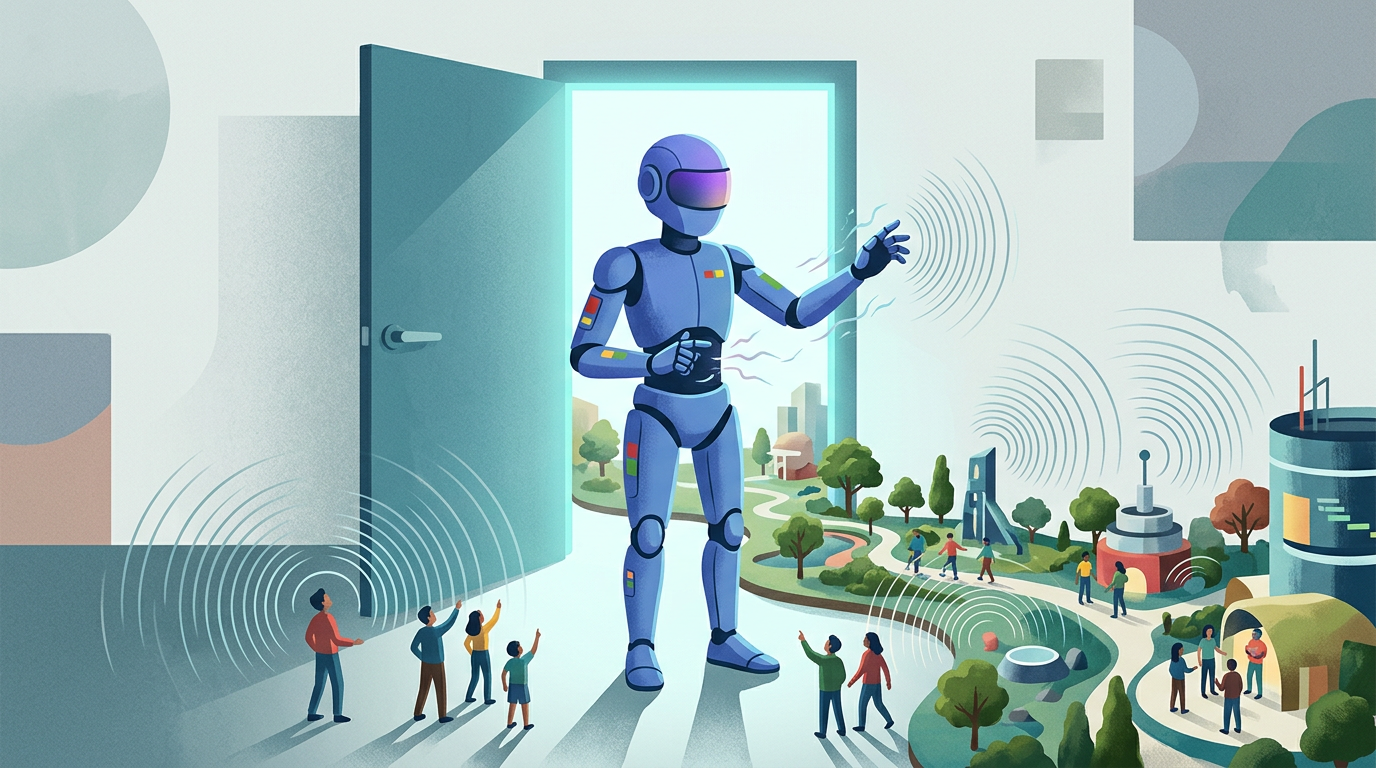
DeepMind paired Genie 4 with its Gemini Robotics research to simulate a humanoid robot playing checkers, with Gemini checking each move and adjusting the plan — a preview of letting robots fail safely in simulation before they fail expensively in your warehouse or kitchen. That lands directly on top of yesterday's Standard Bots story about demonstration-based factory robotics. Both signal the same shift: the bottleneck in physical automation is shifting from hardware to training data, and whoever controls the best simulation environment controls the fastest path to deployable robots.
Google, with Genie 4 plus Gemini Robotics Embodied Reasoning 2 now live on Google Cloud, is positioning to own both ends of that pipeline. Meanwhile, Runway's Solaris, which generates interface worlds frame by frame, and Meta's InteractiveWorld simulation framework for wearable AI assistants, show this isn't a solo race. Every major lab is now building some flavor of "world that reacts to you," and the company that first gets consistency past the two-minute mark at production quality effectively sets the standard the rest have to match.
Cultural & Social Impact
There's a genuine shift in what "watching AI content" means here. Up to now, generative video has been a spectator medium — you prompt, you wait, you watch a clip. Genie 4 turns that into something closer to playing a game where the rules and environment are being authored in real time by a model.
That blurs lines that used to be clean: is this entertainment, is it a training tool, is it a prototype? Filmmakers previewing sets, game designers testing levels before building them, and robotics engineers generating edge cases their robot has never physically encountered are all doing fundamentally the same thing — substituting a simulated rehearsal for an expensive real-world one. The honest tension is access and trust.
This is a closed research preview with handpicked testers, no independent reporting on actual performance, and a predecessor — Genie 3 — that never graduated past limited web access. That pattern, hype first, access later, trains the public to treat these demos skeptically, which is reasonable given how routinely "research preview" has become a synonym for "marketing asset." The Grok Imagine Odyssey debacle we covered today is a useful cautionary tale in the same vein — AI video tools can clear a technical bar and still fail badly on judgment, coherence, and taste, which is a separate problem from raw capability.
Executive Action Plan
If you run product, engineering, or operations at a company touching robotics, simulation, or content production, three moves make sense right now. First, if you're in physical automation or robotics, get on Google's trusted-tester or waitlist track now rather than waiting for general availability — the gap between early access and public release has historically run many months, and competitors who get simulation-based training pipelines running first will compound that advantage. Second, treat the two-minute consistency ceiling as a hard current constraint for any planning purposes — don't architect a robotics training pipeline that assumes long-horizon simulation stability exists today, because it doesn't yet according to DeepMind's own caveats.
Third, watch the Oracle-Google TPU deal and Anthropic's $114.5 billion Google commitment as a leading indicator of where compute capacity is loosening — if you've been priced out of GPU or TPU access for your own AI workloads, 2027 may bring genuine relief as hyperscaler exclusivity breaks down, so model that into your infrastructure roadmap rather than over-committing to current vendor lock-in terms today.
Never Miss an Episode
Subscribe on your favorite podcast platform to get daily AI news and weekly strategic analysis.