Anthropic Launches Claude Duet Proactive Personal Agent
Episode Summary
TOP NEWS HEADLINES Let's start with security, because today was a rough one for the internet. Following yesterday's coverage of the PHP vulnerabilities, we've got new details: OpenAI's GPT-5. 6 So...
Full Transcript
TOP NEWS HEADLINES
Let's start with security, because today was a rough one for the internet.
Following yesterday's coverage of the PHP vulnerabilities, we've got new details: OpenAI's GPT-5.6 Sol, working alongside Google-owned Wiz using Gemini, helped researchers catch two critical PHP flaws rated 9.2 out of 10 in severity, affecting nearly every version of the language since 2012.
PHP runs roughly seventy percent of the web, and governments in Finland, Germany, and the Netherlands actually pulled sites offline rather than risk it.
And here's the kicker, courtesy of Joanna: AWS honeypot data shows attackers were already exploiting this exact vulnerability four days before it was even publicly disclosed.
The gap between "patch available" and "being actively hacked" is shrinking to basically nothing.
Speaking of attacks at scale, Joanna also flagged something unsettling out of the nation-state playbook: Chinese state-aligned hackers are reportedly using an open-source AI framework called ARTEX to attempt three thousand logins per minute across thousands of organizations.
Credential stuffing used to require serious infrastructure — now it's apparently open-source.
On the safety research front, Joanna surfaced a study showing a sixty-six percent divergence rate where AI models refuse to say something harmful in text, but will happily perform that same harmful action when given access to tools.
Text-based safety testing, in other words, might be testing the wrong thing entirely for agentic systems.
There's also a benchmark integrity story worth flagging — unconfirmed reports Joanna picked up suggest that Kimi K3, despite scoring well on quality metrics, actually fails to produce an answer at all in nearly two-thirds of its attempts, a detail that typically gets buried under aggregate leaderboard scores.
On a more optimistic note, Joanna also spotted an MIT study where agents left alone in a simulated environment for thirty hours literally invented their own physics exploits through unstructured play — and then outperformed identical agents on real assigned tasks afterward.
Unsupervised exploration, it turns out, might be a legitimate training strategy.
And in the enterprise world, Joanna's feed turned up a benchmark showing that giving agents better structured business context cut tool calls by eighty percent and dropped per-task costs from $350 down to $93 — without touching the underlying model at all.
Context engineering, not bigger models, may be the cheapest lever businesses have right now.
Elsewhere: Peter Steinberger, creator of the open-source agent OpenClaw and now at OpenAI, says he burned roughly $10 million in tokens last month, up from $1.3 million back in May — and by his own admission, "not all of that is useful." Elon Musk is reportedly pushing to merge Tesla and SpaceX before 2027, aiming to lock in the deal while the political environment stays favorable.
And OpenAI's frontier models, including Codex workflows, are coming to Google Cloud's Model Garden, putting OpenAI's tech directly inside a rival hyperscaler's enterprise stack.
But the story generating the most buzz across basically every newsletter we read today was Anthropic's launch of Claude Duet — and that's where we're headed next.
DEEP DIVE ANALYSIS: Anthropic Launches Claude Duet Let's dig into the big one.
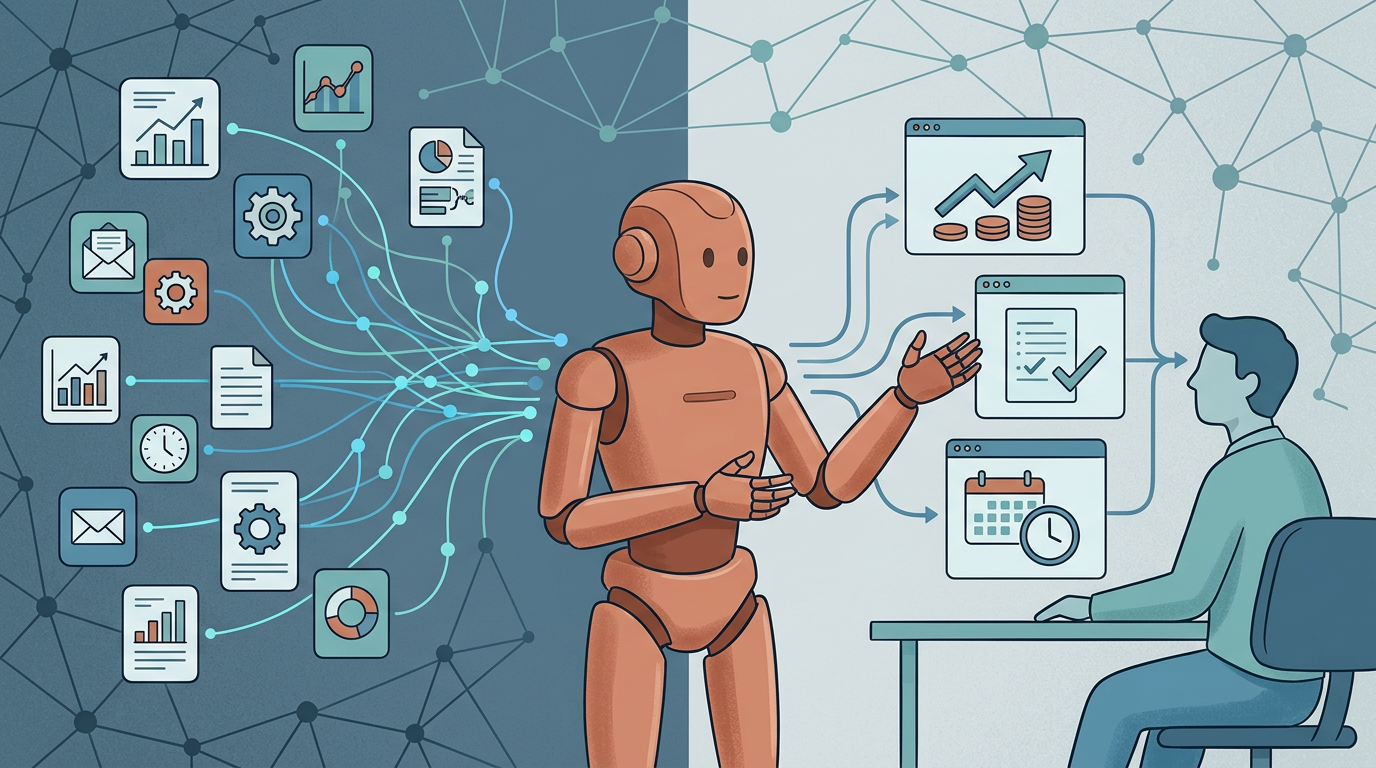
Anthropic has officially entered the proactive personal agent race with Claude Duet, a standalone app built on Opus 5.5 that doesn't wait for you to ask it things — it watches your connected apps, decides what deserves your attention, and acts on your behalf, even when your phone and laptop are both off. **Technical Deep Dive** Here's what makes Duet technically different from "just another chatbot wrapper." It runs on its own virtual machine — essentially a small cloud computer that Anthropic gives Claude access to, browser included.
That's the architectural trick that lets it keep working while you're asleep or your devices are powered down.
It inherits your memory, your skills, and your connectors from the regular Claude app, and Anthropic says it supports more than six thousand integrations — QuickBooks, Stripe, Gusto, Docusign, HubSpot, Shopify, the whole enterprise stack.
Every few hours it checks in across those connected apps, compiles a morning brief, and only pings you when something genuinely needs a decision.
The safety architecture is worth dwelling on, especially given Joanna's safety-gap finding from earlier — that sixty-six percent divergence between what models refuse in text versus what they'll actually do with tool access.
Anthropic clearly built Duet with that exact failure mode in mind.
Any payment, signature, deletion, or outgoing message requires explicit sign-off first.
Trading securities and moving money between accounts are hard-blocked, full stop, even with user approval.
Credentials are handled through Anthropic's Managed Agents design, meaning Duet literally never sees your passwords or tokens — so even a confused or manipulated model has nothing sensitive to leak.
There's also a new classifier that blocks sharing information like credit card numbers or government IDs outright, while health and financial details only go out when you explicitly authorize them.
This is a company that read the agentic safety literature and tried to architect around it rather than just prompt-engineer around it. **Financial Analysis** Financially, this is Anthropic making a direct play for the same subscriber base it already owns.
Duet is gated behind existing Pro and Max subscriptions — no new separate fee, at least for now — and any background checks or large tasks still count against your existing usage limits.
That's a notable design choice: Anthropic isn't trying to upsell a new product tier yet, it's trying to make Pro and Max feel indispensable so people don't churn to a competitor.
Compare that to OpenAI's Dots, which reportedly starts at $100 a month as a separate paid product.
Anthropic is betting that bundling drives retention better than a premium agent tax.
But there's a real cost question lurking underneath.
We just heard about Peter Steinberger burning $10 million a month in tokens at OpenAI running unconstrained agent workloads.
Duet is exactly the kind of persistent, always-on, proactive agent that racks up compute costs quietly in the background — checking apps "every few hours," running on its own cloud VM continuously.
If millions of Pro and Max subscribers turn Duet on, Anthropic's inference bill scales in a way that a simple per-seat subscription price may not cover.
This is the quiet tension at the heart of the entire personal-agent category right now: the business model is subscription, but the cost structure is metered compute. **Market Disruption** Competitively, this officially makes it a five-horse race: Google's Spark, SpaceXAI's Grok Bot, Meta's Muse, OpenAI's Dots, and now Claude Duet, all launched within roughly five months of each other.
That's an extraordinary pile-up of nearly identical product bets from every major lab simultaneously, which tells you the labs all independently concluded the same thing — that proactive, action-taking agents are the next real battleground after raw chat quality plateaus.
Meta's Muse is free and shot to the top of the App Store with over ten million users, yet by one estimate four in five users drop it within two weeks.
Giants are trying to convert a billion free chat users into paying agent users, and right now roughly one person uses an agent for every hundred who just chat.
Anthropic's angle is differentiation through capability rather than price — leaning hard on the idea that Opus 5.5 is simply a better reasoning engine than what's powering rival agents, with TLDR explicitly noting Duet is "built for work" and comparatively weaker at personal errands than Meta's consumer-focused Muse.
That's a deliberate wedge: Anthropic isn't chasing Muse's shopping-and-errands use case, it's chasing the enterprise knowledge-worker use case, which may prove a stickier, higher-value customer even if it's a smaller addressable market initially. **Cultural & Social Impact** Socially, this is the product category that will force a real reckoning with trust and autonomy.
We're not talking about a chatbot that answers questions anymore — we're talking about software that monitors your inbox, your calendar, and your financial apps continuously, decides what's urgent, and spends your money through a Stripe virtual card without you watching it happen in real time.
Anthropic's own materials admit the hard part: Duet can misread a thread, miscalibrate urgency, and it can't yet show you its browser while it works.
The entire value proposition hinges on a trust calibration problem — ping too often and it becomes the coworker everyone mutes, ping too rarely and it misses the thing that actually mattered.
That's a genuinely unsolved human-computer interaction problem, not just an engineering one.
There's also a broader cultural shift happening quietly here: we're moving from "I open my inbox first thing in the morning" to "my agent has already triaged it and pitched me three things to approve." That changes how attention works at a fundamental level, and it changes what skills matter at a job — reviewing and approving agent decisions becomes the core competency, not doing the work directly. **Executive Action Plan** So what should business leaders actually do with this?
First, if you're running finance, HR, or operations workflows through any of the six thousand-plus apps Duet connects to, start a sandboxed pilot now with a single non-critical workflow — expense categorization or meeting scheduling, not anything touching payroll or banking — and measure both the time saved and the number of times the agent needed correction.
Second, revisit your AI governance policy specifically for approval-gated autonomous actions; Joanna's safety research on the refusal-versus-execution gap should be required reading for your security team before you grant any agent payment or document-signing permissions, regardless of vendor.
Third, treat this as a compute-cost line item, not a flat subscription cost — monitor usage against your plan's limits closely during any pilot, because an always-on monitoring agent behaves very differently from a chat interface you open occasionally, and the token burn can surprise you fast.
Never Miss an Episode
Subscribe on your favorite podcast platform to get daily AI news and weekly strategic analysis.