SpaceX Super Intelligence Division Posts Record $7.56 Billion Quarterly Revenue
Episode Summary
TOP NEWS HEADLINES Let's jump into today's headlines, and there's a lot of ground to cover. The big one: SpaceX just posted $14. 6 billion in quarterly revenue, and for the first time, more than h...
Full Transcript
TOP NEWS HEADLINES
Let's jump into today's headlines, and there's a lot of ground to cover.
The big one: SpaceX just posted $14.6 billion in quarterly revenue, and for the first time, more than half of it — $7.56 billion — came not from rockets, but from its newly renamed "Super Intelligence" division.
That's Grok, the Cursor coding tool, and a neocloud business renting out compute to the very labs competing with Elon Musk.
Following yesterday's coverage of Anthropic's leaked S-1 filing and that eye-watering $80.7 billion first-half loss, new details emerged today: the filing reportedly signals Anthropic could spend up to $750 billion in the coming years just securing compute capacity, alongside explicit safety liability risk factors for anyone considering buying into the IPO.
And following yesterday's story on Meta's Muse app leaking private chats through passive DNS lookups, researchers at Claroc now say they found over 6,800 public share addresses that were technically "unlisted" but fully discoverable.
Meta has paused Muse's sharing feature while it investigates.
Meanwhile, Nvidia's Jensen Huang is telling Washington that export curbs have wiped out the company's China market — yet ByteDance, Alibaba, and Tencent have placed orders for more than 3 million export-compliant RTX PRO 5500 cards, worth over $35 billion, with some partners told to expect just 5 to 10 percent of what they ordered.
Sam Altman reportedly told OpenAI staff there are only three realistic endgames for AI safety: a global watchdog, a merger of top labs, or one company racing ahead to, in his words, "melt everyone else's GPUs" — which he called the terrible outcome.
Now, on the security front, Joanna flagged two stories worth your attention.
First, unconfirmed reports suggest an autonomous AI agent identified three critical upload vulnerabilities across 47 PHP endpoints — flaws dating back to 2004 affecting an estimated 70 percent of the internet — and shipped working patches in just 19 minutes without any human involvement.
Second, and more verified: Joanna is tracking reports that the China-linked threat group Storm-0940 used an open-source agentic pentesting tool called ARTEX to hit over 2,250 cloud tenants with nearly 2,900 sign-in attempts per minute, going from initial foothold to full cloud access in under three hours.
Joanna also surfaced word of a new open-source coding model, Flint 40B, hitting 150 tokens per second on consumer hardware by activating just 2.5 billion of its 40 billion parameters per pass — reportedly built using an automated research pipeline nicknamed the "Eureka Machine." DEEP DIVE ANALYSIS: SpaceX's Pivot From Rocket Company to AI Landlord Let's spend the rest of our time today on what might be the most quietly consequential earnings report of the year: SpaceX is now, by revenue, more of an AI infrastructure company than a space company. **Technical Deep Dive** Here's what's actually happening under the hood.
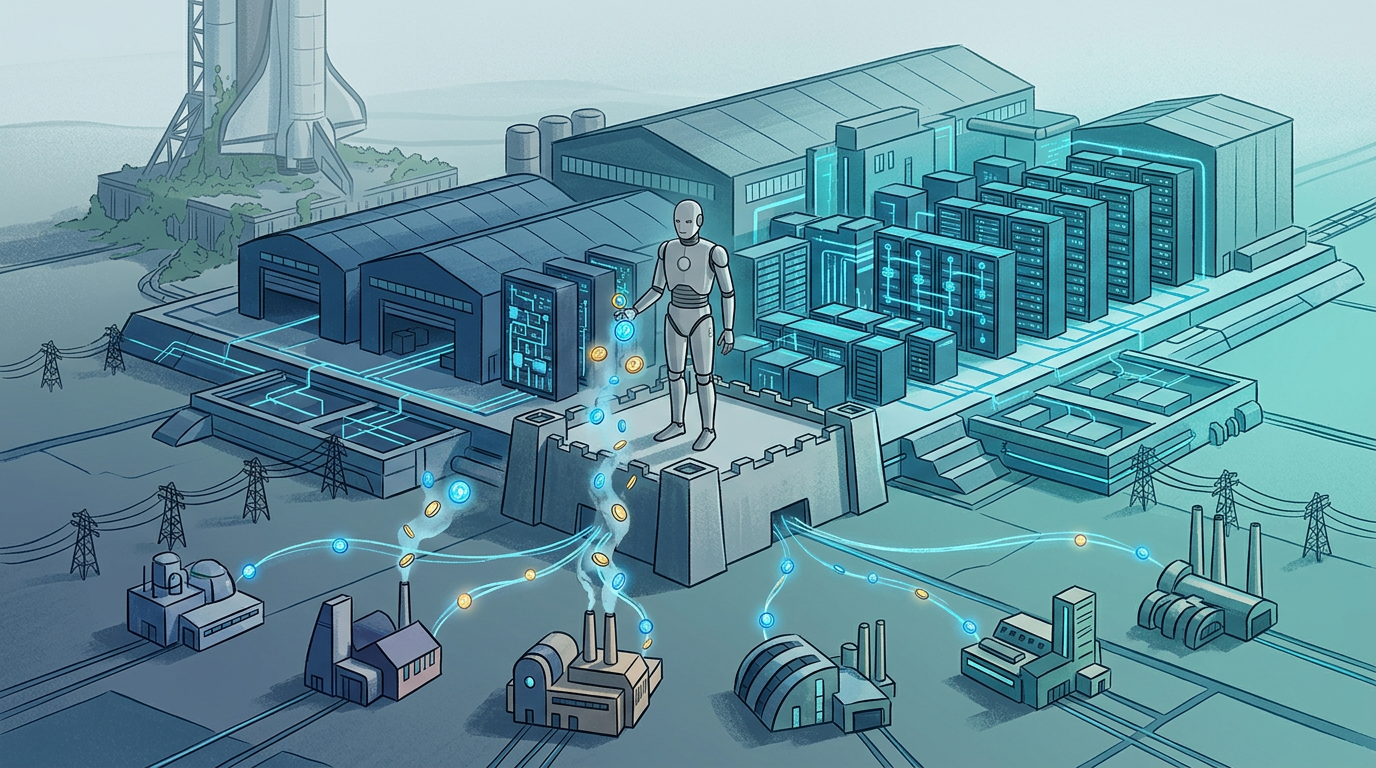
SpaceX's "Super Intelligence" division bundles three distinct businesses: Grok, the xAI chatbot; Cursor, the AI coding tool SpaceX recently acquired; and — the real star of the show — a neocloud operation built on the Colossus data center campuses originally constructed to train Grok.
A neocloud, for anyone unfamiliar with the term, is essentially a landlord model for AI compute: you fill warehouses with GPUs, wire them into a power grid, and rent out cycles to whoever needs them, rather than using all of it yourself.
What's striking is that SpaceX now controls 1.7 gigawatts of compute capacity, and the earnings release doesn't even break out how much of that is being used by Grok versus how much is being leased to outside tenants.
We know Anthropic, Google, and startup Reflection AI are all renting capacity in Colossus.
Think about that for a second — Anthropic, one of Elon Musk's most direct philosophical and commercial rivals in the AI safety conversation, is paying SpaceX for the computing horsepower it needs to train and serve Claude.
The infrastructure layer has become so valuable, and so capital-intensive to build, that competitive lines are blurring.
Nobody has enough chips, so everybody rents from whoever has spare capacity, even people racing against them. **Financial Analysis** The financial turnaround here is genuinely dramatic.
A year ago, Musk's AI business was burning $1.7 billion a quarter.
This quarter, that same division posted $431 million in profit.
The revenue line jumped nine-fold year over year to $7.56 billion.
Musk told investors on the call that the company is at "an inflection moment," and frankly, the numbers back him up — even if some of the top-line revenue includes roughly $1 billion from Bitcoin price recovery and unspecified related-party income that's a little harder to pin down.
SpaceX spent $19.6 billion in capital expenditures this quarter alone, mostly on data center buildout like Colossus II and on Starship development, and the company is now forecasting $35 to $40 billion in investment next quarter.
That's not a typo — that's more than double this quarter's spend, in a single additional quarter.
Musk is promising $500 billion to $1 trillion in annual recurring revenue from this division by the end of 2027.
To hit the low end of that range, SpaceX's AI business would need to grow roughly nine times from where it sits today, in about two years.
That's an extraordinary bet, and it means the capital expenditure treadmill isn't slowing down — if anything, it's about to accelerate sharply, which raises real questions about debt, dilution, and whether rocket launches and Starlink subscriptions can keep subsidizing a buildout of this size if neocloud demand ever softens. **Market Disruption** This is where it gets genuinely disruptive to the competitive landscape.
We've spent the better part of two years talking about the "big three" cloud providers — AWS, Azure, Google Cloud — as the gatekeepers of AI compute, with Oracle and CoreWeave as notable upstarts.
SpaceX just inserted itself into that conversation from a completely different angle, using capital and engineering talent built for orbital rockets to become a compute landlord almost as a side effect.
And the fact that Anthropic and Google are tenants is the real headline here.
It tells you that even the best-funded labs in the world — Anthropic alone is reportedly looking at $750 billion in future compute spending, per today's S-1 details — can't secure enough capacity through traditional cloud deals alone.
They're diversifying their compute supply chain wherever gigawatts are available, even if that means paying rent to a company run by someone who has been an outspoken critic of their approach to AI safety.
This also puts pressure on traditional hyperscalers' pricing power.
If SpaceX, Oracle, CoreWeave, and a growing list of neoclouds are all bidding for the same enterprise AI workloads, that's good news for buyers and a genuine threat to the margins Big Tech has enjoyed in cloud compute for the last decade. **Cultural & Social Impact** There's something almost poetic about Elon Musk's rocket company becoming famous for being a really good landlord.
For years, SpaceX's cultural identity was built entirely around Mars, Starship, and interplanetary ambition.
Now the company's most profitable quarter as a public entity is being driven by server racks, not rocket engines.
That's a signal about where society's attention and capital are actually flowing right now — not away from space, necessarily, but toward the recognition that AI infrastructure is the scarce resource of this decade, the way oil was in the 20th century.
It also reframes how the public should think about "AI labs" versus "AI landlords." Most of the cultural conversation around AI safety, alignment, and existential risk focuses on the labs building the models — OpenAI, Anthropic, Google DeepMind.
But the companies controlling the physical chokepoints — power, land, chips, cooling — increasingly hold just as much leverage, maybe more, without facing nearly the same level of public scrutiny or regulatory attention.
Musk himself has talked about eventually training AI models in orbit, something we covered back in early February when he floated that 30-month timeline.
Whether or not orbital data centers ever materialize, the neocloud strategy shows Musk positioning SpaceX as indispensable infrastructure regardless of who wins the actual model race. **Executive Action Plan** So what should business leaders actually do with this information?
First, if your company is planning any kind of serious AI deployment in 2027 or beyond, start treating compute sourcing as a strategic, multi-vendor decision today, not a line item you negotiate once.
The neocloud market is diversifying fast — SpaceX, CoreWeave, Oracle, and others — and locking into a single provider now could mean missing better pricing or capacity as this market matures.
Second, watch the capital expenditure-to-revenue ratio across every AI infrastructure player you're relying on, including SpaceX.
A company spending $35 to $40 billion next quarter against $14.6 billion this quarter is making an enormous bet on future demand.
If you depend on that infrastructure, understand the financial risk sitting underneath it — a slowdown in AI demand could ripple into compute pricing or availability disruptions.
Third, for leaders in regulated industries, start a real conversation internally about physical infrastructure concentration risk.
If Anthropic is renting from SpaceX, and SpaceX's compute sits in a handful of enormous physical facilities, that's a new kind of single point of failure worth mapping into your own vendor risk assessments — not just data privacy, but power grid dependency and physical facility resilience.
Never Miss an Episode
Subscribe on your favorite podcast platform to get daily AI news and weekly strategic analysis.