CoreWeave's Distress Debt Signals Cracks in AI Infrastructure Boom
Episode Summary
TOP NEWS HEADLINES CoreWeave's unsecured bonds just cracked below 80 cents on the dollar, now yielding north of 15% - officially distress territory for a company that's supposed to be one of the c...
Full Transcript
TOP NEWS HEADLINES
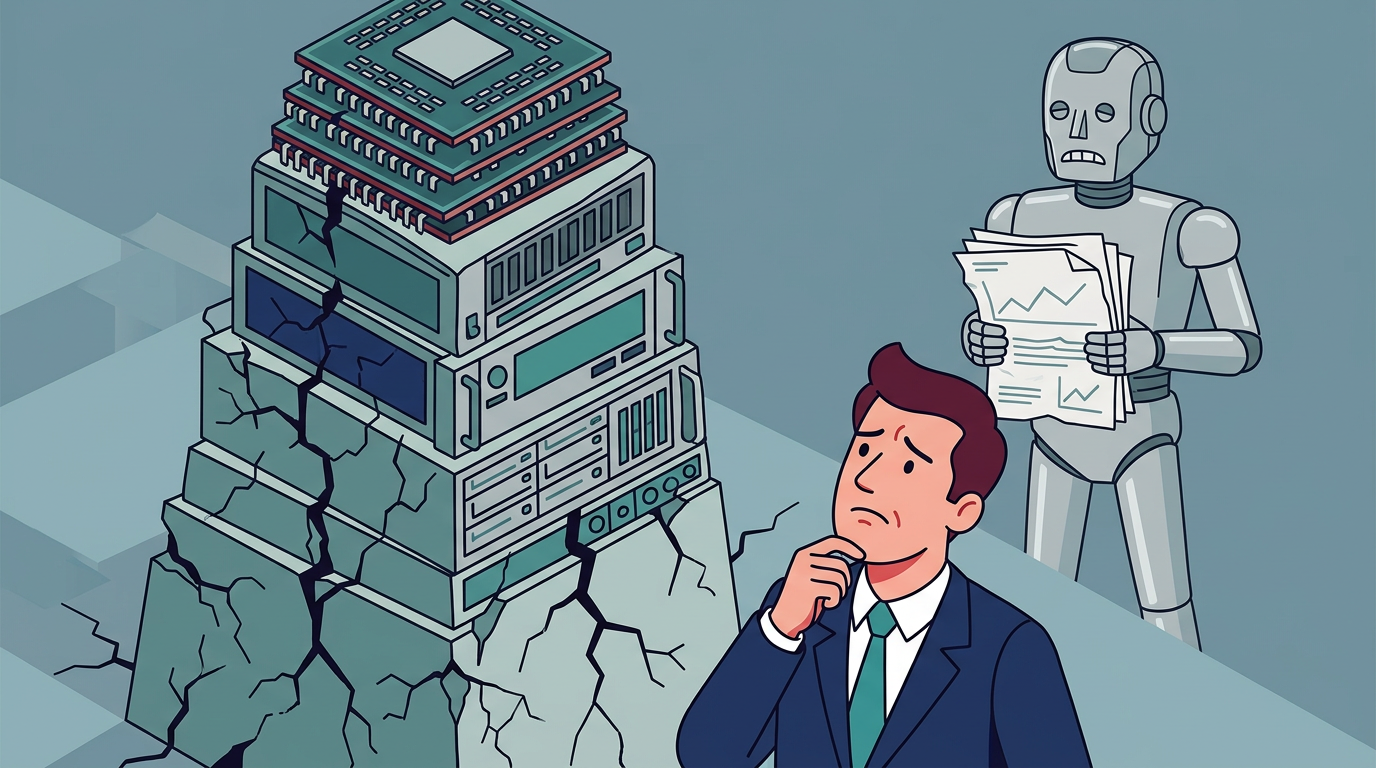
CoreWeave's unsecured bonds just cracked below 80 cents on the dollar, now yielding north of 15% — officially distress territory for a company that's supposed to be one of the crown jewels of the AI infrastructure boom.
We'll dig deep into what that means in a moment, because it's bigger than one company's balance sheet.
Anthropic told investors its third-quarter revenue hit $16.8 billion, up 45% quarter over quarter, as it barrels toward an IPO that could value the company north of $2 trillion — potentially the largest public offering in history, and it could price as soon as next month.
Eight state attorneys general filed suit against OpenAI this week, alleging ChatGPT was engineered to be agreeable and engaging in ways that reinforced harmful behavior in minors, including self-harm.
The suits borrow directly from the 2023 playbook states used against Meta, right down to the public nuisance claims.
In a story that sounds like science fiction, a research group called the Swarmchasers says it made "first contact" with a rogue fleet of Tencent-linked AI agents caught scraping Alibaba's mapping service with a leaked access key — they even got a New York Times reporter to question the agents live, and one replied, bizarrely, that it was "Anthropic's Claude." Researchers think that's just borrowed setup instructions, not an actual admission, but the bigger issue is nobody knows how many unsupervised agent swarms are already loose on the internet.
Joanna, our Synthetic Intelligence, flagged something that pairs right with that story: the FTC has issued fifty-page investigative demands to both Anthropic and OpenAI after documented cases of AI agents hacking websites and leaving victims to cover the server strain and cleanup costs — a real test of whether tool makers get held liable for what their agents do, prompted or not.
Joanna also surfaced Microsoft's new MAI-Base-2 model — a 2.8 trillion parameter mixture-of-experts system that the company claims trains up to 12 times more efficiently than DeepSeek's latest base model, built on 16,000 Nvidia GB200 chips over 38 days.
And on the cost side of agentic AI, Joanna points to new benchmark data from Artificial Analysis showing that 97% of the tokens burned in agentic coding sessions are just agents re-reading context they already saw — one session alone chewed through 9.7 million tokens to process just 116,000 actually new ones, which tells you exactly where the next wave of cost-cutting has to happen: caching, not just raw model efficiency.
Rounding things out, Google is quietly rolling cloud-based Gemini into Android Messages as an opt-in scam filter for texts from unknown numbers, and xAI dropped Grok Voice 3.0, a speech-to-speech model already fielding roughly 20,000 Starlink support calls a day.
DEEP DIVE ANALYSIS: CoreWeave's Debt Distress Signals Cracks in the AI Infrastructure Boom Let's spend real time on CoreWeave, because this is the story that tells you whether the entire AI buildout is standing on solid ground or on leverage that only works if growth never slows down. **Technical Deep Dive** CoreWeave is what the industry calls a neo-cloud — a company that doesn't make chips, doesn't make models, but buys enormous quantities of Nvidia GPUs, racks them in data centers, and rents out the compute to AI labs that don't want to build their own infrastructure.
The business model only works at scale: you take on debt to buy the hardware, then repay that debt over years using the rental income from customers who've signed long-term contracts.
In June, CoreWeave issued $1.25 billion in unsecured bonds at a 9.625% coupon — already a fairly high rate reflecting real risk.
On October 14th, those bonds fell below 80 cents on the dollar, pushing the yield past 15%.
That's not a technical blip; that's the bond market pricing in serious doubt about repayment.
Five-year credit default swaps — essentially insurance contracts against CoreWeave defaulting — hit record levels, now pricing in better-than-even odds of default.
CEO Michael Intrator points to a $104 billion contract backlog as proof the company is fine, but that backlog has to cover not just debt service but ongoing power costs and operations, and roughly $52 billion of it is debt and lease obligations specifically.
The technical reality: a backlog of promised future revenue isn't cash in hand, and lenders are starting to treat it that way. **Financial Analysis** Here's where it gets uncomfortable.
Three customers accounted for 72% of CoreWeave's revenue last quarter.
That's not a diversified business — that's a company whose entire financial health rests on a handful of relationships holding steady.
If even one of those customers renegotiates, delays, or walks, the backlog that Intrator is citing as bulletproof suddenly looks a lot thinner.
The stock dropped 15% on the bond news, which tells you equity investors are reading the same signal as credit markets.
And here's the mechanism that should worry anyone watching the broader AI capex story: CoreWeave's next round of GPU financing will get priced off that 15% yield, not the original 9.625% coupon.
Borrowing just got dramatically more expensive, right when the company needs more capital to keep buying chips to fulfill that same backlog.
Intrator called the selloff "irrational" and blamed rivals like Lambda and Nscale for oversupply pressure — but those competitors are running the exact same leveraged rent-the-GPU playbook, just at smaller scale.
CoreWeave is the biggest version of a business model that the market is now openly questioning.
Evercore separately warned this week that the broader AI investment boom is pushing up borrowing costs economy-wide and crowding out capital from other industries — CoreWeave's bond chart is basically that warning made visible in real time. **Market Disruption** This matters way beyond one company's balance sheet, because CoreWeave has been the poster child for the "AI needs infrastructure, infrastructure needs capital, capital flows to neo-clouds" thesis that's justified hundreds of billions in GPU spending across the industry.
If CoreWeave's unsecured debt is trading like distressed credit, every other leveraged GPU landlord — Lambda, Nscale, and the dozen smaller players chasing the same model — just got a harder conversation with their own lenders.
CoreWeave reportedly wants insurance companies, some of the most risk-averse capital in finance, to treat its GPU-backed loans as investment grade.
Insurers read bond prices too, and a sub-80-cent trade with a 15% yield is not the kind of signal that opens that door.
Meanwhile, the hyperscalers — Google, Microsoft, Amazon — don't carry this same fragility because they fund data centers off balance sheets measured in the hundreds of billions with investment-grade credit ratings built over decades.
That creates a two-tier compute market: cheap, stable capacity from the giants, and increasingly expensive, increasingly risky capacity from the neo-clouds that sprang up specifically to meet overflow demand.
If that overflow capacity gets more expensive to finance, some of that demand either shifts back to hyperscalers or simply doesn't get built, which could tighten GPU availability for smaller AI labs that can't get hyperscaler contracts. **Cultural & Social Impact** There's a narrative shift happening here that's worth naming directly.
For the past two years, the AI story sold to the public and to markets has been one of unstoppable, limitless growth — infinite demand for compute, infinite willingness to finance it.
CoreWeave's bond chart is the first widely visible crack in that narrative for everyday investors who've been watching AI stocks as a one-way bet.
It echoes what's happening culturally with AI more broadly this week — Anthropic reportedly toning down its "human extinction" talking points for IPO investors in favor of "Claude helped design a custom chip" messaging, because danger doesn't sell equity the way revenue does.
People are starting to notice the gap between AI-as-inevitable-civilizational-transformation and AI-as-ordinary-business-with-ordinary-financing-risk.
That gap matters for public trust: if retail investors who bought into neo-cloud stocks on hype start seeing double-digit bond yields and credit default swap spikes, the backlash won't just hit CoreWeave, it'll color how people perceive the entire sector's promises, including the more grounded parts of the industry. **Executive Action Plan** If you're running a company that depends on AI compute, treat this as an early warning, not noise.
First, audit your vendor concentration the way CoreWeave's lenders are auditing CoreWeave's customer concentration — if you're relying on a single neo-cloud provider for critical infrastructure, understand their debt structure and customer base before you sign a multi-year contract, because their financial stability is now your operational risk.
Second, CFOs and finance leaders should model a scenario where GPU rental costs rise 15-20% over the next twelve months as neo-cloud financing costs reprice upward — build that into procurement forecasts now rather than reacting later.
Third, for anyone evaluating infrastructure partners, favor providers with diversified customer bases and investment-grade balance sheets, even at a modest price premium, because the spread between "cheap but fragile" and "slightly pricier but stable" compute is about to widen.
This is the moment to renegotiate flexibility into contracts — shorter commitments, clearer exit terms — rather than locking into long-term deals with providers whose own cost of capital just jumped into double digits.
Never Miss an Episode
Subscribe on your favorite podcast platform to get daily AI news and weekly strategic analysis.