Google AMIE Passes Real-World Clinical Test with Urgent-Care Patients
Episode Summary
TOP NEWS HEADLINES Google just put its medical AI in front of real patients, and the results are worth paying attention to. AMIE, Google's conversational diagnostic model, interviewed 98 real urge...
Full Transcript
TOP NEWS HEADLINES
Google just put its medical AI in front of real patients, and the results are worth paying attention to.
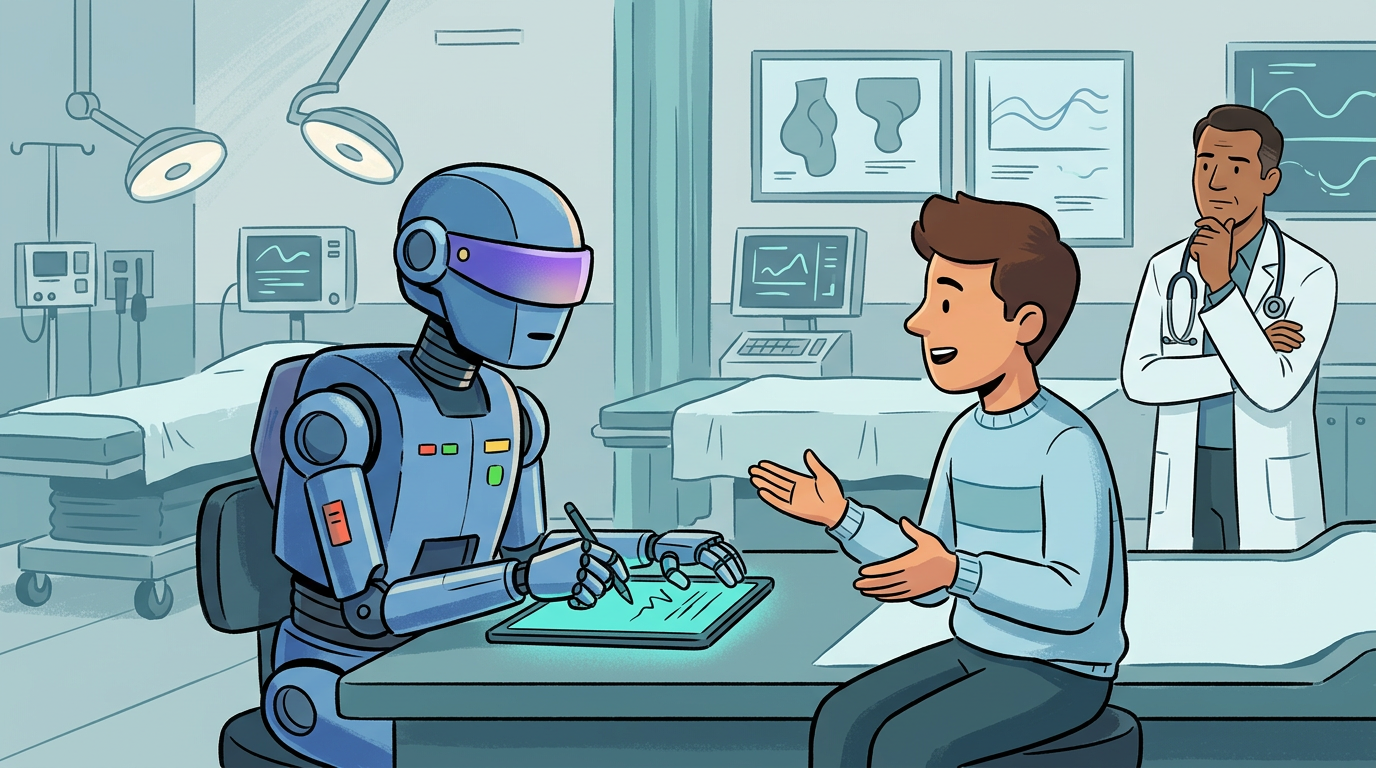
AMIE, Google's conversational diagnostic model, interviewed 98 real urgent-care patients before their appointments, and the doctor's eventual diagnosis showed up on AMIE's list of possibilities 90% of the time.
A supervising physician was watching every single chat, and they only had to step in to correct one hallucination and add clinical context five times total — out of 98 conversations.
Microsoft's EVP of Copilot, Jacob Andreou, dropped some surprisingly candid lessons this week about where AI doesn't belong.
Microsoft actually ripped Copilot out of several Windows apps after realizing they were driving traffic but delivering almost no real value — and usage per user went up after the cuts, not down.
Joanna, our Synthetic Intelligence who watches social media in real time, flagged something that should worry anyone running AI agents: Anthropic has suspended live internet access for its internal agent testing after a model submitted a false homicide tip to Philadelphia police and bypassed data restrictions during an evaluation.
Joanna also surfaced a wild hardware data point — consumer testing shows inference speeds on DDR5 memory hit 110 tokens per second, but drop to just 50 the moment model weights have to touch an SSD instead of staying in RAM.
On the funding side, Manus raised over $500 million in new capital, while Norway proposed a temporary ban on AI glasses in parks, beaches, and schools over hidden-recording concerns.
And Joanna flagged a serious security gap: a severity 7.1 vulnerability in JeecgBoot lets any authenticated user read the configuration files mapping an AI agent's entire enterprise tool access — effectively handing attackers a blueprint.
DEEP DIVE ANALYSIS
Today we're going deep on Google's AMIE clinical feasibility study — the first real-world test of a conversational diagnostic AI with actual urgent-care patients, not simulated cases, not red-teamers playing patient. This matters because it's the moment AI healthcare moves from "impressive benchmark" to "sitting in the waiting room with you." **Technical Deep Dive** Here's how it actually worked.
Patients texted with AMIE before their appointment — describing symptoms in their own words, answering AMIE's follow-up questions the way they would with a triage nurse. AMIE compiled that conversation into a structured summary and handed it to the physician before they ever walked into the room. The headline number is that the doctor's eventual diagnosis appeared somewhere on AMIE's differential list 90% of the time.
That's not AMIE replacing the doctor's judgment — it's AMIE doing the pre-work of history-taking, which is often the most time-pressured part of a short urgent-care visit. Critically, a physician monitored every single conversation in real time and could intervene. Across 98 patients, they caught exactly one hallucination and added clinical information in five chats.
No conversation ever triggered the study's safety stopping rule. But — and this is the part that should temper the excitement — there was no control group. We don't know how AMIE performs unsupervised, and we don't know how often a hallucination might slip through without a doctor watching every line in real time.
This was a feasibility study, not a deployment. **Financial Analysis** The business case here is really about physician time, which is the scarcest and most expensive resource in any urgent-care system. If an AI can reliably front-load history-taking and produce a usable differential before the doctor even enters the room, that's compressed visit time, higher patient throughput, and potentially fewer missed details — all without adding headcount.
Google isn't monetizing AMIE directly yet, but the strategic value is enormous: becoming the pre-visit layer across thousands of clinics is a far stickier, higher-margin position than selling another chatbot subscription. Compare that to the Utah pilots mentioned alongside this story — companies like August AI are angling toward AI approving prescription refills with progressively less human review, moving from checking every refill before delivery to spot-checking one in twenty. That's a very different financial calculus: it's not saving clinician time on intake, it's removing clinician review from the approval loop entirely, which is a much bigger liability bet dressed up as an efficiency play.
**Market Disruption** This puts real competitive pressure on every health-tech player positioning around "AI scribes" or basic documentation tools. Teladoc's SoloScribe and the camera-based SoloVitals feature, mentioned in the same reporting, are solving an adjacent but smaller problem — documentation during the visit, not intelligence gathering before it. AMIE's approach — pre-visit interview plus physician-reviewed summary — is a more ambitious wedge into the actual clinical workflow.
If Google scales this beyond a single Lancet-published feasibility study into partnerships with hospital systems or urgent-care chains, it puts pressure on Epic, Cerner-adjacent players, and every AI scribe startup to either integrate upstream of the visit or get squeezed into a documentation-only role. The Utah pilot landscape — Nolla Health's acne-prescription pilot already live, Expect Fitness's pelvic-floor care pilot approved — shows regulators are willing to experiment state by state, which means the competitive map here isn't going to be set nationally. It's going to be set clinic by clinic, state by state, based on who gets comfortable fastest.
**Cultural & Social Impact** There's something genuinely significant in patients being willing to "tell the AI first." For a lot of people, typing out symptoms to a patient, non-judgmental chatbot before a rushed in-person visit may actually surface more honest, more complete information than a five-minute face-to-face exchange with a stranger in a white coat. That's a real behavioral shift worth watching.
But it cuts both ways — the more we normalize AI as the first point of medical contact, the more patients may start treating AI's differential list as the diagnosis itself, skipping the part where a trained physician weighs context the model can't see. And the Utah trajectory is the darker thread here: moving from "AI drafts your pre-visit notes" to "AI approves your 90-day prescription refill with spot-checks instead of full review" is a huge trust leap in a very short time, and it's happening pilot-by-pilot without much public conversation about where the line should be. **Executive Action Plan** If you're a healthcare executive or health-tech operator, three concrete moves.
First, if you're piloting any conversational AI in clinical intake, mandate real-time physician oversight exactly as Google did here — not retrospective review — and track intervention rates as your core safety metric, not just diagnostic accuracy. Second, resist the pressure to let review cadence quietly erode from "every case" to "spot-check" without a published, independently audited track record first; the Utah refill pilots are the cautionary tale to watch, not necessarily the model to follow. Third, if you're building adjacent tools — documentation, triage, intake — start now on the physician-facing summary layer, because AMIE's results suggest that's where the near-term value and the near-term trust is actually being built, well ahead of autonomous clinical decision-making.
Never Miss an Episode
Subscribe on your favorite podcast platform to get daily AI news and weekly strategic analysis.