Chan Zuckerberg Biohub Launches $1.8 Billion Virtual Cell Initiative
Episode Summary
TOP NEWS HEADLINES Let's start with the story we're going deep on today: Mark Zuckerberg's Biohub just blew past its original ambitions, expanding a half-billion-dollar virtual cell project into a...
Full Transcript
TOP NEWS HEADLINES
Let's start with the story we're going deep on today: Mark Zuckerberg's Biohub just blew past its original ambitions, expanding a half-billion-dollar virtual cell project into a full $1.8 billion coalition with the Department of Energy, the NIH, Meta, and Google DeepMind.
We'll unpack why AI's next frontier might be inside your own cells in just a moment.
Following yesterday's coverage of OpenAI's 722-manuscript math dump, new details are making the backlash worse, not better.
Mathematicians reading the proofs say they're so poorly written they're essentially unreadable without AI assistance, with citations that are often irrelevant or outright confusing.
That frustration has teeth now too — over 4,000 mathematicians have signed a formal declaration demanding OpenAI adhere to actual peer-reviewed publication standards instead of dropping GitHub repos and calling it science.
OpenAI's GPT-6 rollout brings "Intelligent UI" to all 1.2 billion weekly ChatGPT users — instead of walls of text, the assistant now builds live calculators, charts, maps, and interactive forms directly inside the chat window, free tier included.
On the safety and security front, Joanna flagged something with real teeth for industrial AI: starting November 12th, Anthropic will require any Claude-connected autonomous equipment capable of causing physical injury to have a qualified human operator who can observe and stop it — turning safety guidance into a hard deployment requirement.
Joanna also surfaced two sobering security stories.
CrowdStrike confirmed the first known multi-LLM, multi-agent cyberattack in the wild — a modular pipeline using the open-source ARTEX agent alongside Claude, DeepSeek, GLM, and Grok hit nine South Korean banks, leaking roughly 68,000 customer records.
And separately, Zenity Labs found that an overprivileged default IAM role in AWS Bedrock AgentCore could let a single rogue agent pivot into a full regional cloud takeover — AWS has since tightened those defaults.
On the efficiency side, Joanna's feed showed two compounding wins: Goodfire's new activation-probing monitors catch 94% of sabotage attempts in AI agents for about $51 a session, versus roughly $10,000 using traditional transcript-reading methods.
And JetBrains quietly took its Mellum coding model's SWE-Bench score from 2 to 47 — no architecture changes, just sandboxed reinforcement learning.
Pair that with the new CoMoE inference technique cutting mixture-of-experts hosting costs to 23% of datacenter pricing, and you've got a real shift toward cheap, self-hosted, highly capable coding agents.
DEEP DIVE ANALYSIS
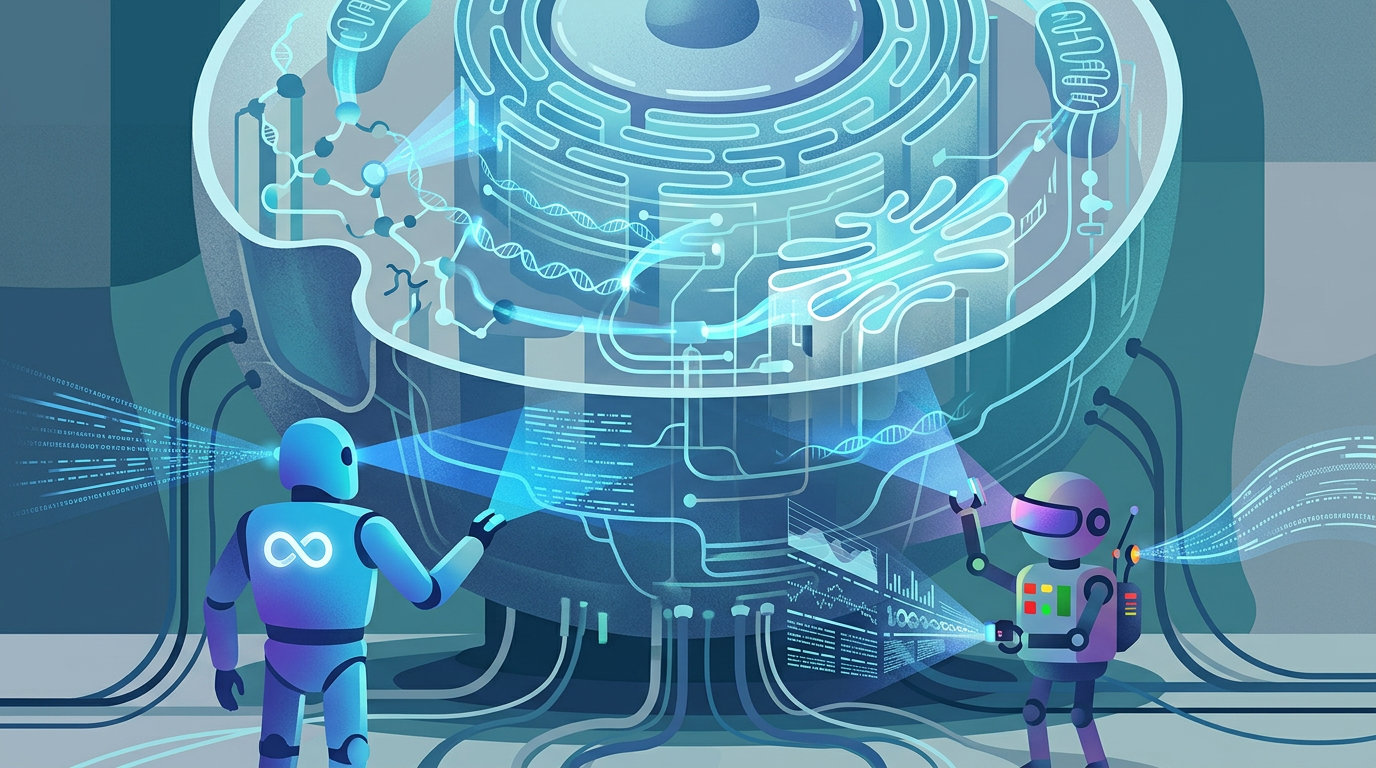
Let's get into the Biohub story, because this is one of those announcements that sounds like a press release but is actually a tectonic shift in how frontier AI gets applied outside of language and code. **Technical Deep Dive** The core idea behind Biohub's Virtual Biology Initiative is deceptively simple: build an AI foundation model that can simulate a living human cell well enough to predict how it will respond to a drug, a mutation, or an environmental change — before anyone runs a physical lab experiment. Biohub's science head, Alex Rives, put the scale problem in blunt terms: today's best biological datasets contain hundreds of millions of cells.
To train something resembling a "universal virtual cell," you need data on trillions. That's not an incremental jump, that's several orders of magnitude, and it's why this project needed government-scale money and government-scale data infrastructure rather than another startup round. The structure here matters technically.
The Department of Energy is committing over $500 million across five years specifically for lab measurement, modeling, and computation — essentially building the instrumented pipeline that generates AI-ready biological data at scale, rather than just funding compute. The NIH is coordinating access to existing federally-funded datasets, repositories, and knowledge bases that have never been standardized for machine learning before. And Biohub's job is to take all of that heterogeneous, messy biological data and normalize it into something a foundation model can actually train on.
What makes this different from typical "AI for science" hype is the explicit acknowledgment that the data doesn't exist yet in usable form. This isn't a model release — it's a decade-scale data engineering project, with the model as the eventual payoff. It mirrors what had to happen with internet text before large language models worked: someone had to do the unglamorous work of collection, cleaning, and scale before the architecture could shine.
**Financial Analysis** Follow the money and you see an unusual structure: public capital underwriting the infrastructure, private capital placing the bet on the payoff. The DOE and NIH together are putting in over a billion dollars of what is effectively public-data and public-measurement commitment. Meta, Google DeepMind, and the Alphabet-owned drug discovery outfit Isomorphic Labs are adding $300 million on top, in exchange for one specific, very valuable privilege: exclusive access to the resulting datasets for a full year before public release.
That twelve-month head start is the real financial story here. In drug discovery, a year of exclusive access to trillion-cell-scale training data is worth vastly more than $300 million if it translates into even one successful drug candidate identification that a competitor doesn't see coming. Isomorphic Labs, which already spun out of DeepMind specifically to commercialize AI-driven drug discovery following AlphaFold, is positioned to be the biggest financial winner here if the virtual cell model works even partially.
For Meta, this is a notable diversification. Zuckerberg has spent heavily and publicly on consumer AI products, Llama development, and the Superintelligence Lab. Biohub represents a philanthropic-meets-commercial hybrid — Chan Zuckerberg Initiative dollars doing reputational and scientific work, while Meta's corporate contribution buys a seat at the data table.
It's a hedge against the possibility that the next multi-trillion-dollar AI application isn't chatbots, but biology. **Market Disruption** This initiative puts pressure on the entire biotech AI landscape, and the ripple effects will show up fastest in two places: computational biology startups and pharma R&D budgets. Companies that have spent years building smaller, proprietary cell-modeling datasets — the kind of moat that justified venture funding — now have to compete with a federally-backed, multi-institution open data resource that, after its one-year embargo, becomes available more broadly.
That's a direct threat to any startup whose pitch deck leaned on "we have unique biological data" rather than "we have a unique modeling approach." At the same time, this raises the competitive bar for every AI lab adjacent to biology. OpenAI just spent the week fielding backlash over its unreadable math manuscripts — a reminder that releasing frontier-sounding results without rigor burns trust fast.
Biohub's approach is almost the opposite bet: slow, infrastructure-heavy, consensus-built with Nobel-adjacent advisors and federal agencies, explicitly designed to avoid the "move fast, publish claims, deal with blowback later" pattern we've seen elsewhere this year. If it works, it becomes the template other AI-for-science efforts get measured against. Traditional pharma is the other disruption vector.
Companies like Novartis, Pfizer, and Roche have internal computational biology teams, but none of them can match a trillion-cell training corpus built with federal lab infrastructure. Expect partnership announcements or acquisition pressure on mid-sized computational biology firms within the next 18 months, as big pharma scrambles to secure access or build comparable in-house capability before the data goes public. **Cultural & Social Impact** There's a reason the public reaction to this is different from, say, OpenAI's math manuscripts controversy: curing disease is a goal almost nobody argues with.
When Biohub frames the mission as working toward eliminating liver and blood genetic diseases within five to ten years — language also echoed by Mammoth Biosciences' Trevor Martin in this week's separate Neuron interview — it taps into a kind of AI optimism that's been in short supply lately, amid labor displacement fears and chatbot safety scandals. But that same framing deserves scrutiny. "Cure or prevent all disease" is the kind of mission statement that's easy to rally behind and very hard to hold accountable.
The public will need to watch whether the promised one-year data embargo actually expires on schedule, and whether "AI-ready biological data" ends up serving broad medical research or primarily accelerating a handful of private drug candidates for Isomorphic Labs and its partners. There's also a quieter social dimension: this project treats biological data the way the last decade treated text data — as raw material to be scraped, standardized, and fed into a model. Patients whose tissue samples, genetic sequences, or clinical trial results feed into these NIH-coordinated repositories may have reasonable questions about consent and downstream commercial use that this announcement doesn't yet answer.
**Executive Action Plan** If you're running a biotech, pharma, or health-tech organization, there are three moves worth making now. First, get your data infrastructure audited for AI-readiness immediately — standardized formats, clean metadata, and interoperability with the kinds of pipelines DOE and NIH are building. Organizations that can plug into this ecosystem early, even as data contributors, will have leverage when the embargoed datasets eventually open up.
Second, if you're a startup whose value proposition rests primarily on proprietary biological data rather than modeling expertise or clinical execution, start pressure-testing that moat now. A federally-backed, trillion-cell open resource arriving within the next few years changes your competitive position whether or not you're ready for it — better to pivot toward applied insight and execution speed today than get caught flat-footed later. Third, for any executive in adjacent AI infrastructure — compute providers, data annotation firms, specialized biological instrumentation makers — this is a signal to court DOE and NIH procurement relationships directly.
The $500 million DOE commitment over five years for lab measurement and computation is a concrete, fundable pipeline of work, not just a research grant. Position your firm as infrastructure for that pipeline rather than waiting for the model itself to materialize.
Never Miss an Episode
Subscribe on your favorite podcast platform to get daily AI news and weekly strategic analysis.