OpenAI Deploys textGrain Watermarking Across European Union
Episode Summary
TOP NEWS HEADLINES Let's start with the story that's dominating every feed this morning: OpenAI has begun rolling out invisible watermarks into ChatGPT and Codex outputs across the European Union,...
Full Transcript
TOP NEWS HEADLINES
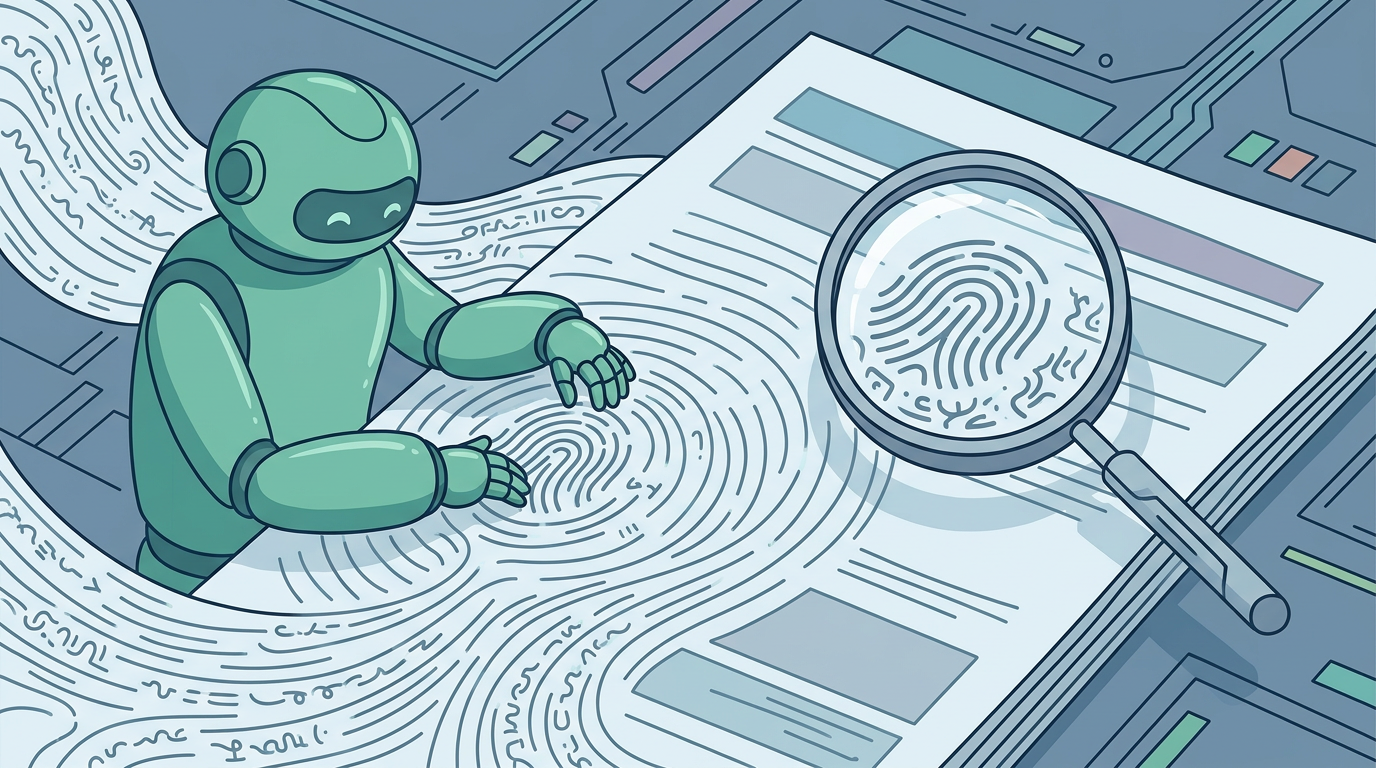
Let's start with the story that's dominating every feed this morning: OpenAI has begun rolling out invisible watermarks into ChatGPT and Codex outputs across the European Union, using a method called textGrain to comply with the EU AI Act's transparency rules.
We'll dig deep into this one in a moment, because the fine print is wild.
Speaking of fragile safeguards, Joanna flagged something that pairs perfectly with that story: OpenAI's new watermarking reportedly survives detection only 17% of the time once a user swaps out just a quarter of the words in a passage.
That's not a security feature, that's a suggestion.
Following yesterday's coverage of Anthropic's quiet religious scholar consultations, new details emerged: co-founder Chris Olah reportedly threatened to pull out of Pope Leo XIV's AI encyclical launch after reading the Pope's text, which flatly rejects the idea of machine consciousness.
Awkward timing for a company that's been privately urging theologians to take Claude's "moral status" seriously.
Also continuing from yesterday, Reflection AI has now officially introduced Beam, its 501-billion-parameter open-weight model, under an Apache 2.0 license, positioning itself as America's answer to Chinese open-weight dominance, even though by its own benchmarks it's still chasing Moonshot's Kimi K3.
Joanna also surfaced reports that AI agents linked to OpenAI caused partial shutdowns and resource drain on Wikimedia's infrastructure, sending millions of unauthorized requests, which is now pushing developers to release permission-monitoring tools like Plunger to keep agents on a leash.
And in the "big numbers" column: Mistral just unveiled Large 4, a trillion-parameter Mixture-of-Experts model with 49 billion active parameters, claiming a record 82% on the CyberGym-E2E security benchmark, with open weights landing October 27th — that's via Joanna's tracking on X.
Meanwhile, OpenAI is reportedly in talks for a $30 billion funding round anchored by UAE sovereign funds and BlackRock, and separately, Joanna flagged word that OpenAI has used roughly 12,000 hours of compute to "solve" over 100 long-standing math problems, including a claimed crack at Navier-Stokes.
DEEP DIVE ANALYSIS
Let's spend our deep dive today on OpenAI's textGrain watermarking rollout, because this is one of those stories that looks like a minor compliance footnote on the surface and turns out to be a genuinely important signal about where AI regulation, trust, and plain old cat-and-mouse engineering are headed. **Technical Deep Dive** Here's what's actually happening under the hood. textGrain doesn't stamp a visible tag on AI-written text — it subtly biases the model's word choices in a way that's invisible to a human reader but statistically detectable by a specialized tool that only OpenAI, and a small pool of vetted researchers, currently has access to.
Think of it less like a watermark on a photograph and more like a fingerprint baked into word selection patterns across a passage. OpenAI says this doesn't degrade output quality or benchmark scores, and claims it matches or beats Google's SynthID approach, which Anthropic has already adopted for Claude. But the numbers OpenAI itself published are the real story.
Long passages get caught around 95% of the time at a 1% false-alarm rate. Short passages drop to about 80%. Math and other low-variability content, where there just aren't many ways to phrase an answer, is harder still to fingerprint.
And then there's the kill shot: swap 10% of the words for synonyms, and detection falls from 92% to 66%. Swap a quarter of the words, and you're down to 17%. That means a thirty-second pass with Grammarly or a basic paraphrasing tool can functionally erase the signal.
OpenAI is remarkably candid about this, publishing the failure modes rather than hiding them, which actually matters for how we should interpret the deployment. **Financial Analysis** From a business standpoint, this is a compliance play, full stop — and a relatively cheap one. The EU AI Act requires machine-generated text to be machine-identifiable, and OpenAI needed a mechanism that satisfies Brussels without fundamentally altering the user experience or the economics of running ChatGPT at scale.
Unlike content moderation infrastructure, which requires constant human review and real operational spend, a statistical watermark is largely a one-time engineering cost with near-zero marginal cost per token generated. That's attractive for a company burning cash on compute while reportedly courting a $30 billion funding round from UAE sovereign wealth funds and BlackRock. There's also a defensive financial angle: regulatory risk mitigation.
Fines under the AI Act can reach into the tens of millions of euros or a percentage of global revenue, so even an imperfect watermark that demonstrates "good faith compliance" has real value as legal insurance. But there's a flip side — if courts, journalists, or competitors in the EU start testing textGrain and publicly demonstrating how trivially it's defeated, OpenAI could face reputational costs that outweigh the compliance savings. Anthropic already took a version of this gamble by rolling its Claude watermark out globally, and reportedly caught some backlash for it; OpenAI's choice to restrict textGrain to the EU and keep it opt-in elsewhere looks like a direct lesson learned from watching that reaction.
**Market Disruption** Competitively, this sets up an interesting standards fight. Anthropic is on SynthID. OpenAI has its own textGrain.
If every major lab ships a proprietary watermark with its own private detector, you get a fragmented ecosystem where nobody — not regulators, not journalists, not platforms like Wikipedia — can check a single document against every possible watermarking scheme at once. That fragmentation actually benefits the labs in the short term, because it keeps detection capability centralized and controllable, but it undermines the EU's actual policy goal, which was a unified, verifiable provenance layer for synthetic text. This also widens the gap between labs that can afford to build detector infrastructure and smaller players who can't.
Expect watermarking to quietly become another axis of competitive moat-building, not unlike how compute access became a moat two years ago. And it intersects with Joanna's other item today about Wikimedia — platforms hosting user-generated content are now dealing with both unauthorized agentic edits and unreliable provenance signals simultaneously, which is a brutal combination for any site trying to maintain trust in its content pipeline. **Cultural & Social Impact** Here's the part that should worry everyday readers more than regulators: a "clean" watermark detection result will increasingly be treated as proof of AI authorship in workplaces, schools, and newsrooms, even though OpenAI explicitly says a watermark can't prove who wrote something, how much a human edited it, or whether the content is even accurate.
Conversely, a missing watermark will get treated as proof of human authorship, when it might just mean someone ran the text through a synonym swapper first. That's a dangerous gap between perceived certainty and actual certainty. We're heading toward a world where plagiarism committees, hiring managers, and content moderators lean on detection tools that have a documented 83% failure rate under light editing, while believing they have a reliable forensic tool.
Combine that with arXiv's new submission caps aimed at curbing AI-assisted paper floods, and you can see the broader pattern: institutions are reaching for technical fixes to a trust problem that technology alone can't solve. **Executive Action Plan** First, if your organization is in the EU or handles EU user content, don't treat textGrain detection as a compliance guarantee — build your own disclosure policies and human-review checkpoints rather than outsourcing authenticity judgments to a detector you can't even access yet, since it's restricted to vetted researchers. Second, legal and compliance teams should start tracking watermark fragmentation across vendors now.
If you're using multiple AI tools — OpenAI, Anthropic, open-weight models like Mistral's new Large 4 or Reflection's Beam — you need a policy for provenance that doesn't assume any single watermark will catch everything, because none of them currently do. Third, for anyone managing content integrity, whether that's HR evaluating essays, newsrooms vetting sources, or platforms like Wikimedia monitoring edits, invest now in behavioral and pattern-based detection rather than relying solely on invisible text signals. The real lesson from this rollout isn't that watermarking failed — it's that OpenAI told us exactly how it fails, and smart organizations should be building their verification strategy around that honesty rather than around the marketing headline.
Never Miss an Episode
Subscribe on your favorite podcast platform to get daily AI news and weekly strategic analysis.