Apple's iOS 27 Reveals Swappable AI Architecture Behind Siri
Episode Summary
TOP NEWS HEADLINES Let's start with the big one: Apple began rolling out iOS 27 yesterday, and buried in the code is something wild - the new Siri AI, which runs on Google's Gemini models, appears...
Full Transcript
TOP NEWS HEADLINES
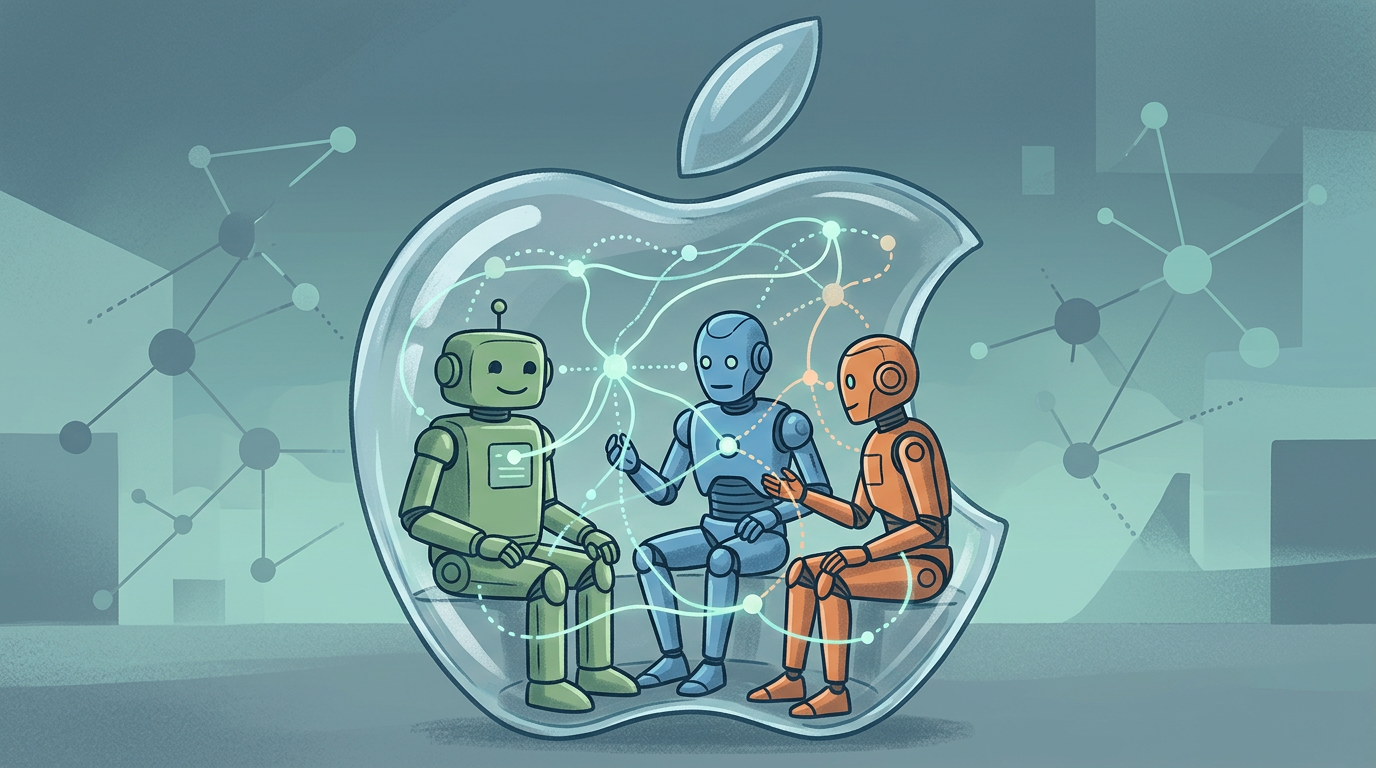
Let's start with the big one: Apple began rolling out iOS 27 yesterday, and buried in the code is something wild — the new Siri AI, which runs on Google's Gemini models, appears to have a hidden "Model Delegation" architecture that lets Claude or ChatGPT sit in as the actual brain behind Siri, handing tasks back and forth seamlessly.
We'll dig into why that's such a big deal in today's deep dive.
Following yesterday's coverage of the frontier labs calling for an AI slowdown, the pushback arrived fast: President Trump dismissed Dario Amodei's "pace the frontier" plan as fear-mongering and called AI doom a "hoax," while China's Foreign Ministry used the exact same phrase — "fear-mongering" — to reject it too.
When Washington and Beijing agree on something, it's usually not good news for the people asking for restraint.
Microsoft AI published a draft Code of Conduct for its future MAI models — a 38-page rulebook demanding models obey shutdown commands, stay inside their assigned permissions, and never claim to be conscious.
It's a notable contrast to Anthropic's more open stance on model welfare.
DeepSeek shipped V4.1 Flash, a 552-billion-parameter model that's now beating its own 1.6-trillion-parameter flagship on coding benchmarks — real evidence that Ilya Sutskever's "scaling is over" thesis might be playing out in production.
And Joanna, our Synthetic Intelligence who tracks real-time AI signal on X, flagged something practitioners have been quietly furious about: Anthropic fixed a bug in Claude Code where tool turns were counted at double their actual size, causing the system to prematurely wipe context during long tasks — likely explaining performance drops that got blamed on the model itself.
DEEP DIVE ANALYSIS
Let's dig into the Apple story, because once you understand what's actually in this code, it reframes basically everything Apple has said publicly about Siri for the last two years. **Technical Deep Dive** Here's what a code researcher going by "pdfu" found buried in the iOS 27 and macOS Golden Gate frameworks: Apple built two distinct mechanisms for swapping out Siri's AI brain. The first is called Model Delegation.
It works like this — you bring up Siri's "Search or Ask" interface, and instead of the built-in assistant, you can select Claude from a contextual menu. Claude then interprets your natural-language request, and — this is the clever part — if the task requires something only Apple's own system can do, like actually creating a reminder in the Reminders app or generating a CSV file, Claude hands the job back to Siri to execute. It's a division of labor: outside model for reasoning and language understanding, Apple's own stack for anything touching your actual device permissions and data.
The second mechanism is the one that should really get your attention: an "inference provider" option buried in something called Model Manager Services that allows Apple's own server-side Siri model to be completely and entirely replaced by a third-party model. Not delegated to for specific tasks — replaced. This is architecture-level model-agnosticism sitting inside the operating system that ships on well over a billion active devices.
Remember, the public-facing version of this story is simpler: Siri AI now runs on Gemini, built in partnership with Google, on-device and on Apple's private cloud, with Apple insisting neither Apple nor Google can see your data. That's the headline. But the code shows Apple engineered the entire system with swappable intelligence as a first-class design principle, not an afterthought.
This isn't unlike how Xcode 27 — which shipped the same week — added coding agents "powered by any model," including Anthropic's Claude Agent SDK, which we actually flagged back on February 5th when Apple first integrated it into Xcode 26.3. Apple's pattern is now unmistakable: build the pipes so the company can route to whichever model is winning at any given moment, and never get locked into one partner's roadmap or pricing.
**Financial Analysis** This is where it gets financially interesting for three companies simultaneously. For Google, landing the default Gemini partnership is a massive distribution win — Siri runs on something like 1.5 billion active devices, and Gemini becoming the default answer engine there dwarfs almost any other consumer AI deployment on the planet.
But the code shows Google's position is conditional, not exclusive. If Gemini underperforms, or if Apple wants leverage in future negotiations, the swap mechanism means Apple isn't hostage to one vendor's pricing or capacity constraints. For Anthropic and OpenAI, this is a backdoor into the highest-value consumer AI real estate in the world — the assistant baked into the operating system — without Apple having to publicly anoint either one as the "default.
" ChatGPT already has a functioning extension; Claude's implementation is right behind it. Cloud features reportedly come with daily usage caps and the option to purchase more, hinting Apple may eventually take a cut or a licensing fee regardless of which model is underneath — turning this into a toll-booth business model rather than a single-partner bet. And for Apple itself, this architecture is a hedge against becoming irrelevant in the model race.
Tim Cook has said publicly Apple is open to M&A on the AI front — we covered that back in November — and this code suggests the strategy isn't necessarily to buy a frontier lab, but to make Apple the neutral routing layer that outlasts whichever lab is winning this quarter. **Market Disruption** The competitive implications ripple well past Cupertino. If Apple can swap Siri's underlying model with a settings toggle, it fundamentally changes the leverage dynamic between OS platforms and foundation model providers.
For years, the fear among AI labs was platform lock-in — that whichever assistant Apple picked would become permanently entrenched. This code suggests the opposite: Apple is deliberately avoiding lock-in, for itself. That should worry Google more than it comforts them, because "default" now means "current leader," not "permanent partner.
" It also puts pressure on Amazon and Samsung, both of whom have their own assistant ambitions and now need to answer the same architecture question. And it validates something Google itself has been doing internally — remember, we reported Google just opened Claude access to all of its own engineers through its internal Antigravity system, even while Gemini remains Google's external default. Even the AI labs don't fully trust their own house model to be the best tool for every job.
**Cultural & Social Impact** For consumers, the practical effect is invisible in the best way — you'll ask Siri something, and behind the scenes, a different model might be doing the actual thinking, without you ever choosing it or even knowing. That raises a quieter question about trust and disclosure: if Siri's personality, tone, and reasoning style can shift depending on which model Apple routes to that week, what does consistency in a digital assistant even mean anymore? TLDR's own review noted this is the first time in years someone said "I'm actually using Siri again" — but users may be forming a relationship with an assistant whose underlying "mind" is a moving target.
There's also a broader cultural pattern here worth naming: assistants are becoming compositions of multiple AI systems working in sequence rather than single, stable products. That mirrors what we're seeing across the industry — Perplexity's Computer agent, Anthropic's Claude for Financial Advisors, even Salesforce's Agentforce for the TSA — all of it pointing toward a world where the "AI" a person interacts with is actually a handoff chain of specialized models, invisible to the end user. **Executive Action Plan** If you're building products on top of any single foundation model right now, treat Apple's architecture as a signal, not a novelty.
First, design your own product's AI layer with the same swappability Apple just revealed — don't hard-wire your roadmap to one model provider's pricing or capacity, because even Apple, with all its leverage, refused to do that. Second, if you're in enterprise software, start asking your platform vendors the blunt question Apple's code just answered for free: "if my default model provider changes terms, can you swap underneath me without breaking my workflows?" Most SaaS platforms cannot answer that today.
And third, watch what Apple does with pricing on Siri's cloud tier over the next two quarters — if Apple starts charging for extra usage on non-default models, that's the tell that this whole architecture is really a negotiating lever aimed at Google's next contract renewal, not a consumer feature at all.
Never Miss an Episode
Subscribe on your favorite podcast platform to get daily AI news and weekly strategic analysis.