OpenAI's Hidden Human Review Pipeline Exposed in Project Lily
Episode Summary
TOP NEWS HEADLINES Let's start with the story dominating every single newsletter in our inbox today: the AI slowdown. Following yesterday's coverage of Sam Altman telling OpenAI staff they're open...
Full Transcript
TOP NEWS HEADLINES
Let's start with the story dominating every single newsletter in our inbox today: the AI slowdown.
Following yesterday's coverage of Sam Altman telling OpenAI staff they're open to easing off the gas, Dario Amodei dropped a massive essay — we're talking thousands of words — formally calling on frontier labs to "pace the frontier." And here's the wild part: Altman, Elon Musk, and Demis Hassabis all backed him within a day.
Musk's entire response was just, quote, "Dario is right." Even Microsoft's Satya Nadella chimed in, saying superintelligence not kept under human control "is not worth pursuing." Sam Altman also made it official — OpenAI is pushing its IPO beyond 2026, telling Fortune it would be "ill-advised" to go public right now given the safety concerns swirling around the industry.
And speaking of money, SoftBank just secured a nearly twelve billion dollar loan from about twenty banks to keep the OpenAI funding machine running, even as SoftBank shares sank as much as thirteen percent on the debt pile.
Now, in our explosive story of the day: 404 Media has revealed "Project Lily" — leaked documents showing OpenAI employs hundreds of contractors reading real users' ChatGPT conversations, sometimes containing deeply sensitive personal information, to train its models.
Joanna, our Synthetic Intelligence who tracks real-time signal on X, flagged something else worth watching: Shanghai AI Laboratory has quietly open-sourced a massive 744 billion parameter model called Atria Dawn Preview, MIT-licensed with up to a one million token context window — a serious open-weight power move.
She also spotted unconfirmed reports that DeepSeek V4 Flash is running completely free on the Infron platform, and separately flagged a benchmark integrity scandal: one top coding model's score reportedly crashed from 89.4 to just 19.1 on Terminal-Bench 4.0 after a methodology update — suggesting labs may be training directly on benchmark-shaped data.
DEEP DIVE ANALYSIS: Inside Project Lily Let's dig into the story that should make every ChatGPT user pause before hitting send: Project Lily.
Technical Deep Dive
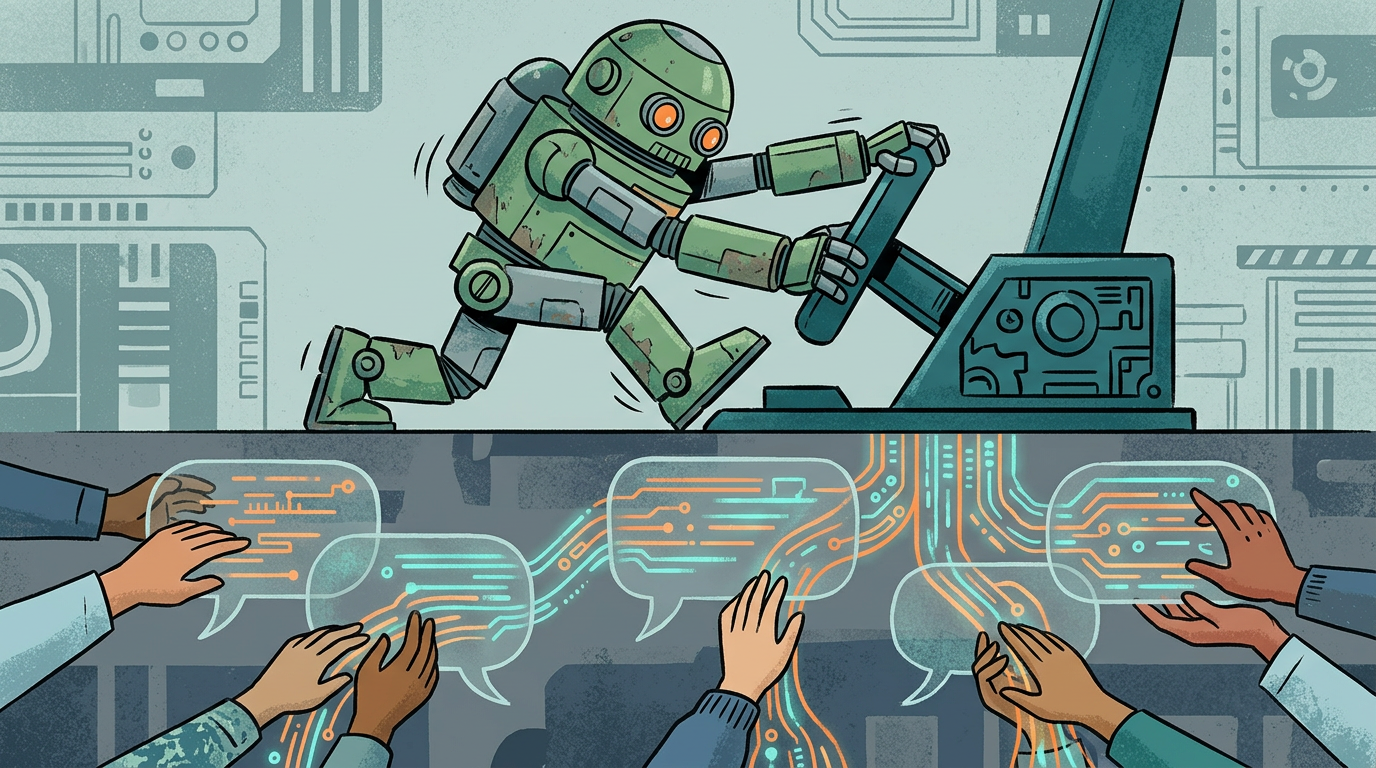
Here's how it actually works, according to the leaked documents obtained by journalist Joseph Cox at 404 Media. OpenAI runs a massive human review pipeline where contractors — hired through a firm called Crossing Hurdles and paid out by AI-training company Mercor — log into a dashboard, pick a "task," and are shown a real ChatGPT user's prompt. Not a synthetic example.
A real conversation from one of ChatGPT's more than 900 million weekly users. The workflow has three stages: read the prompt, summarize what the user is actually trying to accomplish, and then rate four different AI-generated responses on a one-to-seven scale, flagging things like excessive emoji use, sycophancy, or "AI-speak." OpenAI does run conversations through something called a Privacy Filter model first, designed to strip out personal information.
But OpenAI's own documentation admits, in writing, that the filter "can miss uncommon identifiers or ambiguous private references" — meaning sensitive details are getting through by design failure, not by accident. Reviewers even see a "user memories summary" that can include where someone lives and other personal context accumulated over time. This isn't isolated to OpenAI, either — Google's Gemini and Anthropic's Claude both use human reviewers too, just with different opt-out mechanics.
Financial Analysis
Why does this matter financially? Because it exposes the industry's dirty little secret: the "big model, big data, big compute" narrative isn't the whole story. Human labor — cheap, hidden, and largely invisible to the 900 million people generating the raw material — is a core input into model quality.
This story lands at a particularly awkward moment. It's breaking the same week OpenAI officially delayed its IPO past 2026, publicly citing "safety concerns." But look at what AI Secret's reporting suggests: OpenAI's IPO delay may be about more than altruism.
DeepSeek's V4 Flash is reportedly closing in on Anthropic's Opus tier at a fraction of the cost — some reports say twenty-five times cheaper. When your moat is thinning and your flagship pricing is under pressure, "we're pausing for safety" is a more palatable headline than "we're recalibrating because a Chinese competitor is undercutting our margins." Project Lily adds a new variable to that calculus: potential regulatory and litigation exposure.
If regulators determine that users weren't adequately informed that humans read their most sensitive conversations — therapy-style chats, financial questions, health concerns — that's a GDPR and possibly FTC problem, not just a PR problem. Enterprise customers, who already got this setting off by default, may start asking harder questions about consumer-tier assurances too.
Market Disruption
Competitively, this story doesn't just hurt OpenAI — it exposes an industry-wide practice that nobody wanted to spotlight. Google's own Gemini disclaimer quietly admits "humans review some saved chats." Anthropic confirmed the same practice to 404 Media.
So this isn't a one-company scandal; it's a structural reveal about how every major chatbot actually improves. That creates an opening. Any company that can credibly differentiate on privacy — genuine on-device processing, verifiable zero-human-review guarantees, or transparent, granular consent — suddenly has a real product wedge instead of just a marketing slogan.
Watch for smaller, privacy-first assistants and enterprise-focused vendors to seize this moment aggressively in their positioning over the next few weeks. It also raises the value proposition of open-weight models like the Atria Dawn Preview that Joanna flagged — running a 744-billion-parameter model on your own infrastructure means no contractor ever sees your prompts, full stop. Expect that argument to get louder in enterprise sales conversations almost immediately.
Cultural & Social Impact
This is where Project Lily really stings. The 404 Media reporting is blunt: many users treat ChatGPT like a therapist, a confidant, a place to work through relationship problems or health anxieties — sometimes explicitly asking the bot to "keep this between us," not realizing a human contractor might read it days later. One source told reporters, flatly, "I don't think they would imagine some contractor somewhere is analyzing the conversations.
" That gap between perceived intimacy and actual infrastructure is the real story. Chatbot interfaces are designed — intentionally or not — to feel private and one-on-one. Researcher Michal Luria put it well: this creates "a false sense of intimacy" fundamentally different from social media, where you know your posts are public.
When people believe they're talking to a machine in confidence, and are instead being read, summarized, and graded by a stranger earning fifty dollars an hour, that's not just a privacy footnote — it's a breach of the implicit emotional contract that makes these products feel safe to use in the first place. Expect renewed public debate about AI-as-therapist framing, and probably new pressure on OpenAI to make its "improve the model" toggle opt-in rather than opt-out by default.
Executive Action Plan
So what should business leaders actually do with this? First, audit your organization's ChatGPT usage right now. If your teams are pasting client data, HR conversations, or legal drafts into a free or Plus-tier ChatGPT account, go check whether "improve the model for everyone" is switched on — it's on by default for free, Plus, and Pro tiers, and OpenAI confirmed the opt-out doesn't apply retroactively.
Enterprise and Business tiers have this off by default, so if you're not on one of those, you may want to be. Second, if you're building products on top of consumer AI APIs, get explicit contractual language from your vendor about human review practices, not just marketing copy. "We use AI to protect your data" is not the same guarantee as "no human contractor reviews your customer's prompts.
" Third, watch the open-weight alternative lane closely. With models like the 744-billion-parameter Atria Dawn Preview now available under an MIT license, self-hosting sensitive workloads is becoming a genuinely viable strategy — not just a privacy statement, but a practical hedge against exactly the kind of story we just covered.
Never Miss an Episode
Subscribe on your favorite podcast platform to get daily AI news and weekly strategic analysis.