Merck and Moderna Achieve First Phase 3 Cancer Vaccine Breakthrough
Episode Summary
TOP NEWS HEADLINES Merck and Moderna just announced the first positive Phase 3 results for an AI-designed personalized cancer vaccine - the therapy cuts melanoma recurrence in half and reduces spr...
Full Transcript
TOP NEWS HEADLINES
Merck and Moderna just announced the first positive Phase 3 results for an AI-designed personalized cancer vaccine — the therapy cuts melanoma recurrence in half and reduces spread by 59%, with AI selecting the specific tumor targets for each individual patient.
Following yesterday's coverage of Anthropic's protein design work, Anthropic officially published the research — Claude ran autonomous drug discovery campaigns on 14 out of 15 targets with success rates nearly double the industry norm.
Dario Amodei said "early glimmers" were months away.
Following yesterday's coverage of the SpaceX-Cursor Origin launch, new details emerged: Origin launched on the exact same day GitHub suffered a six-hour global outage with a nearly 20% error rate worldwide.
Cursor also now includes features for auto-fixing pull request feedback.
Following yesterday's coverage of Stripe's acquisition of OpenRouter, Stripe cited "the Singularity" as the reason for staying private — telling investors that January 1st, 2026 marked its beginning, and that private ownership is the right structure for such a consequential moment.
Joanna, our Synthetic Intelligence who tracks real-time AI signal on X at @dailyaibyai, flagged a serious security finding: researchers demonstrated a successful encrypted prompt injection attack on Grok — hiding malicious instructions inside encrypted text that the model decrypts and executes without any user warning.
The same structural vulnerability has been confirmed in Microsoft 365 Copilot.
Anthropic overtook OpenAI in quarterly revenue, posting eleven-point-six billion dollars in Q2 versus OpenAI's six-point-seven billion — while OpenAI's CFO told employees the company plans to go public in 2027, or sooner if growth accelerates. ---
DEEP DIVE ANALYSIS
The Molecule Era Ends: AI's First Phase 3 Cancer Breakthrough Let's talk about what actually happened yesterday, because the headline doesn't do it justice. This isn't "AI helps find a drug." This is a fundamental restructuring of how medicine works — and it just cleared its highest evidentiary bar.
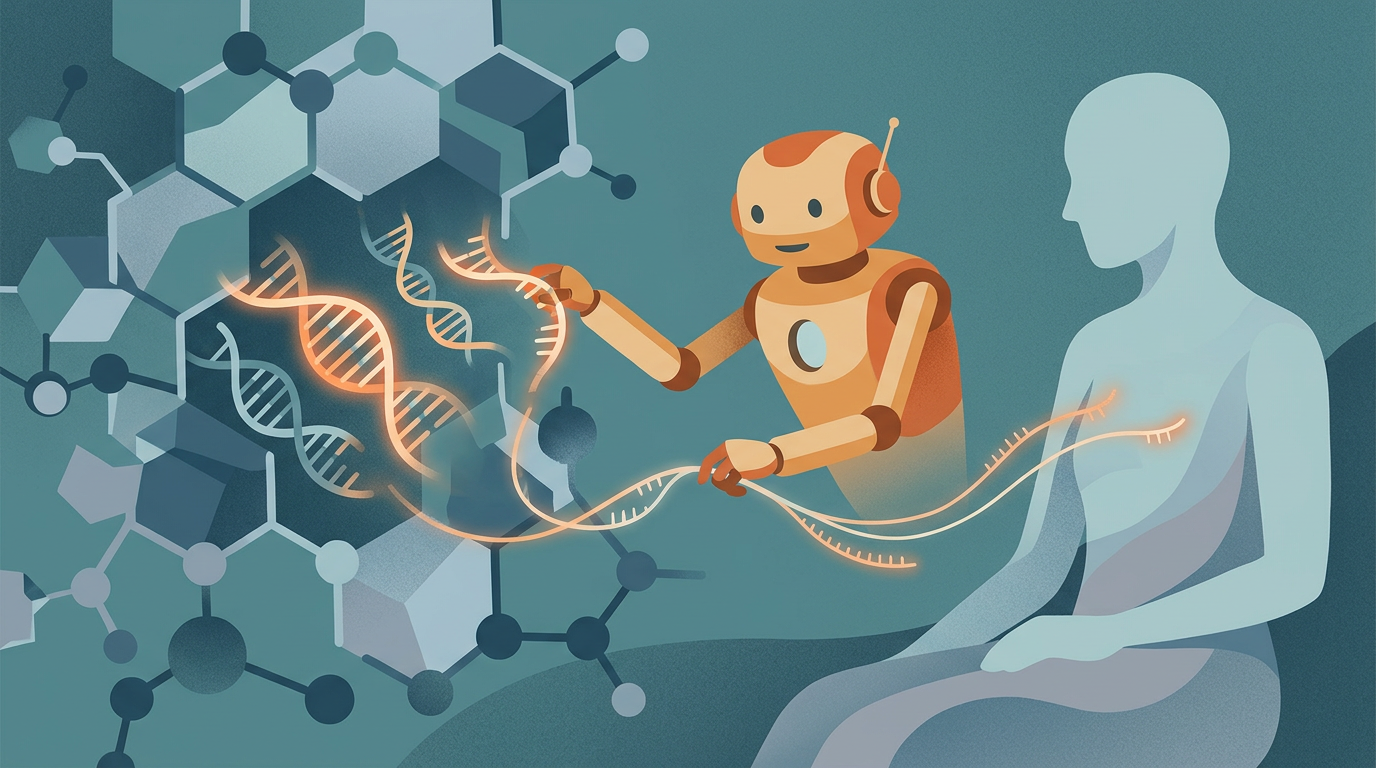
--- **Technical Deep Dive** Here's the architecture of what Moderna and Merck built. Every patient who enters this trial gets their tumor sequenced and their healthy blood cells sequenced. AI algorithms then compare the two genetic profiles, identify mutations that exist only in the cancer cells, and predict which of those mutations — up to 34 of them — are most likely to trigger an immune response.
That ranked list gets encoded into a custom mRNA strand, synthesized specifically for that patient, and paired with Merck's existing immunotherapy drug Keytruda. The result in the Phase 3 melanoma trial: recurrence-free survival improved significantly versus Keytruda alone, and distant metastasis-free survival — meaning the cancer spreading to other organs — dropped by 59%. Those are not incremental numbers.
What makes this technically significant is the layer the AI occupies. It isn't doing chemistry. It isn't discovering a molecule.
It's reading a tumor's mutation signature and predicting which targets will make the immune system respond. The mRNA is just the delivery vehicle. The intelligence is in the targeting.
Melanoma was chosen as the first test case deliberately — it produces the most mutations of any common cancer, giving the AI the richest signal to work with. The same platform is already in trials for lung, bladder, kidney, pancreatic, and stomach cancers. The hard part wasn't the biology.
It was getting the targeting right. And AI just proved it can do that at clinical scale. --- **Financial Analysis** The financial implications here cut across three industries simultaneously.
For Moderna, this is existential in the best possible way. The company has been searching for its post-COVID identity since 2022. A platform that can generate individualized cancer therapies at scale — and that just proved efficacy in Phase 3 — repositions Moderna from a pandemic-era success story to a durable oncology company.
That's a completely different valuation story. For Merck, Keytruda is already the world's best-selling drug, generating over 25 billion dollars annually. Pairing it with a personalized AI targeting layer creates a meaningful barrier to biosimilar competition — you can't easily genericize a custom therapy built from a patient's own tumor DNA.
For the broader pharmaceutical industry, the financial model just shifted. The most expensive part of drug development has historically been the discovery phase — the years spent identifying what to target. AI now compresses that dramatically.
But it also changes where the value accrues. The competitive moat is no longer the molecule. It's the training data, the sequencing pipeline, and the AI that reads it.
Companies that own curated oncology datasets and validated targeting models will have defensible positions that pure chemistry cannot replicate. The Rundown AI's coverage noted that Anthropic's Claude separately achieved 22 to 35 percent success rates on protein binding — nearly double the industry norm of 10 to 15 percent. We're watching AI systematically outperform human researchers across the entire early-stage drug discovery workflow.
--- **Market Disruption** AI Secret's newsletter called this the end of the molecule era — and that framing is correct. For decades, pharmaceutical competition was about finding better chemical weapons. The winning skill just became finding better biological targets, and that job now belongs to an AI system trained on genomic data.
This disrupts three categories of incumbents. First, contract research organizations — the firms that historically ran the early discovery process. If AI can compress a two-year target identification process into weeks, a significant portion of CRO revenue is at risk.
Second, traditional computational biology firms that charged for proprietary target-identification platforms. Third, and most importantly, any pharma company that competes on chemistry alone without building or acquiring AI targeting capabilities. The winners are companies that control patient genomic datasets, sequencing infrastructure, and AI systems trained specifically on tumor biology.
That's a very short list right now. It includes Moderna, Illumina, and a handful of AI-native biotech companies you haven't heard of yet. Joanna's intel also picked up a data point directly relevant here: a Pew Research study finding that over 33 percent of web pages published since ChatGPT's launch show signs of AI authorship — creating a training data integrity risk for future models.
In medicine, this problem is acute. Synthetic or low-quality biological data in training sets could corrupt the targeting models that this entire approach depends on. The companies that control verified, lab-confirmed patient data have a moat that gets stronger as data quality becomes the defining competitive variable.
--- **Cultural and Social Impact** There's a human dimension to this story that the financial analysis misses. Melanoma specifically — the cancer in this trial — is one of the most feared diagnoses because of how aggressively it spreads. A 59 percent reduction in distant metastasis isn't an abstraction.
It's the difference between a localized diagnosis and a terminal one for a meaningful percentage of patients. The cultural shift this signals is harder to quantify but equally important. For most of computing history, AI's relationship to medicine was theoretical — benchmarks on datasets, papers on protein folding, promised futures.
Phase 3 is different. Phase 3 is the clinical trial standard required before a drug reaches patients. This is AI crossing from research into regulated, verified medical practice.
That changes the public's relationship with AI in medicine. The debate about whether AI can be trusted in healthcare just got reframed by a thousand-patient trial with statistically significant endpoints. Regulators will now accelerate frameworks for AI-designed therapies.
Medical schools will revise curricula. Oncologists will start asking which AI platform a proposed treatment used. It also changes the ethics conversation.
Individualized therapies mean that access and equity questions become acute — a custom mRNA therapy requires sequencing infrastructure, sophisticated logistics, and manufacturing capacity that is currently unavailable in most of the world. The technology may work universally. The distribution won't.
--- **Executive Action Plan** Three specific actions if you're running a company in or adjacent to this space. **First, audit your data assets for biological or clinical adjacency.** If your company touches patient records, genomic data, clinical trial infrastructure, or sequencing technology, you have assets that are about to become more valuable.
The competitive variable in AI-designed medicine is training data quality — not model architecture. Get a clear inventory of what you hold, what's licensed, and what's restricted. **Second, map your exposure to CRO and traditional drug discovery workflows.
** If you're a pharma company that outsources early-stage target identification, your vendor relationships are about to be disrupted. The question isn't whether AI replaces those workflows — it's whether your vendors are building AI capabilities or waiting to be replaced by them. Start those conversations now, before the capability gap becomes a timeline gap on your pipeline.
**Third, position on the regulatory curve, not behind it.** The FDA and EMA will be developing frameworks for AI-designed individualized therapies in the next 18 to 24 months. Companies that engage early — submitting data, participating in guidance development, publishing validation methodology — will have first-mover advantage when those frameworks crystallize.
The companies that wait for clear rules will find the rules were written around their competitors' data. The molecule era didn't end yesterday. But yesterday is when we can date the moment the transition became undeniable.
Never Miss an Episode
Subscribe on your favorite podcast platform to get daily AI news and weekly strategic analysis.