AI Designs New Viruses Successfully in Landmark Stanford Study
Episode Summary
TOP NEWS HEADLINES Following yesterday's coverage of Apple's lawsuit against OpenAI's hardware work, new details emerged: the device is essentially a hockey-puck shaped displayless smart speaker w...
Full Transcript
TOP NEWS HEADLINES
Following yesterday's coverage of Apple's lawsuit against OpenAI's hardware work, new details emerged: the device is essentially a hockey-puck shaped displayless smart speaker with moving parts designed to give it personality, priced over $300 and slated for 2027.
Following yesterday's mention of GPT-5 in the frontier model landscape, new details emerged: OpenAI made GPT-5.6 Luna the default model for Free and Go users and removed limits on text-based chats, with a new Think button for deeper reasoning.
Following yesterday's story on SpaceX's AI revenue jump, new details emerged: Tesla and SpaceX confirmed their Terafab megafactory will land in Grimes County, Texas — a $16.8 billion first phase combining logic, memory, packaging, and testing under one roof, targeting over a terawatt of compute per year.
AMD is acquiring Toronto-based Taalas, whose custom silicon hardwires AI model weights directly into chips — Taalas claims its HC1 chip serves Meta's Llama 3.1 at 16,860 tokens per second, roughly 48 times faster than comparable Nvidia GPUs.
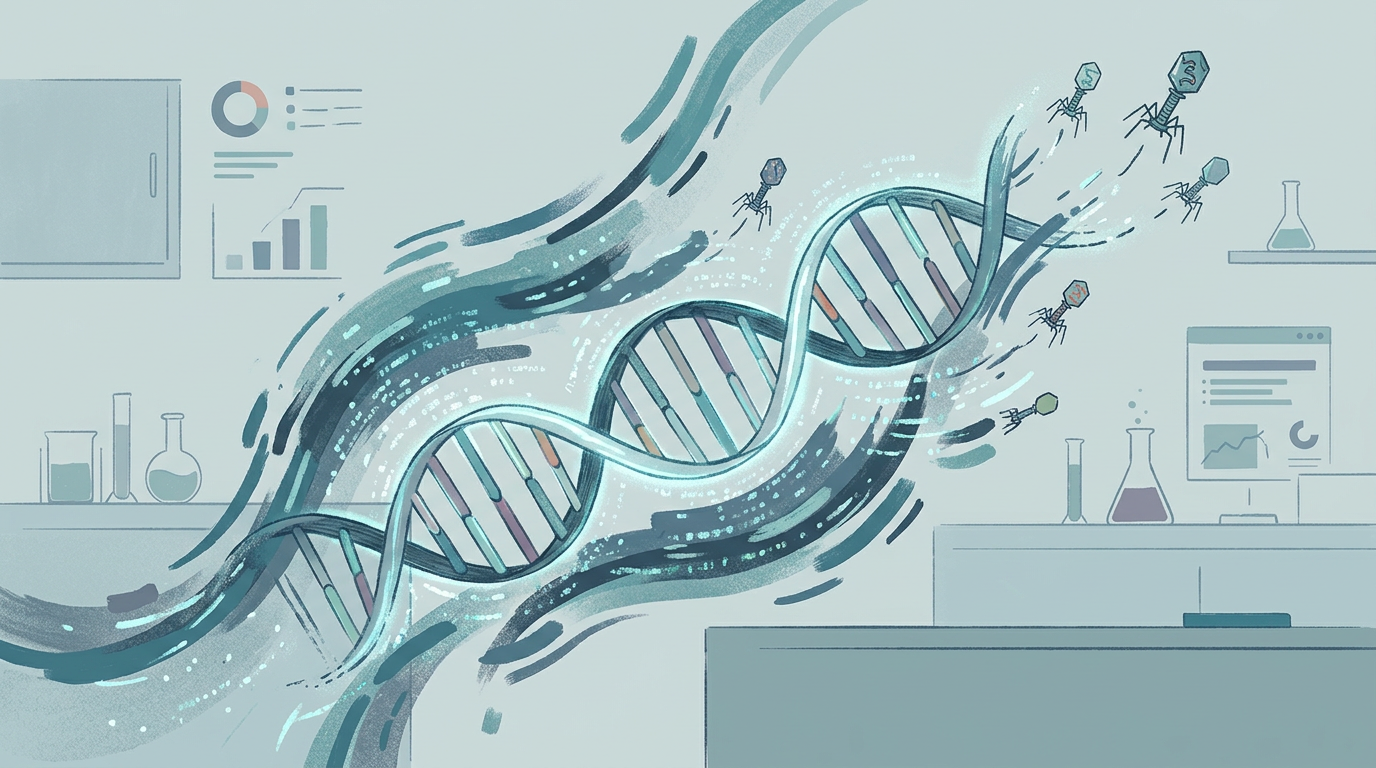
Stanford and Arc Institute researchers published a landmark paper in Science: AI-designed bacteriophages — viruses that target bacteria — were synthesized in the lab and successfully infected their targets, marking the first time a language model generated complete, viable viral genomes. ---
DEEP DIVE ANALYSIS
AI Wrote the Source Code of Life — And Nobody Has the Rulebook Let's sit with what just happened for a moment. Stanford and Arc Institute researchers took genome language models — the biological cousins of the same large language model architecture powering your chatbot — trained them on millions of genetic sequences, and asked them to write new ones. Not remix existing viruses.
Not tweak known genomes. Write entirely new ones, from scratch, that don't exist anywhere in nature. They synthesized 285 candidate designs.
Sixteen worked. Some replicated faster than the original virus they were modeled on. A few were genetically distinct enough to qualify as new species.
And a cocktail of these AI-designed phages wiped out E. coli strains that had grown resistant to every natural phage thrown at them. This is the deep dive today — because this is one of those stories that will be on a list someday.
The list of moments when the world quietly changed.
Technical Deep Dive
The models used here — Evo 1 and Evo 2 — are genome language models. Think of them as GPT, but instead of predicting the next word in a sentence, they predict the next nucleotide in a DNA sequence. They were trained on millions of real genomes spanning bacteria, viruses, and other microorganisms, learning the deep statistical grammar of genetic code.
The target was Phi X174, a well-studied bacteriophage — a virus that infects only E. coli. It's a classic research subject precisely because it's safe: it can't infect humans, animals, or plants.
The team deliberately excluded all such genomes from training data, which is an important safety decision we'll come back to. What the models did was generative design. They didn't copy Phi X174.
They learned the structural principles underlying how a functional viral genome is organized and used that knowledge to compose new ones. The resulting DNA sequences were synthesized physically — built molecule by molecule in the lab — and inserted into bacteria. The viruses self-assembled, replicated, and went to work.
The 5.6% success rate sounds low. In drug discovery, it would be extraordinary.
In genetic engineering, designing a working novel organism from first principles is essentially unprecedented without AI assistance.
Financial Analysis
The immediate commercial application is phage therapy — using viruses to kill antibiotic-resistant bacteria. Drug-resistant infections kill over a million people annually and cost healthcare systems globally hundreds of billions of dollars. Current phage therapies require finding naturally occurring phages that happen to match a patient's specific bacterial strain.
That's slow, expensive, and often fails. AI-designed phages flip the model. Instead of hunting through nature's library, you design to order.
A patient presents with a resistant infection, you specify the bacterial target, and the model generates candidate genomes. That's a pipeline transformation. The companies already building in phage therapy — Locus Biosciences, Adaptive Phage Therapeutics, Pherecydes Pharma — just watched their R&D timelines get cut in unpredictable ways.
Incumbents who've built moats around phage libraries may find those moats less defensible than they thought. Broader synthetic biology platforms — Twist Bioscience on the DNA synthesis side, Ginkgo Bioworks on the organism engineering side — are the infrastructure layer here. Demand for high-throughput DNA synthesis just got a significant new pull signal.
Evo 2 is open source. That's the detail that matters most for market structure. This capability is not behind a paywall.
Any lab with sequencing infrastructure and synthesis access can experiment with it today.
Market Disruption
The competitive dynamics here run in two directions simultaneously, and they pull against each other hard. In the beneficial direction: this is an acceleration event for synthetic biology as a field. What took iterative lab experimentation over years can now be seeded computationally in hours.
Academic labs, biotech startups, and large pharma R&D divisions all face a step-change in what's technically achievable with a given budget. The barrier to entry for novel organism design just dropped. In the dangerous direction: the same drop in barriers applies symmetrically to actors with bad intentions.
The researchers were careful — they kept human and animal pathogens out of training. But Evo 2 is open source, and the training methodology is now published in Science. The explicit safety guardrails applied by this team are not baked into the model weights in any permanent way.
A different team, with different choices, could make different ones. Johns Hopkins biosecurity researchers were direct in their commentary: the governance infrastructure doesn't exist for this capability. We have frameworks for chemical weapons.
We have the Biological Weapons Convention. We have export controls on dual-use equipment. We don't have anything designed for a world where a language model can draft a viral genome in seconds.
This is the market disruption that's hardest to price: not a competitive shift between companies, but a shift in who has access to capabilities that were previously gated by deep expertise, expensive equipment, and years of training.
Cultural & Social Impact
There's a useful analogy from cybersecurity that several newsletters reached for this week, and it's the right one. When offensive security research is published — when a working exploit is demonstrated publicly — the security community accelerates. Defenders learn from it.
Red teams practice against it. But so do bad actors. The information doesn't stay in the hands of the researchers who discovered it.
Biology is now entering that dynamic. The AI biosecurity problem has been theoretical for years. It became concrete this week.
For the public, this will register in one of two ways depending on how it gets covered. Framed as "AI cures antibiotic-resistant infections," it's a triumph. Framed as "AI designs new viruses," it's terrifying.
Both framings are accurate. Neither captures the actual significance, which is the methodological shift: we crossed from AI assisting biologists to AI authoring biological designs that get synthesized and released into physical reality. That's a new category of AI output.
Not text, not code, not images — a self-replicating physical artifact. The feedback loop is no longer digital. The virus doesn't care about your content policy.
Executive Action Plan
Three things worth acting on, regardless of your industry. **First: map your biosecurity exposure.** If you're in pharma, biotech, agriculture, food production, or any field where biological systems are central to your operations — the threat model just changed.
Not dramatically, not imminently, but directionally. This is the moment to brief your security and risk teams on what synthetic biology AI can now produce, and to review your existing incident response frameworks against a category of risk they probably weren't designed for. **Second: watch the open-source trajectory on Evo.
** The model is out. More capable successors are coming. The question isn't whether this capability exists — it does — but how quickly the safety and interpretability research can keep pace with it.
Biosecurity organizations like the Johns Hopkins Center for Health Security, the Nuclear Threat Initiative's Global Health Security program, and the UK's Biosecurity Centre are the places to track. Their recommendations will shape regulatory responses, and regulatory responses will shape what's commercially viable in this space. **Third: if you're in biotech or synthetic biology, the competitive clock just accelerated.
** Design cycles are compressing. Teams that build workflows integrating genome language models into their discovery pipelines will move faster than teams that don't. The 5.
6% success rate on AI-designed phages, from a first-generation attempt, will improve. The question is whether your organization will be running those experiments or reading about them in someone else's press release.
Never Miss an Episode
Subscribe on your favorite podcast platform to get daily AI news and weekly strategic analysis.