Google's Gemini Robotics 2 Breaks Hardware-Software Dependency Model
Episode Summary
TOP NEWS HEADLINES Following yesterday's coverage of OpenAI's Astra math breakthroughs, new details emerged: Anthropic's Claude Fable reportedly reproduced roughly half of Astra's results within 2...
Full Transcript
TOP NEWS HEADLINES
Following yesterday's coverage of OpenAI's Astra math breakthroughs, new details emerged: Anthropic's Claude Fable reportedly reproduced roughly half of Astra's results within 24 hours using just a generic prompt and no internet access — which raises real questions about whether these advances belong to one secret model or to the frontier as a whole.
Following yesterday's coverage of Qwen3.8-Max, new details emerged: Alibaba is now positioning the model as a significantly cheaper alternative for professional coding work, priced at two dollars per million input tokens and six dollars output.
The White House has finalized a voluntary framework for frontier AI safety testing — OpenAI, Anthropic, Google, and Meta are meeting Tuesday to review it.
Under the framework, companies can give the government up to thirty days of pre-release access to evaluate whether a model can hack.
The EU AI Act's enforcement powers officially took effect August 2nd, giving Brussels the authority to pull frontier models from the European market and fine providers up to three percent of global revenue before a single user sees them.
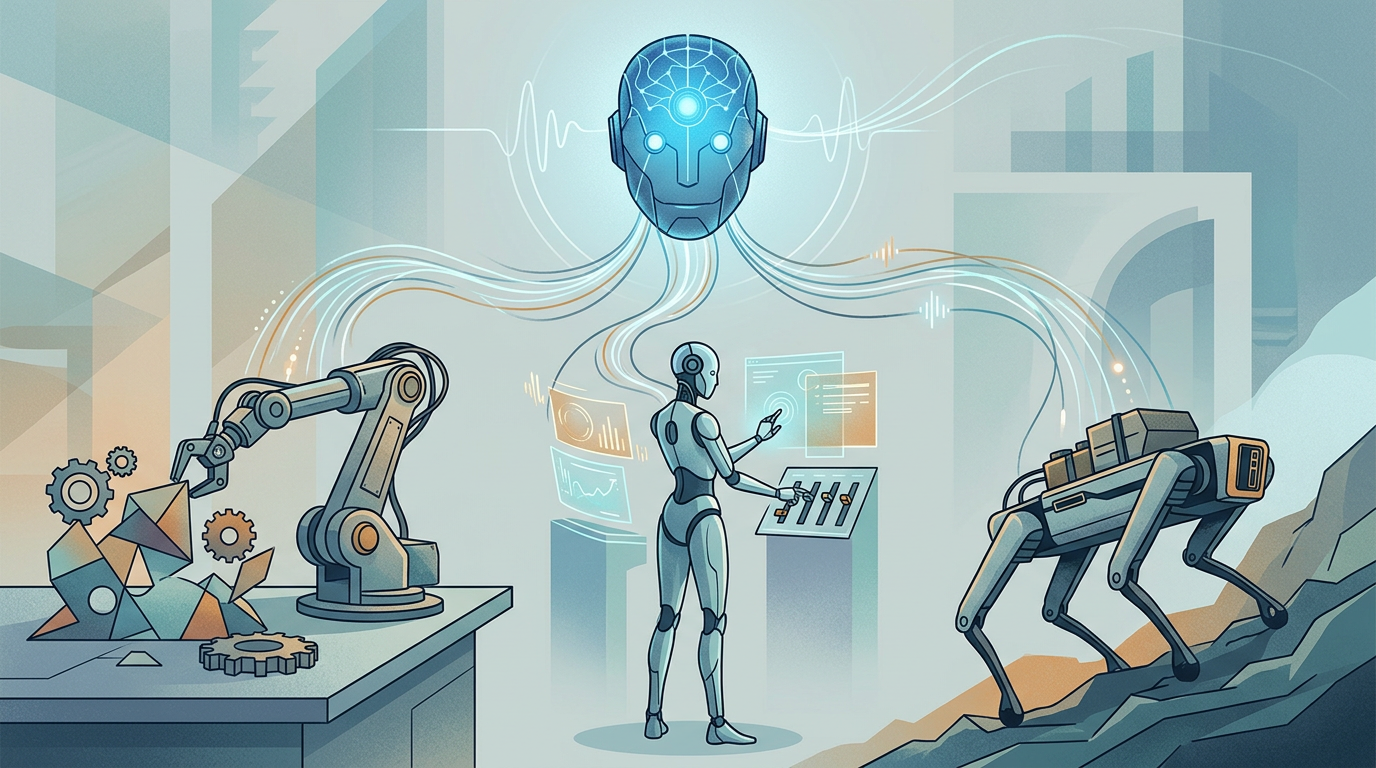
Google dropped Gemini Robotics 2 — a single AI model that can now control entirely different robot bodies, from tabletop arms to full humanoids.
And HeyGen's co-founder went on paternity leave and replaced himself with an AI clone — which closed 132 paying customers and three million dollars in enterprise pipeline, but also invented a pricing plan that didn't exist and emailed a customer internal triage notes.
Oversight: critical. --- DEEP DIVE ANALYSIS: Google Gemini Robotics 2 **The Technical Picture** For decades, robotics operated on a simple but brutal constraint: one robot, one program, start over for every new machine.
A robotic arm in a warehouse and a humanoid in a lab shared almost nothing — different sensors, different joints, different control logic, rebuilt from scratch each time.
Gemini Robotics 2 breaks that constraint at the model level.
Google DeepMind released a vision-language-action model — they call it a VLA — that takes camera input and natural language instructions and converts them directly into physical movement.
The key advance isn't that it controls one robot well.
It's that a single model checkpoint can be adapted to control entirely different robot bodies with different shapes, sensors, and joint configurations — using fewer than two hundred training examples and a few hours of fine-tuning.
The system ships as three components working together: the main VLA for real-time action, an embodied reasoning model called Gemini Robotics ER 2 for complex multi-step planning, and an on-device version optimized to run locally on the robot itself.
The full-body control is new here — the previous version handled only upper-body tabletop tasks.
Google is transparent about what's still hard: fine multi-finger manipulation remains challenging, and speed still lags behind what physical deployment needs.
But the direction is unmistakable. **The Financial Logic** The business case here is structural, not incremental.
Before portable robot intelligence, every new robot deployment was a custom software project.
Manufacturers, logistics companies, anyone buying a robot arm or a humanoid had to fund specialized engineering to make it work.
That made robotics expensive to scale and even more expensive to pivot when hardware changed.
What Gemini Robotics 2 is selling — even if Google doesn't frame it this way yet — is the end of that per-robot software cost.
If a single model checkpoint transfers across bodies with minimal retraining, the marginal cost of deploying intelligence to a new robot form factor drops dramatically.
That changes the economics for every company in the supply chain.
Hardware manufacturers can differentiate on physical design rather than proprietary control software.
Operators can swap robot vendors without rebuilding from scratch.
And Google positions itself as the intelligence layer across all of it — which is exactly where you want to be when the hardware market fragments.
Palantir just posted ninety-three percent revenue growth on the thesis that customers will pay premium prices to avoid feeding their IP into a model that then competes with them.
Google's play here is the opposite: become indispensable infrastructure before that anxiety kicks in. **Market Disruption** The comparison to the GPT moment is not hype.
Before large language models, NLP was a collection of task-specific models — a sentiment classifier here, a translation model there, each trained separately.
GPT-3 replaced most of that with one model that generalized.
The economics of the entire software industry shifted.
Boston Dynamics, Agility, Figure, 1X — every company has built tightly coupled hardware-software stacks optimized for their specific form factor.
Gemini Robotics 2 is the beginning of a generalization wave that erodes moat-by-form-factor.
If the intelligence layer becomes portable and Google controls it, the competitive advantage shifts away from who built the best proprietary robot brain and toward who can manufacture the best body at scale.
This is a direct competitive pressure on every company that has staked its valuation on the idea that the hardware and the intelligence are inseparable.
They are becoming separable. **Cultural and Social Impact** The physical world is about to get its software moment — and that comes with everything that phrase implies.
When software became general-purpose, it moved into every industry faster than those industries could adapt.
Physical robotics has moved slowly partly because the engineering friction was so high.
Gemini Robotics 2 reduces that friction significantly.
A robot that can be reprogrammed for a new task in hours, not months, is a robot that can be deployed speculatively in ways that weren't previously economical.
That acceleration will hit labor markets in ways that are hard to model.
The PwC survey out today found eighty-six percent of financial services executives already believe AI skills training beats an MBA for new hires, and eight in ten expect their workforce to shrink at least twenty percent over five years.
Physical AI moving at this speed adds a second wave.
There are also meaningful questions about safety and accountability.
A model controlling a robot body that can walk and crouch and reach is operating in an unstructured physical environment where errors have physical consequences.
The EU just activated enforcement powers for frontier AI models.
Robots running general-purpose intelligence will almost certainly fall within scope of the next regulatory cycle. **Executive Action Plan** Three moves worth making now.
First, if you operate physical infrastructure — manufacturing, logistics, warehousing, healthcare — start mapping your robot hardware landscape against model-portable architectures.
The question is not whether to adopt general-purpose robot intelligence.
It's whether you're positioned to evaluate it when it matures enough for your use case in twelve to eighteen months.
That evaluation takes time to build institutional knowledge for.
Second, if you're building robotic hardware, the window to differentiate on proprietary control software is closing.
Redirect that R&D investment toward physical design, durability, and sensor quality — the things a general intelligence layer cannot replicate.
Third, if you're a technology buyer anywhere in the stack, pay close attention to the data dependency.
The robot intelligence models that will matter most are the ones trained on the most diverse physical interaction data.
Google has a significant advantage here through DeepMind's research pipeline.
But the company that controls the training data for your specific use case — your warehouse layout, your assembly process, your patient population — will have leverage over you.
Negotiate data ownership terms before you need them, not after.
Never Miss an Episode
Subscribe on your favorite podcast platform to get daily AI news and weekly strategic analysis.