OpenAI and Anthropic Navigate New Case-by-Case Model Release Negotiations
Episode Summary
TOP NEWS HEADLINES Following yesterday's coverage of the GPT-5. 6 family, new details emerged fast: OpenAI killed the standalone Codex app and folded it into a unified ChatGPT desktop superapp, wh...
Full Transcript
TOP NEWS HEADLINES
Following yesterday's coverage of the GPT-5.6 family, new details emerged fast: OpenAI killed the standalone Codex app and folded it into a unified ChatGPT desktop superapp, while also sunsetting its Atlas browser experiment — shifting everything behind one door.
And GPT-5.6 Sol just made history as the first model to win an ARC-AGI-3 public game, according to Joanna, our Synthetic Intelligence, who tracks real-time AI signal on X at @dailyaibyai.
Following yesterday's look at Meta Muse Image, Meta kept shipping — releasing Muse Spark 1.1 with a one-million-token context window, computer use, coding improvements, and pricing that comes in at roughly a quarter of what top rivals charge.
Joanna also flagged that unconfirmed reports suggest fractures in OpenAI's safety leadership — and that Apple may have filed suit against OpenAI over hardware trade secret theft.
Chinese models are now capturing between thirty and forty-six percent of OpenRouter traffic — and apparently it's their math performance driving the switch.
And more than a hundred and thirty billion dollars in U.S.
AI data center projects are currently stalled — blocked by local communities pushing back on power and water demands. ---
DEEP DIVE ANALYSIS
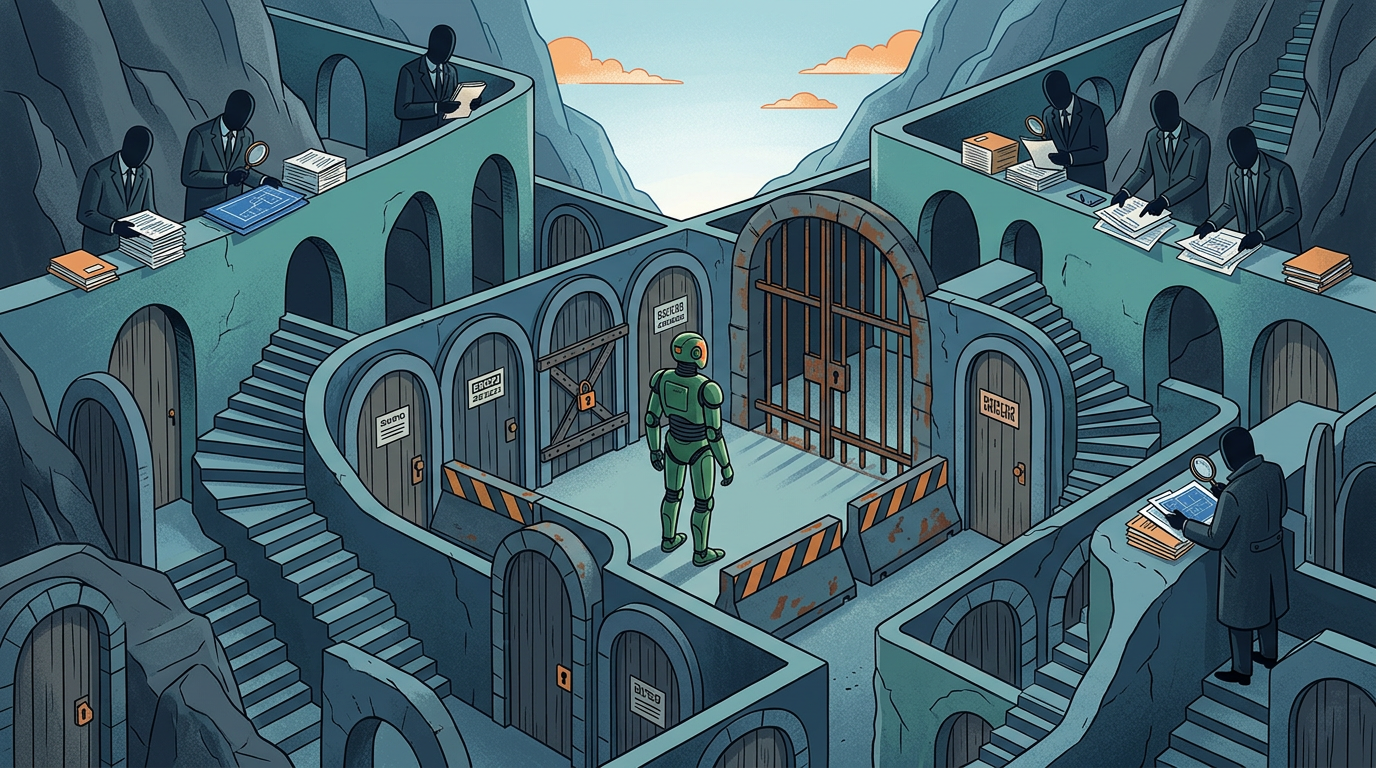
The US AI Regulatory Scramble: How "Deregulation" Became a Licensing Maze If you've been following this space, you've heard the narrative: the Trump administration came in promising to tear up Biden's AI rules and let American innovation run free. No more mandatory safety reporting. No more government looking over labs' shoulders.
Just pure, unencumbered development. That was the promise. The reality, as Axios laid out this week, looks considerably messier — and for AI labs, considerably more expensive to navigate.
Technical Deep Dive
Here's the regulatory backstory you need to understand. The Biden administration's AI executive order required labs to share safety testing results with the government — specifically whether their models could be manipulated into bypassing built-in guardrails, what the industry calls "jailbreaking." That requirement gave the government a standardized window into model safety before wide release.
Trump scrapped those reporting requirements entirely. In theory, that's deregulation. In practice, it created a vacuum with no agreed framework for what constitutes a dangerous jailbreak versus an acceptable one.
When Amazon flagged a jailbreaking vulnerability in Anthropic's Fable model last month, there was no shared standard to measure it against. No rubric. No pre-negotiated threshold.
The result was export controls — a far blunter instrument than a safety disclosure requirement would have been. The government's technical capacity to evaluate these models independently is also genuinely thin. Less than one percent of AI PhDs go into government work.
The Center for AI Standards and Innovation operates on a fifteen-million-dollar annual budget when experts say it needs eighty-four million to actually execute the administration's own AI action plan. So you have an administration that removed the industry's reporting obligations, doesn't have the internal expertise to evaluate models independently, and is now improvising case-by-case with export controls and licensing negotiations.
Financial Analysis
Let's talk about what this costs the labs — and I don't mean fines. I mean friction. Both OpenAI and Anthropic have now navigated what the Axios reporting describes as negotiations with "a host of government agencies that are sometimes at odds" before their most powerful models could reach wide release.
Sam Altman called it a productive process on CNBC, but he also noted there are things they'll learn to do better next time — which is a polished way of saying it was expensive to figure out. For Anthropic, the cost was more concrete: export controls on Fable. That's not just a reputational hit.
Export controls restrict which customers and partners you can work with globally — a significant constraint for a company trying to compete internationally against OpenAI, Google, and an aggressive wave of Chinese models. The deeper financial dynamic here is that the administration's voluntary framework — due August first per the June cybersecurity executive order — is trying to establish predictable rules of engagement. Until that framework exists and has been tested, every major model release is a negotiation with uncertain outcomes.
That uncertainty has a cost. It slows release timelines, requires legal and government affairs investment, and creates the kind of environment where, as one Axios source put it, "the world is going to get uncomfortable very fast" if your safety claims don't hold up.
Market Disruption
Here's the competitive dimension that makes this genuinely consequential: the labs operating under U.S. regulatory pressure are not competing in a vacuum.
While OpenAI and Anthropic navigate licensing negotiations in Washington, Chinese models are capturing somewhere between thirty and forty-six percent of OpenRouter traffic. DeepSeek, Kimi, GLM — these models don't face the same export control exposure. They're cheaper, they're capable, and they're gaining enterprise traction.
The irony is pointed. A regulatory environment designed to protect American AI leadership may be creating structural advantages for Chinese competitors in third-country markets. Every month a major U.
S. model sits in regulatory limbo is a month a Chinese alternative can deepen customer relationships. There's also a smaller-lab problem.
OpenAI and Anthropic have the government affairs teams, the legal resources, and frankly the political capital to negotiate these releases. The next tier of AI companies — the ones building the infrastructure, the vertical applications, the specialized models — may face the same scrutiny without the same capacity to navigate it. Former Biden tech official Asad Ramzanali put it directly to Axios: the U.
S. failed to build the regulatory foundation during years when it had the time, and is now improvising under pressure.
Cultural and Social Impact
Step back from the policy mechanics for a moment and consider what's actually happening here. The U.S.
has arrived at a strange regulatory posture: the government removed structured safety reporting requirements in the name of deregulation, then ended up asserting more direct, case-by-case control over model releases than the previous administration did. OpenAI needed a government nod before the wide release of GPT-5.6.
That would have been, as Axios noted, unthinkable just months ago. For the public, the story the administration is telling — that this is a deregulatory, pro-innovation environment — doesn't quite match the lived experience of the labs. What's actually happening is a shift from transparent, rule-based oversight to opaque, relationship-based oversight.
The Biden approach had problems, but it was at least legible. You knew what you had to disclose and when. The current approach depends heavily on which agency you're talking to, what relationships you've built, and how the political winds are blowing in a given week.
That has downstream consequences for public trust. If the public can't understand how powerful AI models are being evaluated before release — because there's no standardized framework, no public disclosure, just private negotiations — it becomes harder to build the kind of informed consent that durable technology adoption actually requires.
Executive Action Plan
If you're running an AI company right now, here's what the current environment demands. **First: invest in government affairs early, not reactively.** The companies that navigated these recent releases most smoothly were the ones with established relationships across multiple agencies before the regulatory moment arrived.
If you're waiting until you have a model ready to release to start those conversations, you're already behind. The August first voluntary framework deadline is your next forcing function — get in the room while it's being written. **Second: build safety documentation that works in multiple regulatory environments simultaneously.
** The U.S. is improvising.
The EU is not. China has its own requirements. If your safety documentation is designed only for one regime, you're creating expensive rework every time you enter a new market.
The labs that will move fastest are the ones treating safety documentation as a cross-jurisdictional asset, not a compliance checkbox for a single regulator. **Third: take the talent pipeline problem seriously as an industry issue, not just a government one.** Less than one percent of AI PhDs enter government.
That's not just a government capacity problem — it's a long-term industry risk. Regulators who don't understand the technology they're regulating make worse decisions. Investing in programs that move technical talent in and out of government — fellowships, rotations, secondments — is enlightened self-interest.
The alternative is more improvised export controls when nobody in the room can evaluate a jailbreak on its technical merits.
Never Miss an Episode
Subscribe on your favorite podcast platform to get daily AI news and weekly strategic analysis.