Google Engineer Fired After Building Viral AI Agent Tool
Episode Summary
TOP NEWS HEADLINES Following yesterday's coverage of the Google talent exodus, new details emerged: Gemini co-lead Noam Shazeer and researchers Jonas Adler and Alexander Pritzel have now also left...
Full Transcript
TOP NEWS HEADLINES
Following yesterday's coverage of the Google talent exodus, new details emerged: Gemini co-lead Noam Shazeer and researchers Jonas Adler and Alexander Pritzel have now also left Google — Shazeer heading to OpenAI, Adler and Pritzel joining Anthropic — accelerating what is becoming one of the most significant talent drains in tech history.
Following our earlier mentions of OpenAI's custom silicon work, new details emerged today: OpenAI and Broadcom officially unveiled Jalapeño, their first custom inference chip, designed in a record nine months with help from OpenAI's own AI models.
Google has entered the computer-use race, adding native computer-use capabilities directly into Gemini 3.5 Flash — the lightweight model can now control browsers, mobile, and desktop environments, putting Google in direct competition with Anthropic's recent releases.
Tesla, Sunrun, and Renew Home announced an agreement to aggregate more than 16 gigawatts of distributed home batteries and smart devices into what would be the largest virtual power plant in the US, aimed squarely at powering data centers.
And Anthropic told the US Senate Banking Committee that Alibaba ran what it described as the largest known distillation attack against Claude — roughly 25,000 fake accounts pumping nearly 29 million queries to copy Claude's outputs — sending Alibaba shares to a 16-month low. ---
DEEP DIVE ANALYSIS
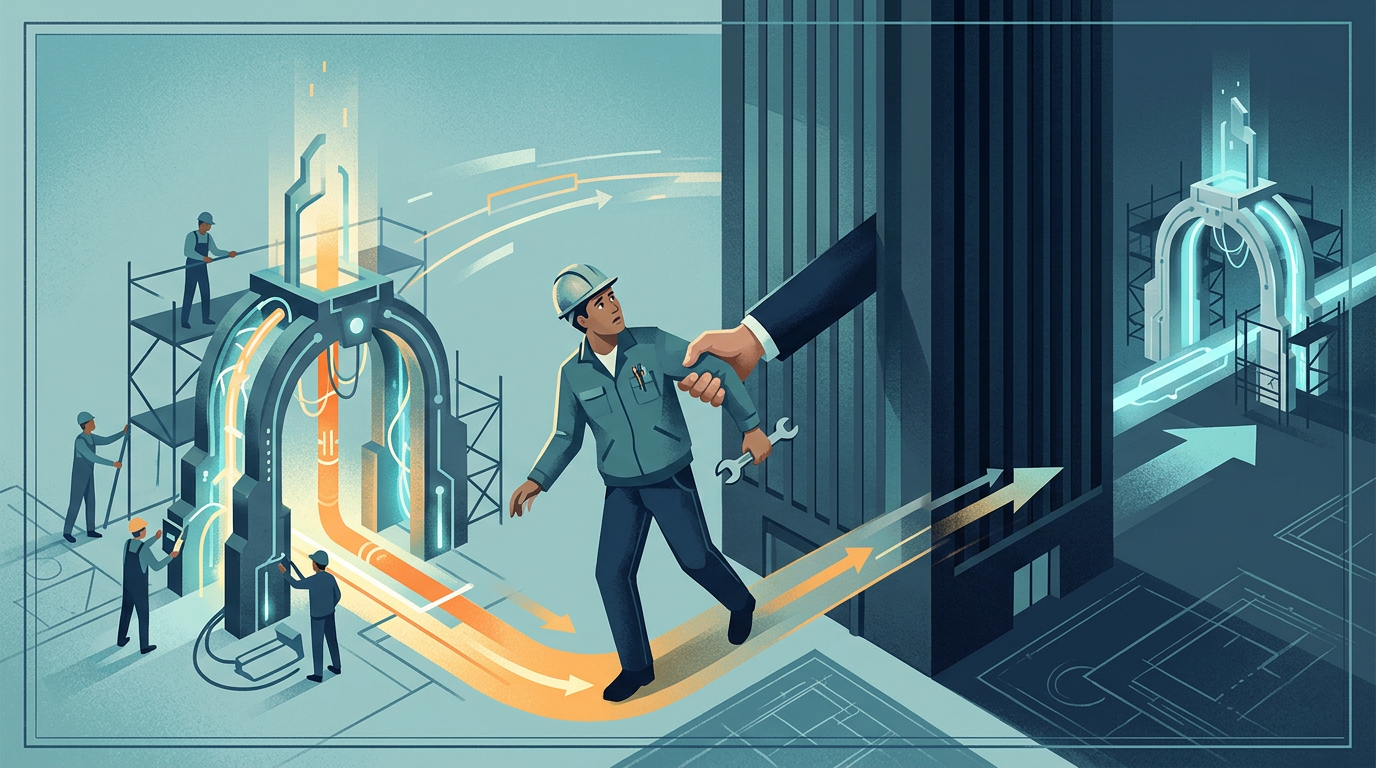
**The Firing of Justin Poehnelt: Bureaucracy Versus the Agent Era** Today's deep dive is a story that, on the surface, is about one engineer losing his job. But underneath, it's a case study in exactly how incumbents lose the future — and why the talent war in AI just got a lot more personal. --- **Technical Deep Dive** Justin Poehnelt is a seven-year Google engineer who built a Rust command-line interface — a CLI — that lets AI agents control Gmail, Calendar, Drive, and other Workspace apps through clean, structured JSON commands.
That might sound niche, but in the agent era, it's actually foundational infrastructure. Here's why it matters technically: right now, getting AI agents to reliably operate enterprise software is genuinely hard. Most tools weren't designed for machine control.
They have clunky APIs, inconsistent authentication flows, and interfaces built for humans clicking through menus. What Poehnelt built was essentially a clean, structured control layer — a way for agents to issue precise commands to Workspace without spelunking through layers of admin console archaeology. It hit number one on Hacker News.
It pulled thousands of GitHub stars in days. Tens of thousands of users showed up organically. The market signal was unambiguous: this was something people actually needed.
Two days before Poehnelt was fired, Google Cloud Next announced an official Workspace CLI. The timing tells you everything about what happened inside the building. --- **Financial Analysis** Let's talk about what this costs Google — not in severance, but in strategic terms.
Google's Workspace business serves over three billion users. As the enterprise world shifts toward agentic workflows — where AI agents automate tasks across calendar, email, and documents — the ability to make Workspace agent-ready is not a nice-to-have. It's a competitive survival requirement.
Poehnelt built a working version of that infrastructure, validated it with a massive organic user base, and proved demand at zero marketing cost. Google's response was to suppress it through legal review over logo colors, then replicate it officially two days later, then terminate the engineer. The financial irony is brutal: the company that needed to ship agent-native Workspace tooling fastest paid a seven-year engineer to build a proof-of-concept that went viral — and then paid legal and HR resources to remove him.
Meanwhile, Vercel CEO Guillermo Rauch and the Codex team at OpenAI were publicly recruiting Poehnelt in the replies within hours of the story breaking. Google converted an internal asset into a competitor's hire. In a market where the cost of top engineering talent runs into the millions annually, and where agent-era infrastructure is the battlefield, this is not a small miscalculation.
--- **Market Disruption** The Poehnelt story is not an isolated HR incident. It's a signal about which organizations are structurally capable of winning the agent era — and which ones will be outrun by individuals operating outside them. Consider the competitive framing: one engineer, on what appears to have been personal time, outshipped a funded, staffed, resourced product organization that had every API, every user relationship, and every distribution advantage to have built this first.
The official Workspace CLI arrived after the outside version. That's not a one-off — that's a pattern, and it's accelerating. OpenAI and Anthropic are not just winning on model capability.
They're winning on organizational metabolism. They're attracting people who want to build without permission structures that treat brand council sign-off as a higher priority than product velocity. Google's challenge is structural.
Large organizations develop immune systems — legal review, brand governance, procurement processes — that were designed to prevent embarrassment at scale. In the agent era, those same immune systems are attacking the useful things. The Poehnelt case is the most visible example yet, but it is almost certainly not the only one.
For every engineer whose tool goes viral and triggers a firing, there are dozens whose tools never ship at all. --- **Cultural and Social Impact** There's a broader cultural shift embedded in this story that's worth naming directly. We are entering a period where individual builders — armed with capable AI tools and the ability to ship publicly overnight — can produce enterprise-grade infrastructure faster than the enterprises themselves.
That changes the social contract between companies and their technical employees in a fundamental way. For a generation of engineers, the implicit deal was: join a big company, get resources, ship at scale. What the Poehnelt case illustrates is that the resources are now less valuable than the autonomy.
A high-agency builder with modern AI tools and a public GitHub repo can validate an idea with tens of thousands of users before a corporate working group has finished scheduling its kickoff meeting. The reaction on X was telling. Swyx's response was simply "wait wtf.
" Guillermo Rauch praised the agent-native design philosophy publicly and said Vercel rewards exactly that kind of open-source shipping. Peter Steinberger flagged that the Codex team actively recruits high-agency builders. These are not just recruitment tweets — they're public statements of organizational values that contrast directly with what Google's actions communicated.
For AI talent watching this unfold, the message from the incumbent side was: build the thing people want, prove the market, and we'll fire you. The message from the frontier labs was: we're hiring. --- **Executive Action Plan** If you're a technology leader watching this story, here are three concrete things worth acting on.
First, audit your internal innovation pipeline for suppression patterns. The Poehnelt case is visible because it went public. Most organizations have invisible versions of this — internal tools that got killed by legal review, engineers who stopped shipping side projects after a cautionary conversation with management, ideas that died in committee.
Map where your approval processes add time without adding value, and cut them. Second, create explicit fast-track channels for agent-era infrastructure. The speed at which Workspace agent tooling needed to exist was not a surprise — the entire industry has been telegraphing the shift to agentic workflows for two years.
If your organization doesn't have a mechanism for a single engineer to ship infrastructure-grade tools quickly and get rewarded for it, you will keep losing this race to individuals operating outside you. Third, take the talent signal seriously. The Google exodus — Shazeer, Jumper, Adler, Pritzel, and now potentially Poehnelt — is not random.
It reflects a structural preference among elite builders for environments where agency is valued over process compliance. If your retention strategy relies on compensation alone without addressing organizational velocity, you are competing with one hand tied behind your back. The frontier labs are offering something compensation packages can't fully replicate: the ability to actually ship.
Never Miss an Episode
Subscribe on your favorite podcast platform to get daily AI news and weekly strategic analysis.