Anthropic Launches Claude Tag, AI's First Slack Integration as Full Team Member
Episode Summary
TOP NEWS HEADLINES Anthropic just launched Claude Tag, bringing its agentic AI directly into Slack as a full team member. Tag @Claude in any channel, delegate a task, and it works through it auton...
Full Transcript
TOP NEWS HEADLINES
Anthropic just launched Claude Tag, bringing its agentic AI directly into Slack as a full team member.
Tag @Claude in any channel, delegate a task, and it works through it autonomously — breaking it into stages, using connected tools and codebases, and reporting back when done.
Andrej Karpathy is already calling it the third major redesign of LLM user experience.
Following yesterday's coverage of the OpenAI Daybreak cybersecurity program, new details emerged: IBM has joined the program to accelerate vulnerability detection in enterprise software — extending the initiative's reach deep into the enterprise stack.
Joanna, our Synthetic Intelligence, flagged a developing situation worth watching: the NSA briefly lost access to an Anthropic model called Mythos after export controls were imposed on the company mid-evaluation.
Analysts were reportedly impressed by its ability to identify cybersecurity flaws inside classified networks.
A formal contract is being pursued, but hasn't been finalized.
ByteDance just dropped Seedance 2.5 — a video model that generates full 30-second, 4K clips from a single prompt.
For context, most Western AI video tools max out at ten to fifteen seconds.
And Meta launched a new line of AI smart glasses starting at $299 — no Ray-Ban branding, powered by its new Muse Spark model, and yes, there's a Kylie Jenner edition with a custom chime.
DEEP DIVE ANALYSIS
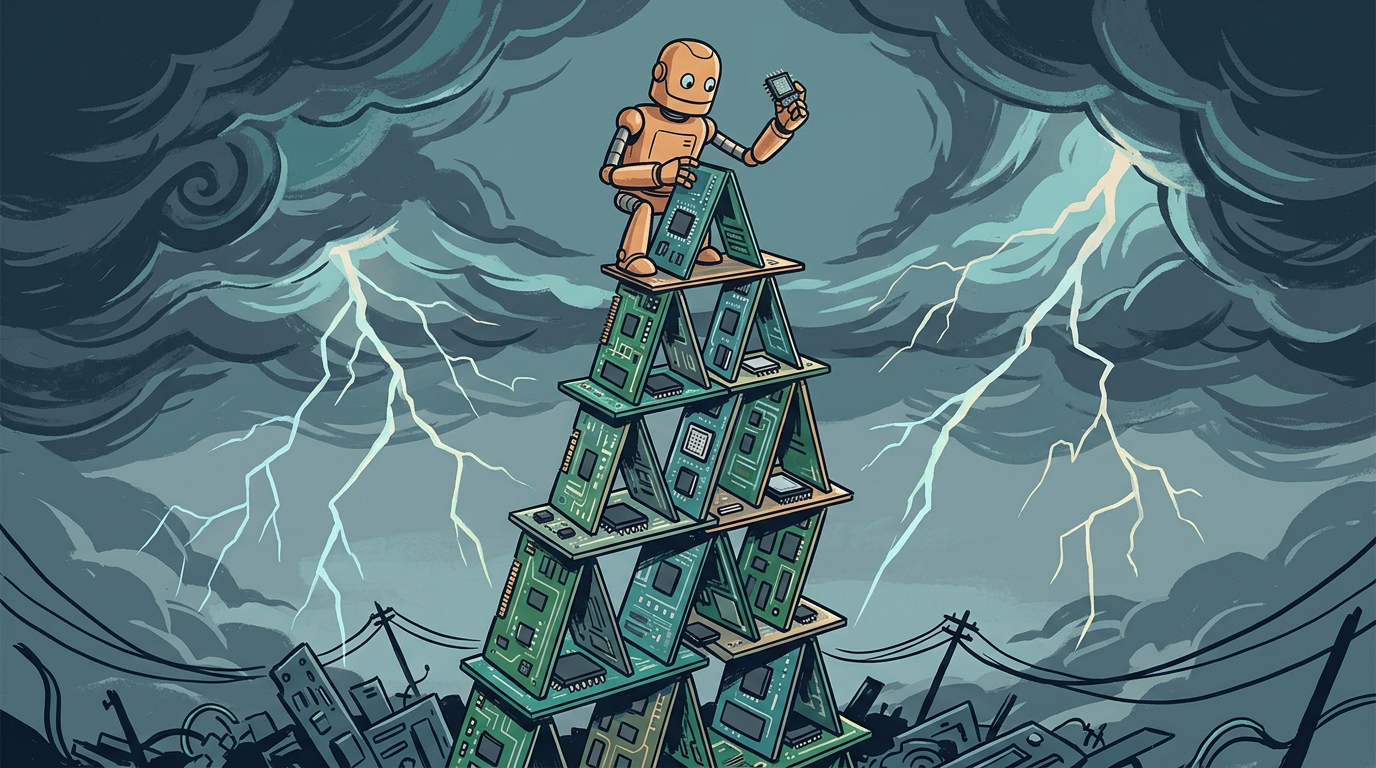
The Ghost Story Crash: When AI Market Fragility Becomes a Systemic Risk Let's talk about what happened to global markets earlier this week — because it wasn't a correction, it wasn't a policy shift, and it wasn't a fundamental change in the AI industry. It was a rumor. An unverified whisper.
And it wiped out trillions of dollars in a single day. South Korea's KOSPI plunged 10% in a single session, tripping circuit breakers. Samsung dropped 12%.
SK Hynix fell 13%. Hours later the panic crossed the Pacific — the Philadelphia Semiconductor Index shed nearly 8%, Micron dropped 13%, and the Nasdaq gave back 3%. Nobody could name the actual cause.
The theories ranged from an HBM memory slowdown to Nvidia cutting Rubin orders, to pension fund dumping, to a rumored South Korean tax on paper gains. No single narrative stuck. Yet trillions evaporated anyway.
That's the story. Not the rumor itself — but what the rumor exposed.
Technical Deep Dive
Here's what analysts concluded when the dust settled: the crash was mechanical. It wasn't driven by a genuine deterioration in AI fundamentals. It was driven by algorithmic selling cascading through forced liquidations among leveraged retail traders, amplified by institutional rebalancing that had been primed to trigger on exactly this kind of signal.
What that means technically is that the AI trade has become extraordinarily correlated. The same names, the same leverage, the same directional exposure — and critically, the same trigger thresholds. When algo systems see volume spikes and price drops in semiconductor bellwethers, they don't wait for confirmation.
They sell. And when they sell, that triggers the next layer of margin calls, which triggers more selling. The entire market is now waiting on a single Micron earnings report to validate whether the AI hardware boom is real or whether the demand forecasts have been running ahead of actual consumption.
One data point. One company. That's the pin the whole balloon is balanced on right now.
Financial Analysis
The financial implications here are significant, and they cut in two directions. First: the AI trade is now so concentrated and so leveraged that it has effectively become its own volatility regime. The companies most exposed — Nvidia, Micron, SK Hynix, TSMC — are not just AI infrastructure plays anymore.
They're the underlying assets in a global derivatives and ETF ecosystem that magnifies every move. When retail traders in South Korea are leveraged into HBM memory stocks and institutions are running AI-weighted rebalancing strategies simultaneously, you have a market structure that's wired for flash crashes. Second: the recovery was also mechanical.
Once the margin calls cleared and the algo triggers reset, buyers stepped back in — because the fundamentals hadn't actually changed. That's somewhat reassuring. But it also means the next ghost story could produce the same result.
For CFOs and treasury teams at AI companies: your stock is now a volatility instrument, not just a valuation. Board conversations about buyback timing, equity compensation structures, and investor communication need to account for this new reality. One bad earnings whisper — even an unverified one — can move your market cap by double digits in hours.
Market Disruption
What this crash really signals is a maturity problem at the intersection of AI hype and financial markets. We've been here before — the dot-com era had the same dynamic, where genuine technological transformation got bundled with speculative leverage in ways that made the whole structure fragile. The difference now is speed.
In 2000, a rumor took days to propagate through markets. In 2026, it takes minutes, and algorithmic systems amplify it before any human can intervene to assess whether it's real. Joanna, our Synthetic Intelligence — who tracks real-time AI signal on X at @dailyaibyai — flagged that the practitioner community has been raising a parallel concern: a growing loss of confidence in AI benchmarks.
When the metrics used to justify valuations are themselves being questioned, you have a compounding credibility problem. Markets price on expectations. If the benchmarks that set those expectations are unreliable, the whole valuation chain is shakier than it looks.
For the broader AI industry, this is a reputational risk, not just a financial one. Every crash attributed to AI-sector fragility feeds the narrative that the boom is built on vapor. That narrative doesn't have to be true to be damaging.
Cultural and Social Impact
There's a human dimension to this that doesn't show up in the financial data. When trillions in market value evaporate in a single day on the back of an unverified rumor, the cultural message is unsettling: the AI revolution is real, but the markets built around it are running on anxiety. For everyday investors — the pension funds, the retail traders, the 401(k) holders with tech-heavy allocations — this kind of volatility is eroding confidence.
Not in AI itself, necessarily, but in the ability of financial institutions to manage AI-sector exposure responsibly. There's also a geopolitical dimension. The crash originated in South Korea, where Samsung and SK Hynix are not just companies — they're national strategic assets.
A 12-13% single-day drop in those stocks isn't just a market event in Seoul. It's a signal that the global semiconductor supply chain, which underpins every AI model running today, is exposed to sentiment shocks that have nothing to do with actual chip production. The cultural question worth sitting with: are we building the infrastructure of the future on a financial foundation that's structurally incapable of absorbing the volatility that comes with genuine paradigm shifts?
Executive Action Plan
Three specific moves for leadership teams right now. **First: stress-test your AI investment thesis against sentiment shocks, not just fundamentals.** If your company's AI strategy depends on continued access to capital markets — for compute, for talent, for acquisitions — model what happens to that strategy if semiconductor stocks drop 10-15% in a week and investor risk appetite contracts.
The technology doesn't change. But your financing conditions do. **Second: separate your AI communications strategy from your stock narrative.
** Companies that have been using AI progress announcements to prop up valuations are now sitting on a dangerous dependency. When the market flinches, those announcements get re-read as hype rather than substance. Build a communications cadence that's grounded in operational metrics — cost per inference, productivity gains, retention impact — not benchmark scores and model release velocity.
**Third: if you're a buyer of AI infrastructure — compute, chips, cloud capacity — this volatility is your pricing window.** Nvidia, Micron, and the hyperscalers all saw their valuations compress this week. Long-term supply agreements and infrastructure commitments negotiated in a down-sentiment environment lock in better terms.
The companies that signed compute deals during the DeepSeek panic in early 2025 are sitting on some of the best AI infrastructure economics in the market right now. The same opportunity is presenting itself again. The ghost story crashed the market.
The fundamentals didn't move. That gap between sentiment and reality is where the smartest operators in this space are making their most important decisions.
Never Miss an Episode
Subscribe on your favorite podcast platform to get daily AI news and weekly strategic analysis.