Nobel Laureate John Jumper Leaves DeepMind for Anthropic
Episode Summary
TOP NEWS HEADLINES Following yesterday's coverage of the Google DeepMind talent exodus, new details emerged: Nobel laureate John Jumper - who co-led the AlphaFold team and won the Nobel Prize for ...
Full Transcript
TOP NEWS HEADLINES
Following yesterday's coverage of the Google DeepMind talent exodus, new details emerged: Nobel laureate John Jumper — who co-led the AlphaFold team and won the Nobel Prize for predicting protein structures — is leaving DeepMind for Anthropic after nine years.
That's two of Google's most irreplaceable researchers out the door in a single week.
Following yesterday's coverage of Z.ai's GLM 5.2, new details emerged: the model has caught fire in the open-weight coding community, with quantized builds pulling over 10,000 downloads — validating exactly what Joanna flagged yesterday about enterprises reconsidering rented intelligence.
Tesla has filed a trademark for "Megapod" — a complete, self-contained, turnkey AI data center system bundling servers, networking, power, and cooling.
It puts Tesla in direct competition with Nvidia's full-stack data center offerings.
Unconfirmed reports suggest Trump told reporters he no longer views Anthropic as a national security threat following a G7 meeting with the CEO — though restrictions have yet to be formally rescinded.
Sakana AI just launched Fugu, a multi-agent orchestration system that behaves like a single seamless model — users call one API, and a coordinated swarm of expert models handles selection, delegation, and synthesis behind the scenes. ---
DEEP DIVE ANALYSIS
**The Ghost in the Machine: Capability Distillation and the Death of Model Moats** A developer on Hugging Face named Taha K. — going by lordx64 — released a model called Qwable-v1. It doesn't use Anthropic's weights.
It doesn't require any stolen code. What it does is reproduce the *behavior* of Claude Fable-5 — specifically its agentic tool-use patterns — by training on Fable-5's observable traces. Over 10,000 downloads in days.
And with that, one of the foundational assumptions of frontier AI IP just cracked open. Let's unpack exactly what happened here, and why it matters far beyond one Hugging Face upload. --- **Technical Deep Dive** Model distillation isn't new.
The core idea — training a smaller model to mimic a larger one — has existed for years. What's new is the *target*. Previous distillation typically required access to the teacher model's internal outputs, logits, or training pipeline.
What Qwable-v1 demonstrates is behavioral distillation at the API layer: watch a model work, log how it calls tools, chains reasoning steps, and navigates code — then train on those traces. Fable-5 is a deployed product. Every time it solves a problem in public, it's generating training signal.
The weights stay locked in Anthropic's servers. The *behavior* leaks through every API call. And behavior, it turns out, is the actual asset.
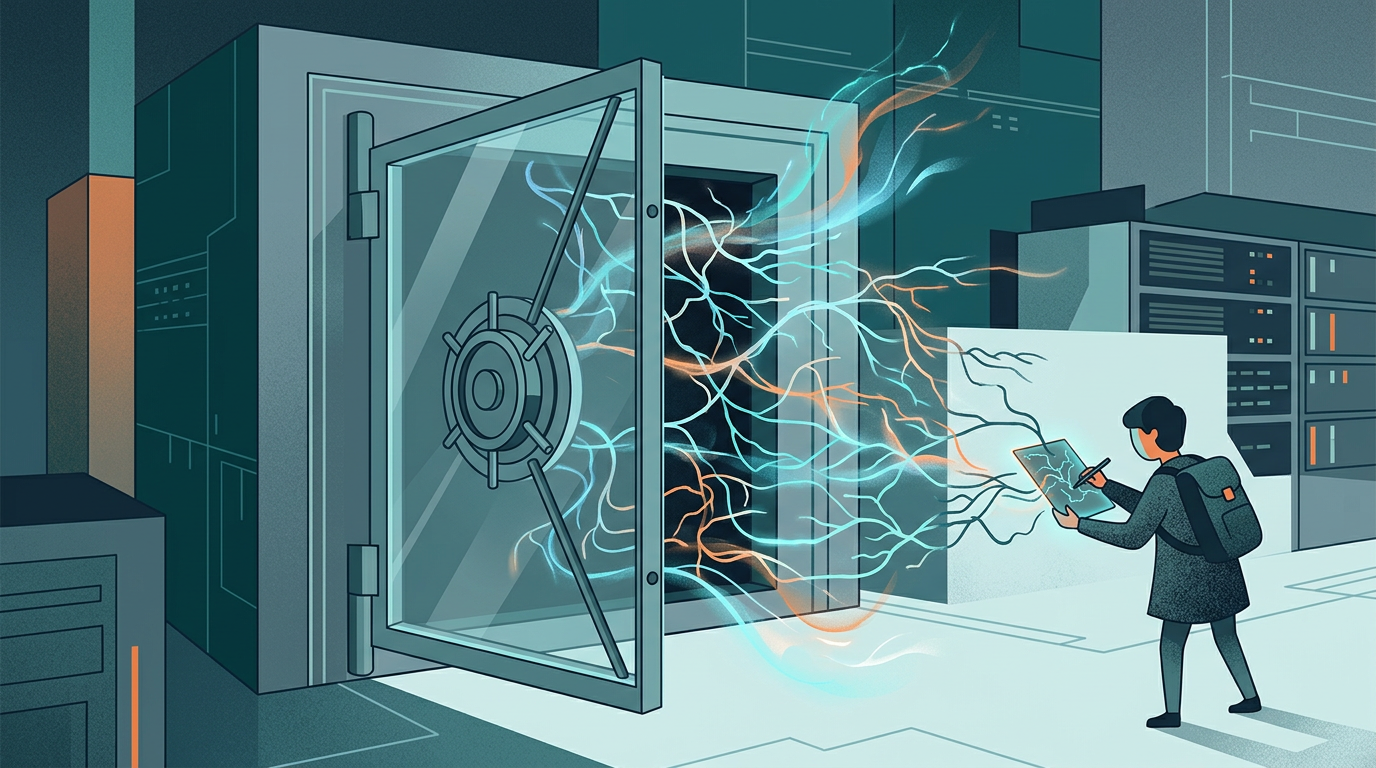
The tool-use logic, the agentic decision trees, the way Fable-5 structures multi-step code tasks — all of it is observable, loggable, and reproducible. You don't need the vault. You just need to watch the vault work.
This is a fundamental shift in the threat model. Export controls assume the dangerous thing is the file. The weights.
The artifact you can put on a USB drive. But capability doesn't live only in weights. It lives in behavior, and behavior is contagious.
--- **Financial Analysis** The business model of every frontier AI lab rests on a single premise: that the gap between their closed model and the open alternatives is wide enough to justify subscription pricing. Anthropic charges enterprise customers significant premiums for Claude access. OpenAI's margins depend on GPT-5 being meaningfully better than anything a team can run on their own infrastructure.
Behavioral distillation compresses that gap without touching the legal red lines around weight theft. Qwable-v1 doesn't infringe on Anthropic's model directly — it learned by watching. The legal exposure is genuinely murky, and the commercial exposure is not.
If a team can get 80% of Fable-5's agentic coding capability from an open model running on their own hardware, the calculus on a six-figure enterprise API contract changes immediately. GLM 5.2 — which we covered this week — is already pushing that math on cost.
Qwable-v1 is pushing it on *capability*. The combination is the real story. Cheap open models closing the quality gap, now with a demonstrated pathway to clone the behavioral DNA of frontier systems.
Frontier labs are guarding vaults while the value escapes as exhaust. --- **Market Disruption** The ripple effects hit three layers simultaneously. First, the moat narrative for closed frontier models weakens considerably.
Investors have been pricing companies like Anthropic and OpenAI as if locked weights equal durable competitive advantage. They don't — not anymore. The advantage was always time and talent, not the weights themselves.
Second, the export control framework that Washington has built around AI capability looks increasingly misaligned with the actual threat surface. Controlling chip exports, restricting weight transfers — these are logical if the capability lives in the artifact. If capability leaks through observable behavior from any deployed API, the perimeter is effectively everywhere and nowhere.
Third, this accelerates the open-weight ecosystem in a specific direction. It's not just about running cheaper models for commodity tasks anymore. Developers now have a pathway to distill the *specialized behaviors* of frontier systems — not just their raw reasoning, but their agentic patterns, their tool-use strategies, their multi-step problem decomposition.
That's a very different kind of open model than what existed two years ago. Watch for frontier labs to respond by limiting API observability — rate limits, output obfuscation, trace stripping. The arms race just moved to a new front.
--- **Cultural & Social Impact** There's a deeper story here about how we think about AI ownership, and it goes beyond IP law. The AI industry has spent years building public intuition around "the model" as a discrete, ownable thing — like software you license. That framing is collapsing.
A model's behavior, trained into it through billions of dollars of compute and human feedback, can be observed by anyone with API access and reconstructed by anyone with enough data and a GPU cluster. The behavior is more like a cultural artifact than a software product: once it's out in the world, interacting with people, it propagates. This has real implications for safety policy, not just commerce.
Anthropic and others invest heavily in constitutional training, RLHF, and behavioral guardrails. If those guardrails are part of the observable behavior pattern — and they are — they can be distilled in or distilled out. Qwable-v1 may have copied Fable-5's tool-use logic.
A different actor could specifically train on examples where safety behaviors were absent. The assumption that you can control AI capability by controlling who has the weights was always a simplification. It's now demonstrably incomplete.
--- **Executive Action Plan** Three moves for leaders watching this unfold: **One: Audit your AI procurement assumptions now.** If your enterprise AI strategy is built entirely on closed API relationships, price that risk explicitly. Behavioral distillation means the open-weight ecosystem will continue closing the capability gap faster than your vendor roadmap predicts.
Build a hybrid architecture — closed models for your highest-stakes, most differentiated workloads; open models for everything reproducible and cost-sensitive. The line between those categories just moved. **Two: Rethink what your actual competitive moat is.
** If you've been building proprietary workflows on top of a frontier API, those workflows are now potentially replicable by anyone who watches how you use the model. Your defensibility isn't the API access — it's your data, your feedback loops, your domain expertise baked into fine-tuned open models you control. Shift investment accordingly.
**Three: Get in front of your legal and compliance teams before regulators do.** The behavioral distillation question is legally unresolved. Training on publicly observable API outputs sits in genuinely gray territory.
Companies building on or with distilled models need a clear legal posture before a test case forces one on them. The window for proactive positioning is short — this story moves fast.
Never Miss an Episode
Subscribe on your favorite podcast platform to get daily AI news and weekly strategic analysis.