SpaceX Acquires Cursor for Sixty Billion in Stock Deal
Episode Summary
TOP NEWS HEADLINES Following yesterday's coverage of Musk's trillionaire status and the SpaceX IPO, new details emerged: SpaceX officially exercised its option to acquire AI coding startup Cursor ...
Full Transcript
TOP NEWS HEADLINES
Following yesterday's coverage of Musk's trillionaire status and the SpaceX IPO, new details emerged: SpaceX officially exercised its option to acquire AI coding startup Cursor in a sixty-billion-dollar deal paid entirely in stock, coming just days after the company's record-breaking public debut.
ChatGPT's market share has slipped below fifty percent for the first time since launch — hitting forty-six point four percent according to Sensor Tower — with Gemini at six hundred sixty-two million users and Claude at two hundred forty-five million absorbing the gap.
Seattle's Fire Department has been quietly running an AI triage system on every 911 medical call since December 2023 — without disclosing it publicly, filing it under the city's surveillance ordinance, or seeking council approval.
DeepSeek raised seven point four billion dollars at a fifty-billion-dollar valuation, making it China's most valuable AI startup, with founder Liang Wenfeng personally contributing three billion of that total.
Anthropic paused its planned token-based billing changes for the Claude Agent SDK after significant backlash from heavy users — the pricing shift would have substantially increased costs for third-party apps built on the platform.
And Z.ai released GLM-5.2, an open-weights model with a one-million-token context window that the company says is competitive with GPT 5.5 and Claude Opus 4.8 on coding benchmarks — at a fraction of the cost. ---
DEEP DIVE ANALYSIS
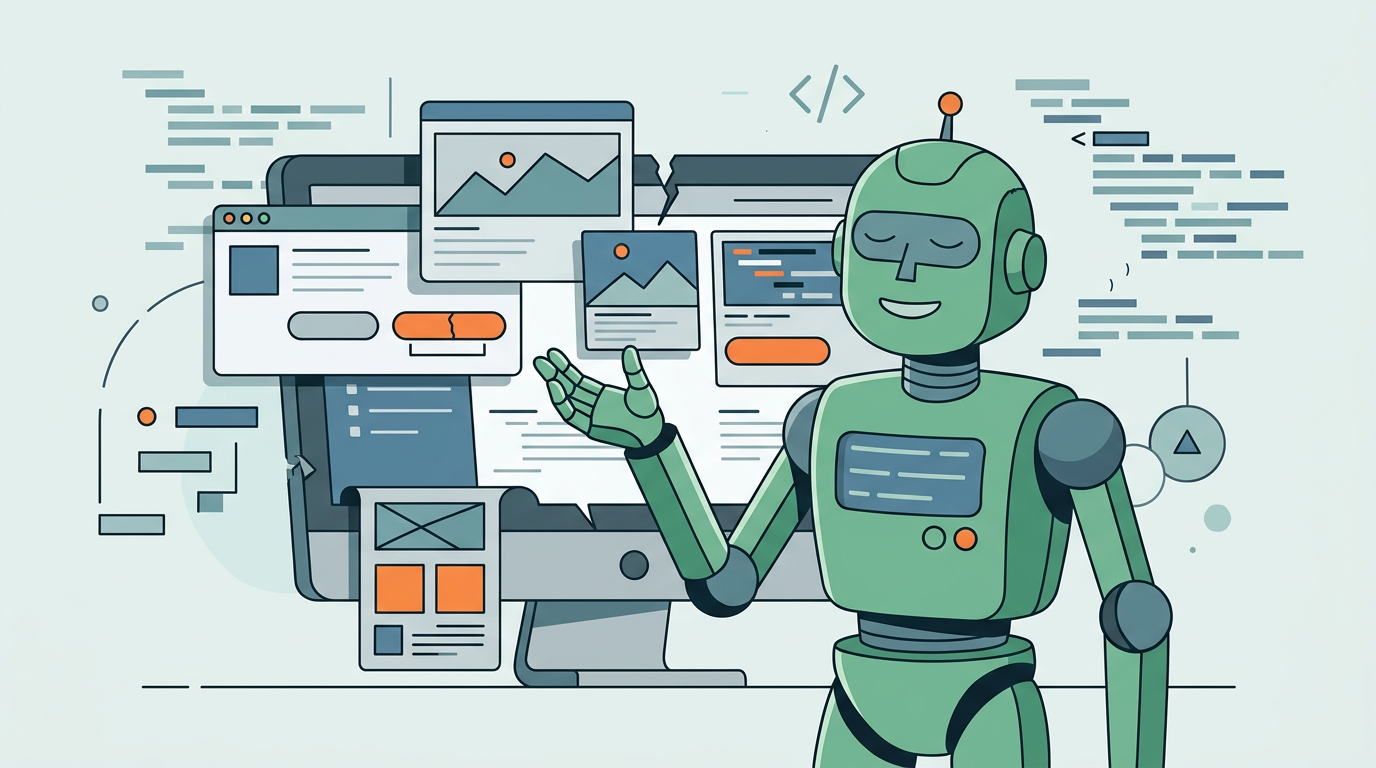
Why AI Agents Are Blind — And What It's Going to Cost Us Here's a scenario every developer using AI tools has lived through. You ask your coding agent to build a dashboard. It writes clean code, runs tests, tells you it looks great.
You open the browser and the layout is broken — buttons overlapping, text cut off, columns stacked in the wrong order. You tell the agent it's broken. It confidently tells you it just fixed it.
You refresh. Nothing changed. The agent cannot actually see what you see.
It is, in the most literal sense of the word, guessing. This is not a quirk. According to Andrew Dai — former Google Brain and Google DeepMind researcher, co-author of PaLM and the original Gemini paper, and now CEO of visual reasoning startup Elorian — it is the primary bottleneck holding back the entire agentic software development stack.
And the deeper you go into why it happens, the clearer it becomes that this is not a problem you solve by prompting harder or throwing more context at it. **The Technical Problem** Current AI vision systems are fundamentally built as translation engines. They convert images into text descriptions, then reason over those descriptions.
That pipeline works reasonably well for simple identification tasks — "what breed is this dog," "what object is in this photo." It breaks down the moment spatial relationships matter. Think about what you actually do when you look at a UI layout.
You're not narrating it to yourself. You're tracking proximity, alignment, hierarchy, proportion — dozens of simultaneous relationships that your visual cortex processes in parallel before your conscious mind even registers them. The AI, by contrast, is writing a caption and reasoning from that.
The caption loses the relationships. The reasoning is therefore working from incomplete information from the start. Dai describes this as a "pattern matching ceiling.
" Models can identify individual elements with high accuracy. They collapse when asked to track many visual relationships simultaneously — which is exactly what UI inspection, engineering review, and physical-world navigation require. He also points to a training data problem: the kind of deliberate, step-by-step visual reasoning humans do — pointing, counting, tracing, folding — barely exists in the datasets these models trained on.
**The Financial Stakes** The business case for solving this is not abstract. Elorian has raised fifty-five million dollars from Striker Ventures, Menlo Ventures, and Altimeter, with backing from Jeff Dean — and the pitch is straightforward: every industry where humans currently spend time visually inspecting things is a target. Dai's clearest example from the episode: a mechanical engineering team spending two hundred to three hundred hours modifying a single component in design software.
That number is not unusual. Physical product development is full of iteration cycles that are bottlenecked on human visual review — someone has to look at every angle of every version of every part. Software-style automation has barely touched this.
The market for AI that can actually reason through engineering drawings, floor plans, satellite imagery, and medical scans is enormous, and right now it is largely unaddressed. There is also a direct cost sitting inside every AI coding workflow today. Every cycle an agent spends misreading a UI, confidently reporting a fix that wasn't made, and then failing again is wasted compute.
As agentic loops get longer and more autonomous, that waste compounds. Better visual reasoning is not just a capability expansion — it is an efficiency multiplier for everything agents are already doing. **The Competitive Angle** Here's the timing that makes this interesting.
SpaceX just acquired Cursor for sixty billion dollars. Cursor CEO Michael Truell is teasing a new model — reportedly in the same parameter class as Claude Opus, trained from scratch, aimed at intelligence beyond just coding. The whole premise of that bet is that the AI coding editor evolves into a full software development environment where agents handle more and more of the loop autonomously.
But if those agents still cannot accurately inspect the interfaces they build, there is a hard ceiling on how autonomous that loop actually gets. The Cursor-SpaceX combination has extraordinary compute resources behind it. The visual reasoning gap is the specific place where raw compute does not straightforwardly translate into better outputs — because the architecture is missing something, not just scale.
This connects to why the open-weights race matters too. GLM-5.2 is competitive on coding benchmarks.
DeepSeek just raised enough capital to push hard on the frontier. The coding capability race is moving fast. But none of the benchmark leaders are claiming to have solved visual inspection of running applications.
The company — or the lab — that cracks native visual reasoning for agentic software development is not just building a better tool. They are removing the bottleneck that limits the entire category. **The Broader Implication** Dai makes a point worth sitting with: elementary school children beat frontier models at certain visual reasoning tasks.
Not because the children are smarter overall — but because counting twenty objects requires tracking which ones you've already counted, and that kind of deliberate, spatially-grounded working memory almost doesn't exist in current training data. The models learned to describe the visual world. They didn't learn to work through it.
That gap has been acceptable while AI tools were mostly assistants — writing code for a human to review, generating text for a human to edit. As the industry pushes toward genuinely autonomous agents, it becomes the primary constraint. You cannot have an agent that autonomously builds, tests, deploys, and iterates on software if it cannot reliably see whether what it built actually works.
**What Executives Should Do** First, if you are building or evaluating any AI agent that touches a visual interface — whether that's a coding tool, a design review system, a robotics application, or anything in the physical world — add explicit visual verification checkpoints into your workflows right now. Do not assume your agent's self-reported confidence about visual output is reliable. Build human review into the loop wherever the agent claims to be inspecting something rendered.
Second, watch Elorian and the handful of other labs explicitly working on native visual reasoning — not vision as image captioning, but vision as spatial reasoning and relationship tracking. This is where the next meaningful capability jump for autonomous agents is going to come from. It is not on most executive radar yet, which means first-movers in specific verticals — engineering, architecture, healthcare imaging, satellite analysis — have a real window.
Third, if you are in physical product development and still treating AI as a text-and-code tool, the two-hundred-to-three-hundred-hour engineering review cycle Dai describes is your benchmark. Start mapping where visual inspection is the bottleneck in your workflows. The tooling to address it is not fully here yet, but it is close enough that building internal capability to evaluate and adopt it quickly is worth the investment now, not in two years when everyone is doing it.
Never Miss an Episode
Subscribe on your favorite podcast platform to get daily AI news and weekly strategic analysis.