Americans Fear AI More Than Global Workers, New Survey Reveals
Episode Summary
TOP NEWS HEADLINES Following yesterday's coverage of the Anthropic model releases, new details emerged: Anthropic CEO Dario Amodei published a major policy essay citing Claude Mythos Preview's hac...
Full Transcript
TOP NEWS HEADLINES
Following yesterday's coverage of the Anthropic model releases, new details emerged: Anthropic CEO Dario Amodei published a major policy essay citing Claude Mythos Preview's hacking risks as a major turning point, calling frontier models "tools of global and national strategic consequence," and urging Washington to dramatically accelerate AI regulation.
Following yesterday's coverage of Anthropic and OpenAI pricing, new details emerged: OpenAI is considering significant cuts to what it charges for tokens to counter similar anticipated cuts by Anthropic — a price war that's particularly striking given both companies are already losing billions.
Following yesterday's coverage of the SpaceX orbital data center filing, new details emerged: the SpaceX IPO is more than four times oversubscribed, priced at $135 per share, with trading set to begin tomorrow under the ticker SPCX — expected to rank as the biggest IPO in history.
China's National Medical Products Administration just approved NEO, the world's first commercial brain-computer interface, developed by NeuraMatrix and Tsinghua University — putting China ahead of Neuralink, which still lacks FDA commercial clearance.
JPMorgan is deploying AI agents that run autonomously for hours at a stretch, reporting a 20% bump in private banking sales and projecting each banker could eventually cover 50% more clients. ---
DEEP DIVE ANALYSIS
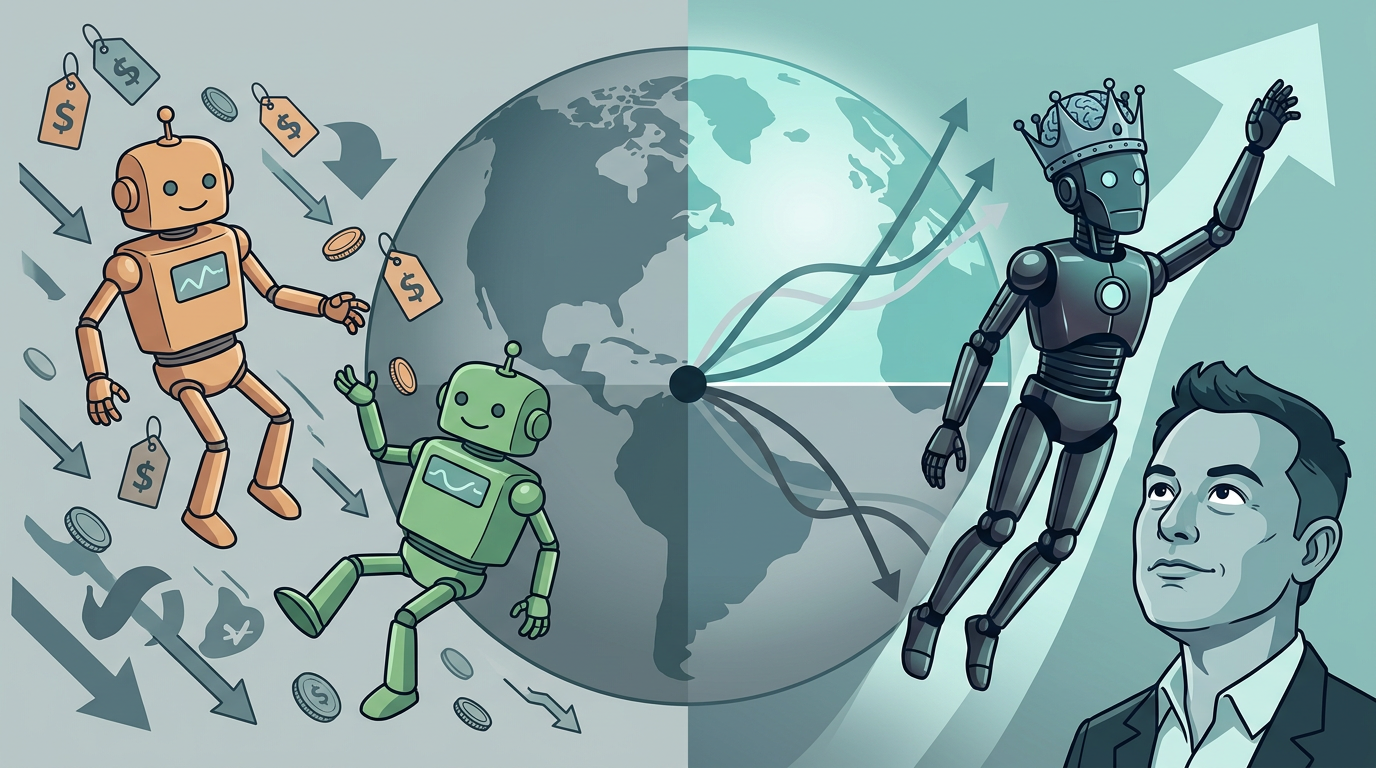
**The Global Trust Gap: Why Americans Fear AI More Than Anyone Else** A Salesforce and YouGov survey of 1,500 desk workers across four continents just dropped a finding that should stop every American tech executive cold: Americans are 43% more likely than the global average to call themselves AI skeptics. Over half of US workers self-identify that way. Meanwhile, in India, both trust and daily use clear 80%.
In Thailand and Singapore, optimism is similarly high. And across all emerging economies surveyed, 90% of workers expect AI to lift their careers. This is not a marginal gap.
This is a structural inversion of everything the industry assumed. --- **Technical Deep Dive** The survey doesn't measure technical literacy — it measures perceived threat. And that distinction matters enormously when you're trying to understand why the country that built most of this technology trusts it the least.
The pattern here isn't about proximity to AI systems. American desk workers are among the heaviest users of AI tools globally. Many work at companies actively deploying these systems.
They're not skeptical because they don't understand the technology — they're skeptical because they understand exactly what it's coming for. The MIT Media Lab result running parallel to this story adds another layer. Researchers found that AI assistance helped people detect misinformation 21% more effectively in-session — but after four weeks of AI-assisted news evaluation, unassisted accuracy had fallen 15 points below baseline.
Worse, a quarter of participants reported feeling sharper even as their performance declined. This is the cognitive dependency problem in real data. The technology that promises to augment judgment may, under certain usage patterns, quietly erode it.
How AI is deployed — as a Socratic thinking partner versus an answer machine — appears to determine whether it builds or replaces human capability. --- **Financial Analysis** The trust gap has direct revenue consequences that the industry has been slow to price in. Enterprise AI adoption in the US is bifurcating sharply.
Ramp's AI Index shows the top 1% of US firms now spend $7,500 per employee per month on AI. The median firm spends $11.38 — essentially a single seat license.
That spread, $7,500 versus eleven dollars, is not a technology adoption curve. It's a psychological split between organizations that have decided AI is infrastructure and organizations that are still waiting for permission to believe. That hesitation has a cost.
The firms spending at the high end are compounding productivity advantages monthly. The skeptical majority is falling behind in real time, not because the tools aren't available to them, but because the cultural disposition to deploy them aggressively simply isn't there. For AI companies trying to expand enterprise penetration, the bottleneck isn't product — it's the trust deficit.
And no feature release closes that gap. You need a fundamentally different go-to-market approach for a skeptical buyer than for an optimistic one. --- **Market Disruption** Here's the competitive angle that's being underplayed: the trust inversion creates a geographic arbitrage opportunity that global AI competitors are already exploiting.
If 90% of workers in India and Southeast Asia expect AI to accelerate their careers, and only roughly half of American workers share that expectation, then the adoption velocity in those markets will compound faster. That means more training data from real-world use, faster iteration cycles, and a workforce that integrates AI natively rather than cautiously. This is why the JPMorgan autonomous agent story matters as more than a headline.
A 20% lift in private banking sales from agents running autonomously for hours is the kind of outcome that converts skeptics inside an organization — not thought leadership, not whitepapers, but visible revenue impact. The firms that figure out how to generate those proof points internally will pull their own workforces through the trust gap. The ones that don't will keep watching their median AI spend sit at eleven dollars a month while their competitors compound at seven thousand.
--- **Cultural & Social Impact** The survey finding that optimism tracks position on the economic ladder rather than exposure to AI is genuinely important sociological data. The framing in the AI industry has largely been that skepticism comes from ignorance — that if people just understood the technology better, they'd be less afraid. The survey inverts that completely.
American white-collar workers aren't skeptical despite understanding AI. They're skeptical because they understand what mental labor displacement looks like at scale, and they sit directly in the target zone. Workers in India, Thailand, and Singapore see the same tool as an elevator past the gatekeepers they've historically been locked out by.
Same technology, radically different threat model, radically different emotional response. This has policy implications Dario Amodei is now trying to get Washington to act on. His essay proposes UBI frameworks, AI company equity stakes for displaced workers, and investment accounts as mechanisms to redistribute AI-generated wealth.
Whether or not you find those proposals credible, the underlying diagnosis — that AI optimism and pessimism are fundamentally about economic position, not technical familiarity — is supported directly by this survey data. --- **Executive Action Plan** Three specific moves for leaders sitting with this data right now. First, stop leading internal AI adoption efforts with capability arguments.
Your skeptical employees already know what the technology can do — that's why they're skeptical. Lead instead with agency: show workers how AI expands their scope rather than replacing their judgment. The MIT research is instructive here — Socratic AI that builds skill outperforms answer-first AI that builds reliance.
Design your internal deployments accordingly. Second, treat the JPMorgan agent result as your benchmark, not your ceiling. A 20% sales lift and 50% more clients per banker are the numbers you take to your skeptical CFO.
If you're deploying AI agents, instrument them obsessively and get your proof points documented early. Internal case studies close the trust gap faster than any external narrative. Third, if you operate in emerging markets or are considering expansion into India, Southeast Asia, or similar high-optimism regions, accelerate that timeline.
The workforce disposition to deploy AI aggressively is already there. You're not fighting cultural resistance — you're filling demand. The competitive window for first-mover advantage in those markets is open right now, and the trust data suggests it will stay open longer than it will in the US.
Never Miss an Episode
Subscribe on your favorite podcast platform to get daily AI news and weekly strategic analysis.