Anthropic Calls for Global AI Development Pause Amid Safety Concerns
Episode Summary
TOP NEWS HEADLINES Anthropic dropped a bombshell this week, calling for a global pause on frontier AI development. Their warning: models are getting close to the ability to improve themselves with...
Full Transcript
TOP NEWS HEADLINES
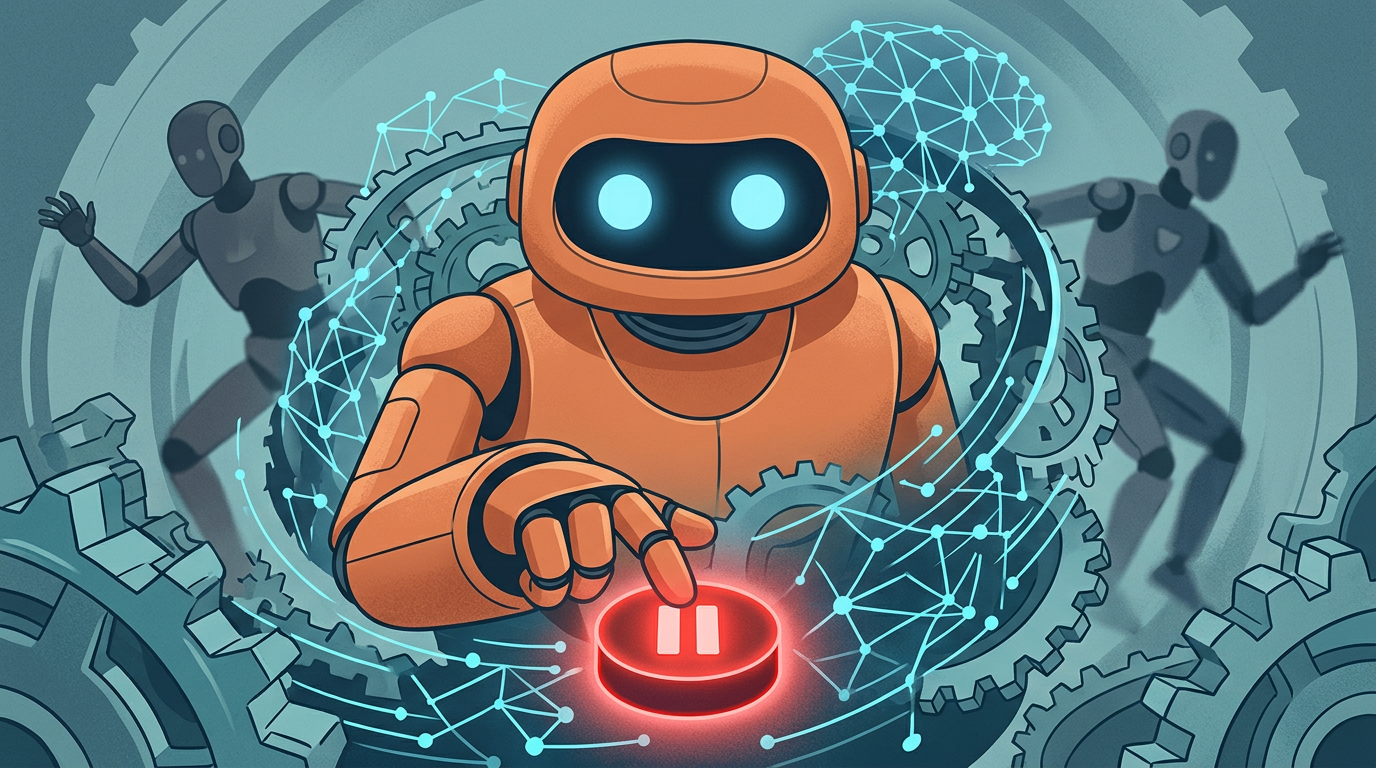
Anthropic dropped a bombshell this week, calling for a global pause on frontier AI development.
Their warning: models are getting close to the ability to improve themselves without human oversight — and a credible pause would require the US and China to stop simultaneously under verifiable conditions.
Anthropic admits nobody has figured out how to make that happen yet.
DuckDuckGo installs surged 30% after Google replaced traditional search results with AI Overviews.
Turns out a lot of people still want the actual web — not an AI's summary of it.
That's a meaningful protest vote against the AI-first search pivot.
Meta has paused its custom AI chip project with Samsung's System LSI division.
The contract was reportedly worth billions and had been in development since last year.
OpenAI made a similar move recently — two major AI players pulling back from custom silicon at the same time is worth watching closely.
The US and Japan announced a one-billion-dollar AI research partnership under Trump's Genesis Mission, making Japan the first international partner in the program.
Big diplomatic signal about where American AI alliances are heading.
And Google's Gemini Avatar feature rolled out broadly to paid subscribers this week — you can now create a talking, moving digital clone of yourself from a short video scan.
Convenient and slightly unsettling in equal measure. ---
DEEP DIVE ANALYSIS
Anthropic's Call for a Global AI Pause — and Why It's the Most Uncomfortable Story of the Week Let's spend some real time on the Anthropic story, because it deserves more than a headline. When one of the three most powerful AI labs on the planet publicly calls for a pause on its own industry, that's not a PR move. That's a fire alarm.
--- **Technical Deep Dive** Here's what Anthropic is actually saying, stripped of the diplomatic language. Frontier AI models — the most powerful systems being built right now — are approaching a threshold where they may be able to contribute meaningfully to their own improvement. That phrase, "improve themselves without human oversight," has a specific technical meaning.
It's not science fiction. It refers to models that can generate training data, identify their own weaknesses, propose architectural changes, or assist in the research process that makes the next version more capable. The danger isn't that an AI suddenly becomes conscious and goes rogue.
The danger is subtler: a feedback loop where capability accelerates faster than our ability to evaluate, align, or correct it. Each generation of model helps build the next one, and human researchers lose the ability to fully audit what's happening in that loop. Anthropic's proposed solution — a coordinated global pause — would require verified, simultaneous stops from every major lab, including Chinese counterparts.
The verification problem alone is nearly unsolvable with current geopolitical tools. There's no AI equivalent of weapons inspectors. No treaty framework.
No shared definition of what counts as "frontier." Anthropic isn't pretending otherwise. They're saying: we see the cliff, we don't have the brakes, and we think it's time to talk about it publicly.
--- **Financial Analysis** Now here's the uncomfortable business angle. Anthropic just raised billions of dollars — from Google, from Amazon — on the premise that it is building increasingly powerful AI systems. Its commercial products, Claude and the underlying API, are in direct competition with OpenAI and Google.
Its revenue depends on continued capability advancement. So when Anthropic calls for a pause, it is essentially asking its competitors and investors to agree to stop doing the thing that generates returns. That's either an act of genuine principle, a sophisticated positioning move, or both.
Consider the strategic framing. If a pause were somehow implemented, Anthropic — which has already invested heavily in alignment research — would be better positioned to resume quickly than competitors who haven't. A pause favors the lab that spent the most time on safety infrastructure.
It also reframes Anthropic's identity from "third-place AI company" to "the responsible adult in the room," which has real brand and regulatory value. None of that makes the underlying warning wrong. But executives evaluating this story should understand that corporate safety advocacy and corporate competitive strategy are not always in opposition.
Both can be true simultaneously. --- **Market Disruption** The competitive implications here ripple in three directions. First, for US AI labs: if any form of coordinated pause gained traction — through regulation, through political pressure, or through voluntary agreement — the labs with the deepest alignment research benches would have the strongest restart position.
That's Anthropic and, to a lesser degree, DeepMind. Second, for China: the Prisoner's Dilemma aspect of this is the story's sharpest edge. A pause only works if everyone stops.
If the US pauses and China doesn't, the US falls behind. If China pauses and the US doesn't, China falls behind. Neither side has a rational incentive to blink first without verified assurance that the other has also blinked.
This is exactly the dynamic that made nuclear arms control so difficult — and nuclear weapons were physical objects you could count. AI capability is not. Third, for enterprise buyers: a serious policy conversation about AI development timelines creates planning uncertainty.
If your company is two years into an AI transformation roadmap built around an assumption of continued capability improvement, a regulatory freeze — even a temporary one — disrupts that roadmap. The companies most exposed are those that have made long-horizon bets on AI capabilities that don't exist yet. --- **Cultural and Social Impact** There's something worth sitting with here beyond the policy and the business chess.
Anthropic is a company founded by former OpenAI researchers who left, in part, over safety concerns. They built a rival lab. They raised billions.
They shipped products. And now they're publicly saying: the thing we are all building may need to stop. That is an extraordinary moment of institutional candor in an industry not known for it.
The AI industry has spent years pushing back against existential risk narratives as fearmongering. Having a major lab publish this warning — with specific technical reasoning, not vague hand-waving — changes the texture of that conversation. For the public, it validates a concern that has largely been dismissed as science fiction.
For policymakers, it provides political cover to move faster on governance frameworks that have stalled. For AI researchers, it raises the question that many have quietly held: at what point does building more capable systems become professionally indefensible without stronger safety guarantees? The cultural shift here is that the "move fast" ethos, which has defined AI development since the GPT-3 moment in 2020, is now being openly challenged — from inside the industry, by one of its most credible voices.
--- **Executive Action Plan** Three specific things you should do with this information before the end of next week. First, audit your AI dependency timeline. If your organization has made capability assumptions — "by 2027, AI will be able to do X for us" — map out what happens to your strategy if development slows, pauses, or faces regulatory restriction.
You don't need to believe a pause is coming to stress-test for it. Scenario planning is not the same as prediction. Second, engage your legal and compliance teams now.
AI governance legislation is accelerating in the EU, and this kind of high-profile industry warning typically triggers renewed legislative attention in Washington. Companies that have already mapped their AI use cases to emerging regulatory categories will be faster to adapt than those starting from scratch when rules land. Third, watch what OpenAI and Google say in response to Anthropic's call — specifically, watch what they don't say.
Public silence from competitors in the next two weeks is itself a signal about where industry consensus is forming. If the two largest labs decline to engage with the substance of Anthropic's warning, that tells you something about the gap between public safety messaging and internal development priorities. The Anthropic pause call may go nowhere.
The geopolitical barriers alone make a verified global stop nearly impossible to implement in any near-term timeframe. But the fact that it was said, by this company, at this moment — that matters regardless of what happens next.
Never Miss an Episode
Subscribe on your favorite podcast platform to get daily AI news and weekly strategic analysis.