ChatGPT Hits One Billion Users as Anthropic Reveals Claude Writes 80% of Code
Episode Summary
TOP NEWS HEADLINES ChatGPT just crossed one billion monthly active users in May - reaching that milestone faster than Google Maps, TikTok, Instagram, and YouTube combined. The category barely exis...
Full Transcript
TOP NEWS HEADLINES
ChatGPT just crossed one billion monthly active users in May — reaching that milestone faster than Google Maps, TikTok, Instagram, and YouTube combined.
Anthropic published a landmark report this week showing that more than 80% of its production code is now written by Claude, with engineers shipping eight times more code per day than they did in 2024 — and the company is openly discussing what happens when AI starts building its own successors.
OpenAI rolled out "Dreaming" — a new memory system for ChatGPT that builds a running profile of each user, boosting factual recall from 41% to nearly 83% in internal tests.
It's rolling out to Plus and Pro users in the US now.
The CEOs of OpenAI, Anthropic, Google DeepMind, and Microsoft signed a joint letter urging Congress to mandate screening of synthetic DNA orders, warning that AI now outperforms PhD-level virologists on technical bioweapons knowledge.
A bipartisan House proposal called the Great American Artificial Intelligence Act dropped this week — a 269-page framework that would preempt state AI laws for three years and establish a federal center for AI standards with $100 million per year in funding.
And bot traffic on the internet has officially surpassed human traffic, according to Cloudflare's co-founder — a milestone he didn't expect to arrive until next year. ---
DEEP DIVE ANALYSIS
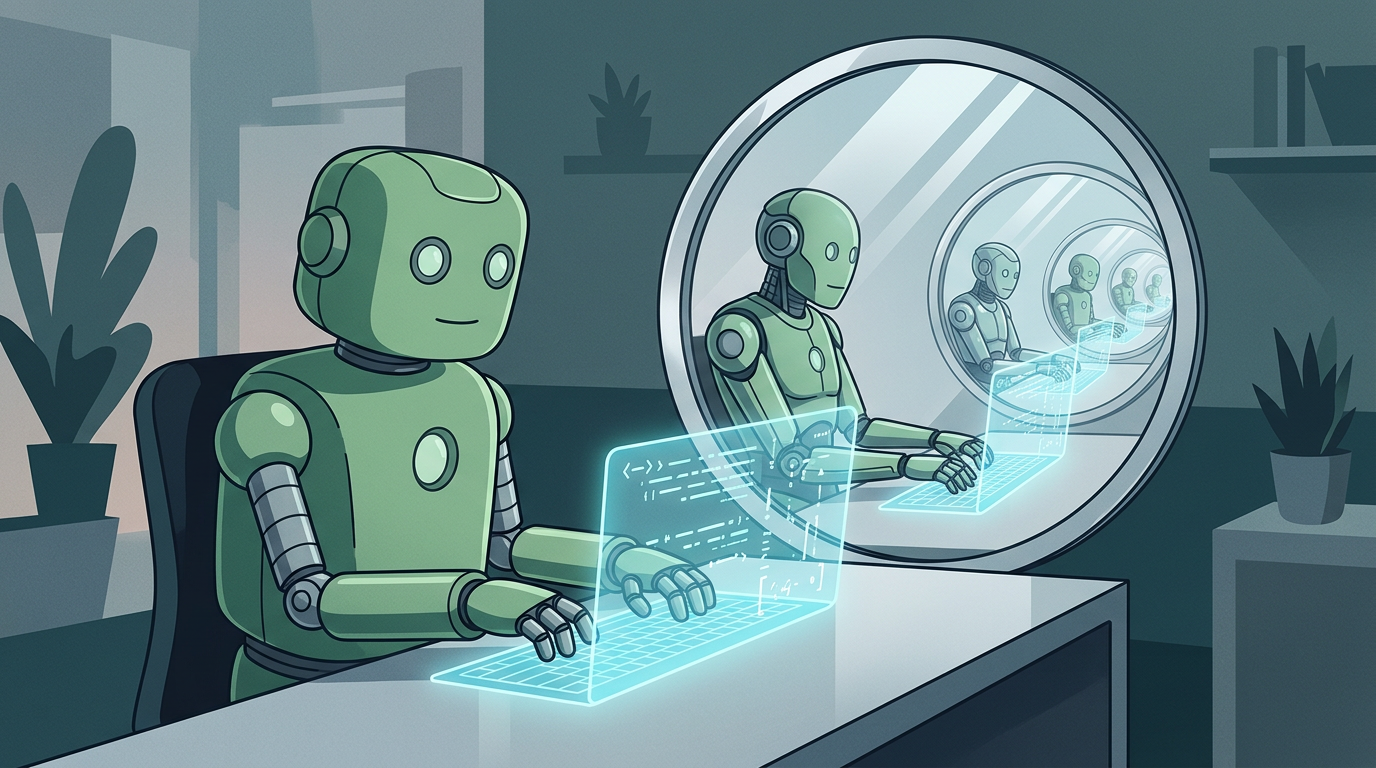
Anthropic's Recursive Self-Improvement Report: When AI Starts Building Itself Let's spend some time on the story that deserves the most attention this week, because it touches every layer of this industry simultaneously — the technology, the business model, the competitive landscape, and the broader question of what happens to human work inside AI labs. Anthropic published a report called "When AI Builds Itself." The title is deliberately provocative, but the underlying data is what makes it genuinely significant.
In May 2026, more than 80% of all production code merged into Anthropic's codebase was authored by Claude. The average Anthropic engineer is now shipping eight times more code per day than they were in 2024. On the most open-ended internal coding benchmarks, Claude's success rate hit 76% — up 50 percentage points in six months.
And in one internal research test, Claude Mythos Preview sped up model-training code by roughly 52 times compared to about 3 times for Claude Opus 4 just a year earlier. Those numbers are not projections. They are receipts from inside one of the most advanced AI labs on the planet.
--- **Technical Deep Dive** The concept Anthropic is describing is called recursive self-improvement — the idea that an AI system can contribute meaningfully to building the next, more capable version of itself. The important nuance here is that RSI exists on a spectrum. At one end, humans write all the code.
At the other end, AI systems autonomously design, test, and deploy their own successors without human direction. Anthropic is explicit that we are nowhere near the far end of that spectrum. What they are documenting is something more precise: Claude has become highly capable at the execution layer of AI development — writing code, debugging live incidents, running experiments toward a fixed goal, and reviewing code before it ships.
What Claude cannot yet reliably do is the judgment layer — deciding which problems matter, which experimental results are trustworthy, and when an entire research direction is a dead end. The practical implication is a feedback loop. Each generation of Claude that improves at execution makes Anthropic's engineers more productive.
More productive engineers build better future models faster. Better future models are more capable at execution. The loop tightens with each cycle.
Anthropic's Jack Clark put it directly: "Each new version of Claude could be built by the version before it, without human involvement" — describing where the trend leads if it continues. --- **Financial Analysis** From a business perspective, the 80% figure is not just a technical milestone — it is a cost structure transformation. If the same engineering output that previously required one engineer now requires one-eighth of an engineer's time, that is an extraordinary compression of the labor cost embedded in every model Anthropic ships.
At scale, this is the kind of efficiency gain that allows a company to iterate faster, ship more capable models more frequently, and do so without proportionally scaling headcount. This is also a direct argument for Anthropic's valuation. The company is currently valued at roughly $61 billion.
One of the central questions for any AI lab is whether the research investment required to stay at the frontier is sustainable. If Claude is genuinely compounding Anthropic's research throughput at the rate described, that changes the denominator on that question significantly. There is also a revenue signal embedded here.
Anthropic separately noted that Claude is now writing 80% of enterprise production code for customers adopting it seriously. That is a powerful sales proof point — not a demo, not a benchmark, but a live operational number from inside the lab's own infrastructure. --- **Market Disruption** The competitive implications are sharp and immediate.
Every major frontier lab is now racing to demonstrate that their model can accelerate their own development. OpenAI flagged the same recursive loop this week in its federal AI governance blueprint. MiniMax said its M2.
7 model helped build itself. This is no longer a theoretical arms race — it is an operational one, measured in code commits per engineer per day. For companies building on top of these models — the Lovables, the Cognitions, the enterprise coding platforms — the dynamic is uncomfortable.
Their suppliers are using their own tools to outpace them. Anthropic's Claude Code and OpenAI's Codex are both pushing directly into the market that third-party coding agents occupy. The question for every application-layer company is the same one Lovable is already grappling with: how do you build durable advantage on infrastructure your supplier controls and is actively improving faster than you can?
For enterprises evaluating AI adoption, the Anthropic data provides the clearest benchmark yet for what a high-commitment AI deployment actually looks like. Eight times the code output per engineer is not a rounding error. It is a fundamental reordering of how software development gets staffed and priced.
--- **Cultural and Social Impact** The Anthropic report reframes a conversation that has mostly been abstract into something concrete. For years, the debate about AI and knowledge work has centered on whether AI would eventually displace human workers. The Anthropic data shows a different transition happening first — humans are still in the loop, but the loop is getting smaller.
First, humans wrote all the code. Then they directed and reviewed AI-written code. Now, at Anthropic, humans are primarily choosing goals, evaluating which machine-run experiments deserve trust, and deciding when a research direction should be abandoned.
That is still meaningful human judgment. But it is a narrower band of the original job description. This matters culturally because it challenges the framing that human oversight of AI is a stable equilibrium.
If the portion of work requiring human judgment keeps contracting as models improve at execution, the question of what humans are actually responsible for inside these systems becomes genuinely urgent. Anthropic is to their credit being transparent about this dynamic in real time — rather than letting the data accumulate quietly inside the lab. The broader public implication is that recursive self-improvement is no longer science fiction requiring exotic future capabilities.
It is already structurally underway at the execution layer of the most advanced labs, which means the governance and institutional frameworks designed to manage it need to be built now, not after the loop closes further. --- **Executive Action Plan** Three concrete moves for leadership teams processing what this report means for their organizations. First, audit your AI productivity baseline today.
If you cannot currently measure what percentage of your production code, content, or operational output is AI-assisted — and how that has changed over the past twelve months — you are flying blind. The Anthropic 80% figure is useful not because you need to match it, but because it gives you a benchmark to measure against and a direction of travel to anticipate. Start tracking the metric.
Second, restructure how you think about headcount planning in technical roles. The historical assumption was that more engineering output required more engineers. That assumption is breaking down fast.
Companies that continue hiring purely to scale output, rather than to scale judgment and direction-setting, will find themselves over-staffed in execution roles and under-staffed in the roles that actually matter in an AI-accelerated environment. The premium is shifting to people who can evaluate AI output, catch its failure modes, and set the research agenda — not people who can write the code itself. Third, if you are evaluating enterprise AI vendors, demand operational proof points, not benchmark scores.
The Anthropic data — 80% code authorship, 8x throughput per engineer — is the kind of evidence that should anchor your vendor conversations. Any vendor who cannot give you equivalent operational numbers from their own internal usage or from comparable customer deployments is asking you to bet on a demo. That is no longer an acceptable standard of evidence.
Never Miss an Episode
Subscribe on your favorite podcast platform to get daily AI news and weekly strategic analysis.