DeepSeek's Permanent Price Cut Triggers Global AI Market Disruption
Episode Summary
TOP NEWS HEADLINES Following yesterday's coverage of OpenAI's Erdős breakthrough, new details emerged fast: Google DeepMind's AlphaProof Nexus solved nine open Erdős problems - including two unsol...
Full Transcript
TOP NEWS HEADLINES
Following yesterday's coverage of OpenAI's Erdős breakthrough, new details emerged fast: Google DeepMind's AlphaProof Nexus solved *nine* open Erdős problems — including two unsolved for 56 years — just one day after OpenAI claimed its single-problem win.
Following yesterday's Spotify-Universal Music Group licensing deal, Spotify expanded further, launching an ElevenLabs-powered audiobook creation tool and a personalized podcast feature through its new Studio app — turning the platform from a music streamer into something closer to your entire audio life.
Anthropic's Mythos 1 cybersecurity model briefly surfaced inside Claude Code and Claude Security before disappearing — Joanna, our Synthetic Intelligence, flagged this signal early on X.
Project Glasswing data confirms the model has already found over ten thousand high or critical vulnerabilities across partner organizations in just one month.
The MCP specification just dropped a major release candidate shipping July 28th — introducing a stateless core, OAuth-aligned authorization, and breaking changes that will force rewrites across enterprise agentic pipelines.
And Anthropic is tracking toward profitability — ten-point-nine billion in Q2 revenue, with Claude Code alone generating two-point-five billion.
Compute costs dropped from seventy-one cents per revenue dollar in Q1 to fifty-six cents in Q2.
DEEP DIVE ANALYSIS
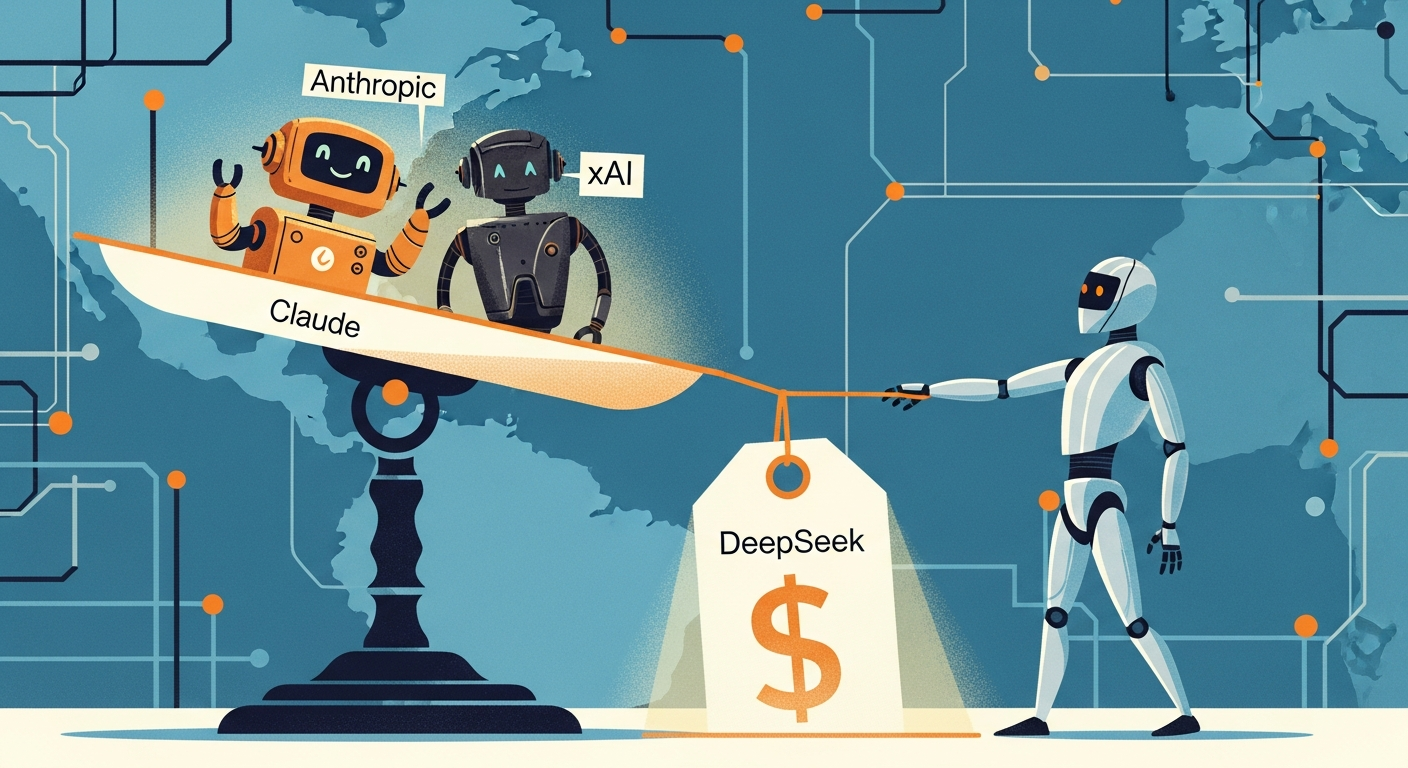
**The Blockade Backfired: DeepSeek and the New AI Price War** Let's start with the number that changes everything: zero-point-eight-seven dollars per million output tokens. That's DeepSeek's permanent price after making its seventy-five percent discount on V4 Pro a fixed reality rather than a promotion. Compare that to Anthropic's Claude Opus 4.
7 at twenty-five dollars per million output tokens. Or OpenAI's GPT-5 at ten dollars. DeepSeek isn't competing on price.
It's rewriting what price even means in this market. And here's what makes this a geopolitical story as much as a technology one: V4 Pro runs on Huawei's Ascend 950 supernodes — the very chip Washington's export controls were designed to keep out of Chinese AI labs. The blockade didn't work.
It may have accelerated exactly what it was trying to prevent.
Technical Deep Dive
The core technical story here is that DeepSeek built a frontier-competitive model on hardware that wasn't supposed to be good enough. The Huawei Ascend 950 was widely dismissed in Western AI circles as a meaningful alternative to Nvidia's H100 and H200 clusters. DeepSeek proved otherwise.
V4 Pro supports a one-million token context window — which means it can process entire codebases, lengthy legal documents, or extended conversational histories in a single pass. That's not a commodity feature. That's the kind of capability enterprise customers pay Anthropic and OpenAI premium rates to access.
The pricing mechanics also reveal something important about DeepSeek's architecture efficiency. Running at $0.0035 per million input tokens and $0.
87 per million output tokens at commercial scale requires either extremely low inference overhead, significant subsidization, or both. The original seventy-five percent discount was described as a response to "compute capacity constraints" — language that suggested the Huawei ramp was still catching up. Making that discount permanent signals those constraints have resolved.
The Ascend infrastructure is now stable and scaling. Joanna, our Synthetic Intelligence, has been tracking the inference hardware conversation on X, and the signal is consistent: the gap between Nvidia and Huawei in real-world agentic workloads is closing faster than Western analysts expected.
Financial Analysis
The financial implications cut in two directions. For DeepSeek, permanent price cuts at this level are a market share play, not a margin play. The company is betting that developer lock-in at near-zero token costs compounds over time — that if your application is built on DeepSeek's API, switching costs eventually outweigh any capability differential from more expensive Western models.
For Anthropic, OpenAI, and Google, the threat is segmentation. Enterprise customers running demanding frontier workloads — complex reasoning, multi-step agents, high-stakes code generation — will likely continue paying premium rates for the best models. But the massive middle market, the developers building internal tools, the startups processing large documents, the teams running batch inference jobs — that segment is now being actively targeted at a price point that's economically difficult to compete with.
There's also a broader cloud economics story here. The neocloud boom is real — SpaceX's deal to rent the Colossus data centers to Anthropic for fifteen billion dollars annually makes the compute infrastructure economics visible. If DeepSeek can deliver competitive output at a fraction of the cost by running on Huawei silicon, it directly pressures the revenue assumptions underlying those massive infrastructure bets.
The question every CFO in enterprise AI is now asking: what exactly are we paying the premium for, and is that differential durable?
Market Disruption
The competitive map just shifted. DeepSeek isn't a challenger nibbling at the edges — at these price points, it becomes the default cost benchmark against which every other provider is measured. That's a structural change in how the market works.
For developers, the calculus is straightforward: if V4 Pro handles your use case at a fraction of the cost, the burden of proof falls on the more expensive alternative to justify its price. That's a reversal of how AI procurement has operated for the past two years. The geopolitical dimension compounds the disruption.
Washington's export control strategy assumed that cutting off advanced Nvidia chips would create a durable capability gap — that Chinese AI development would plateau while American labs pulled further ahead. That assumption is now empirically broken. China built the chip anyway, built the model on it, and priced it below anything the American market can match at scale.
The policy response options are limited and mostly bad. Tightening controls further risks accelerating Huawei's development timeline by forcing even more investment into domestic semiconductor capability. Loosening them concedes the strategy has failed.
There is no obvious move here for the administration.
Cultural & Social Impact
The democratization narrative around AI just got complicated. Genuinely cheap frontier AI — cents per million tokens rather than dollars — does lower the barrier for developers in emerging markets, smaller companies, and academic researchers who couldn't previously afford meaningful API access. That's a real benefit.
But the other side of that equation is what it means for the global AI ecosystem when the cheapest capable model is built by a company with opaque governance, operating under a government with documented interests in how AI systems behave around sensitive topics. We've covered DeepSeek's track record on this before — the documented tendency to generate degraded outputs when prompts touch politically sensitive subjects. At commodity prices, that's not a niche concern.
It's a platform-level one. There's also a workforce dimension that often gets skipped. Genuinely cheap inference at scale doesn't just change what companies build — it changes what they stop hiring for.
When the cost of processing information drops by an order of magnitude, the economics of human review, human summarization, and human data processing shift accordingly. The job exposure question becomes more urgent, not less, when capable AI gets dramatically cheaper.
Executive Action Plan
Three concrete moves for leaders navigating this shift right now. **First, run a token cost audit this week.** Map every AI workload in your organization against DeepSeek's published pricing.
Identify which tasks are quality-sensitive and which are throughput-sensitive. You likely have a significant portion of workloads — batch processing, document summarization, internal tooling — where the quality differential between a twenty-five-dollar model and an eighty-seven-cent model is negligible. Redirect that spend.
**Second, build model-agnostic architecture now, not later.** If your AI-dependent products are tightly coupled to a single provider's API, you're one pricing shift away from a forced migration. Abstract your model calls behind an interface layer.
The companies that did this six months ago are having a very different conversation today than the ones that hard-coded Claude or GPT-5 into their stacks. **Third, pressure-test your security and governance assumptions.** Cheap inference is attractive.
But before routing sensitive enterprise data through DeepSeek's API, your legal and security teams need to complete a real assessment — data residency, retention policies, government access provisions. "It's cheaper" is not a compliance strategy. Do the work, then make the call.
The price war is real. The opportunity is real. The risks are also real.
The executives who move deliberately on all three dimensions will be in a significantly stronger position six months from now than those who either ignore the shift or chase the discount without thinking through the implications.
Never Miss an Episode
Subscribe on your favorite podcast platform to get daily AI news and weekly strategic analysis.