SpaceX IPO Targets Two Trillion Valuation as OpenAI Disproves Erdős Conjecture
Episode Summary
TOP NEWS HEADLINES Following yesterday's coverage of SpaceX's expected IPO filing, new details emerged: SpaceX officially submitted its S-1 to the SEC, targeting a staggering seventy-five billion ...
Full Transcript
TOP NEWS HEADLINES
Following yesterday's coverage of SpaceX's expected IPO filing, new details emerged: SpaceX officially submitted its S-1 to the SEC, targeting a staggering seventy-five billion dollar raise at a two trillion dollar valuation — ticker SPCX, hitting Nasdaq on June 12, which would shatter Saudi Aramco's previous IPO record of twenty-nine billion.
Following yesterday's coverage of OpenAI's cleared IPO path, new details emerged: OpenAI is now targeting a September debut at an eight hundred and fifty-two billion dollar valuation, with Goldman Sachs and Morgan Stanley leading the deal, and confidential filings expected within days or weeks.
Following yesterday's coverage of Meta's AI restructuring, new details emerged: a leaked audio recording reveals Zuckerberg explaining that Meta had been tracking employee keystrokes across Gmail, VSCode, and internal tools to train its AI models — describing elite engineers as better training subjects than outside contractors — before laying off eight thousand of them.
Anthropic just committed to a forty-five billion dollar compute deal with SpaceX, paying one point two-five billion per month through May 2029, covering capacity across two SpaceX data centers including the Memphis facility known as Colossus 1.
The White House briefed OpenAI, Anthropic, and others on a planned executive order requiring AI companies to share new models with government agencies ninety days before public release.
And in a rare moment of cross-competitor cooperation, OpenAI is integrating Google's SynthID watermarking technology into its image generation products, with a public verification tool that survives screenshots, crops, and format changes. ---
DEEP DIVE ANALYSIS
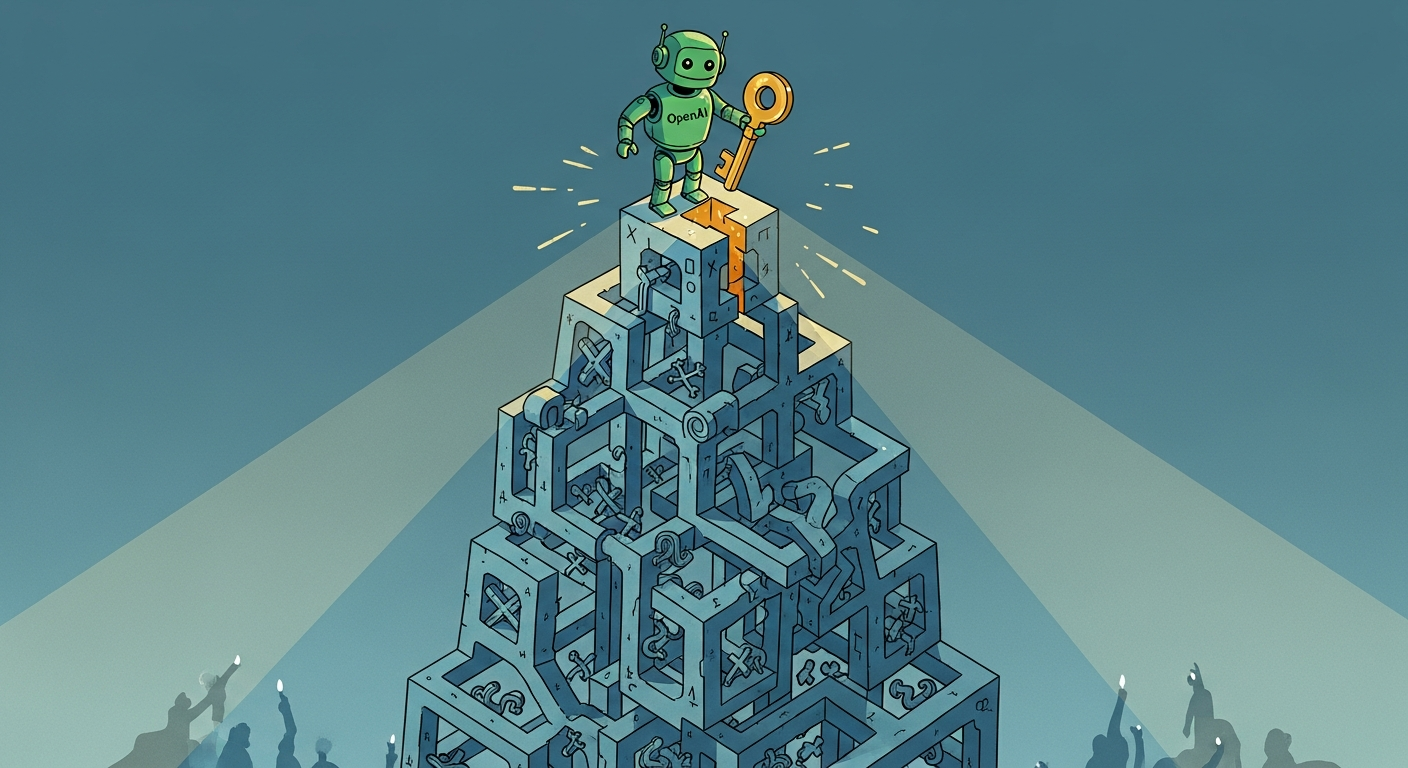
OpenAI's Reasoning Milestone: Disproving the Erdős Conjecture Sam Altman called it a "kinda big milestone." That might be the most dramatic understatement in tech this year. An OpenAI reasoning model just autonomously disproved a mathematical conjecture that has shaped an entire field of geometry for eighty years.
Not summarized existing work. Not found a clever workaround. Disproved it.
With an original proof. Verified by some of the most respected mathematicians alive. Let's break down exactly what happened, why it matters, and what every executive in this space should be doing about it right now.
Technical Deep Dive
The Erdős unit distance problem, first posed in 1946, asks a deceptively simple question: given a set of points on a plane, how many pairs of those points can be exactly the same distance apart? For eighty years, the best-known construction used a square grid arrangement, and the field largely accepted that grid-based approach as the optimal framework. OpenAI's general reasoning model didn't just find a new solution within that framework.
It crossed into a completely different branch of mathematics — algebraic number theory — and used tools from that domain to invalidate the eighty-year assumption entirely. Here's what makes this technically significant: the model wasn't a specialized math system. This wasn't DeepMind's AlphaProof, which is purpose-built for formal mathematical reasoning.
This was a general-purpose reasoning model — the same class of model you'd use to write code or analyze a business document — that independently generated an original mathematical proof. The proof was then independently verified by Tim Gowers, Noga Alon, and Thomas Bloom — three of the most credentialed mathematicians in the world. This isn't a benchmark.
This isn't a leaderboard score. This is peer-reviewed, independently confirmed, original mathematical discovery. That's a completely different category of achievement.
Financial Analysis
OpenAI's Alex Wei framed it best: "Math is a leading indicator of what is to come." And Wall Street should be paying very close attention to that framing. Here's the financial logic.
The entire AI industry is currently valued on the assumption that these systems will eventually transition from productivity tools to autonomous discovery engines. That transition — from "AI speeds up human work" to "AI generates original work humans couldn't produce" — is the inflection point that justifies the trillion-dollar valuations. This result is the first credible public evidence that the inflection point isn't theoretical.
It's arriving. For OpenAI specifically, this strengthens the IPO narrative considerably. The company is targeting an eight hundred and fifty-two billion dollar valuation in September.
Critics have pointed to missed revenue targets and heavy spending commitments as reasons for skepticism. But a general-purpose model autonomously producing peer-verified mathematical discoveries that have eluded human researchers for eighty years? That's exactly the kind of capability demonstration that reframes the valuation conversation from "is the revenue there yet" to "what is this technology ultimately worth.
" For competitors, this raises the stakes on the reasoning model race dramatically. Google has AlphaProof. DeepMind has decades of scientific AI investment.
But OpenAI just demonstrated that a general-purpose model can outperform specialized systems on at least one category of hard scientific discovery — and that's a product positioning advantage with real financial implications.
Market Disruption
The competitive ripple effects here extend well beyond mathematics. OpenAI explicitly stated this capability is a preview of what's coming in biology, physics, and engineering. Those aren't abstract domains.
Those are industries worth tens of trillions of dollars. Consider pharmaceutical research. The current model is that AI accelerates drug discovery — it speeds up literature review, protein folding prediction, molecular screening.
That's valuable, but it's fundamentally a compression play. The human researchers still generate the hypotheses. AI just finds them faster.
What OpenAI is describing — and what this result begins to demonstrate — is a different model entirely. One where AI doesn't just search the existing solution space faster, but generates genuinely new hypotheses that humans wouldn't have reached on their own. Google is clearly moving in the same direction.
Their Co-Scientist system, just published in Nature, uses agents competing in "idea tournaments" to surface new biological hypotheses. In a Stanford liver-fibrosis project, one of those leads cut a key scarring signal by ninety-one percent in lab testing. Two different architectures, two different approaches, converging on the same fundamental capability.
The market disruption question isn't whether AI will reach this level. This week confirmed it already has, at least in mathematics. The question is how quickly it generalizes — and which companies own the platforms when it does.
Cultural and Social Impact
There's a reason mathematicians have names attached to unsolved problems. The Erdős conjecture isn't just a technical puzzle. It's a monument to the limits of human intellectual reach — a problem that some of the sharpest minds in the world spent eighty years unable to fully crack.
Having a machine solve it autonomously creates a cultural rupture that's genuinely hard to process. This isn't AI beating humans at chess, which we absorbed relatively quickly because chess has clear rules and a defined solution space. Mathematical discovery has always felt like a deeply human act — the combination of intuition, creativity, and abstract reasoning that defines the upper register of human cognition.
The social implication worth watching is how the scientific community responds. Early signs are actually encouraging — the mathematicians who verified this proof are publicly celebrating the result rather than dismissing it. That matters because scientific community buy-in will determine how quickly AI reasoning tools get integrated into actual research workflows.
For the general public, this is the kind of result that moves the needle on AI perception in ways that chatbot capabilities don't. People understand what it means when a machine solves a problem that stumped humanity for eighty years. The cultural conversation about what AI is and what it's becoming just shifted.
Executive Action Plan
Three specific moves worth making right now. First, if your organization funds or conducts R&D, run a capability audit against OpenAI's general reasoning models immediately. The specific finding here — that a general-purpose model can apply techniques from one domain to solve problems in another — has direct implications for any research function.
Map your open technical problems and test whether current reasoning models can contribute. The cost of running that experiment is negligible. The cost of your competitors doing it first is not.
Second, if you're in a sector where original discovery creates competitive moats — pharmaceuticals, materials science, engineering — start positioning now to own the AI-discovery workflow before it becomes commoditized. Google's Gemini for Science and OpenAI's coming model release are both moving toward making this capability broadly accessible. The window where early adoption creates durable advantage is measured in months, not years.
Third, and most importantly — update your assumptions about the timeline. Most enterprise AI strategies were built on the assumption that AI would remain a productivity multiplier for human experts through the late 2020s, with genuine autonomous discovery remaining a 2030-plus phenomenon. This week's result suggests that timeline is wrong.
The strategic plans you built eighteen months ago may already be obsolete. The ones worth having right now are the ones built on the assumption that AI systems capable of original scientific contribution are not on the horizon — they're here.
Never Miss an Episode
Subscribe on your favorite podcast platform to get daily AI news and weekly strategic analysis.