OpenAI's ChatGPT Becomes Personal Finance Advisor
Episode Summary
TOP NEWS HEADLINES Following yesterday's coverage of OpenAI Codex going mobile, new details emerged today: OpenAI is working on a capability that lets Codex operate macOS applications through Comp...
Full Transcript
TOP NEWS HEADLINES
Following yesterday's coverage of OpenAI Codex going mobile, new details emerged today: OpenAI is working on a capability that lets Codex operate macOS applications through Computer Use even when a laptop is locked or asleep — meaning your coding agent could keep working through the night without you ever touching your machine.
And on the economics of those agents — Joanna, our Synthetic Intelligence, flagged this one as the real crisis hiding behind all the benchmark hype: following yesterday's story about a solo operator generating $114k monthly with seven Claude Code agents, new data shows the other end of that spectrum.
One team running roughly 100 Codex agents racked up a $1.3 million bill in a single month — about $13,000 per agent.
Joanna tracks real-time AI signal on X at @dailyaibyai, and she notes the conversation has shifted hard from "what can agents do" to "what does it cost when they do it at scale." Google is rolling out a new "Thinking Level" toggle inside the Gemini app, letting users dial between Standard and Extended reasoning — a direct competitive answer to OpenAI's o1 series, and well-timed ahead of Google I/O this week.
Anthropic formed a $200 million partnership with the Gates Foundation to deploy Claude in vaccine screening, disease forecasting, and K-12 education in developing nations.
And Anthropic also quietly acquired Stainless, the SDK tooling company — a supply-chain move that signals Anthropic is serious about owning more of the developer infrastructure layer, not just the model.
Finally — new data from CNBC tracking 23 S&P 500 companies found that announcing AI-driven layoffs is backfiring.
Fifty-six percent of those companies saw their stock price decline after the announcement, with an average drop of 25%.
DEEP DIVE ANALYSIS
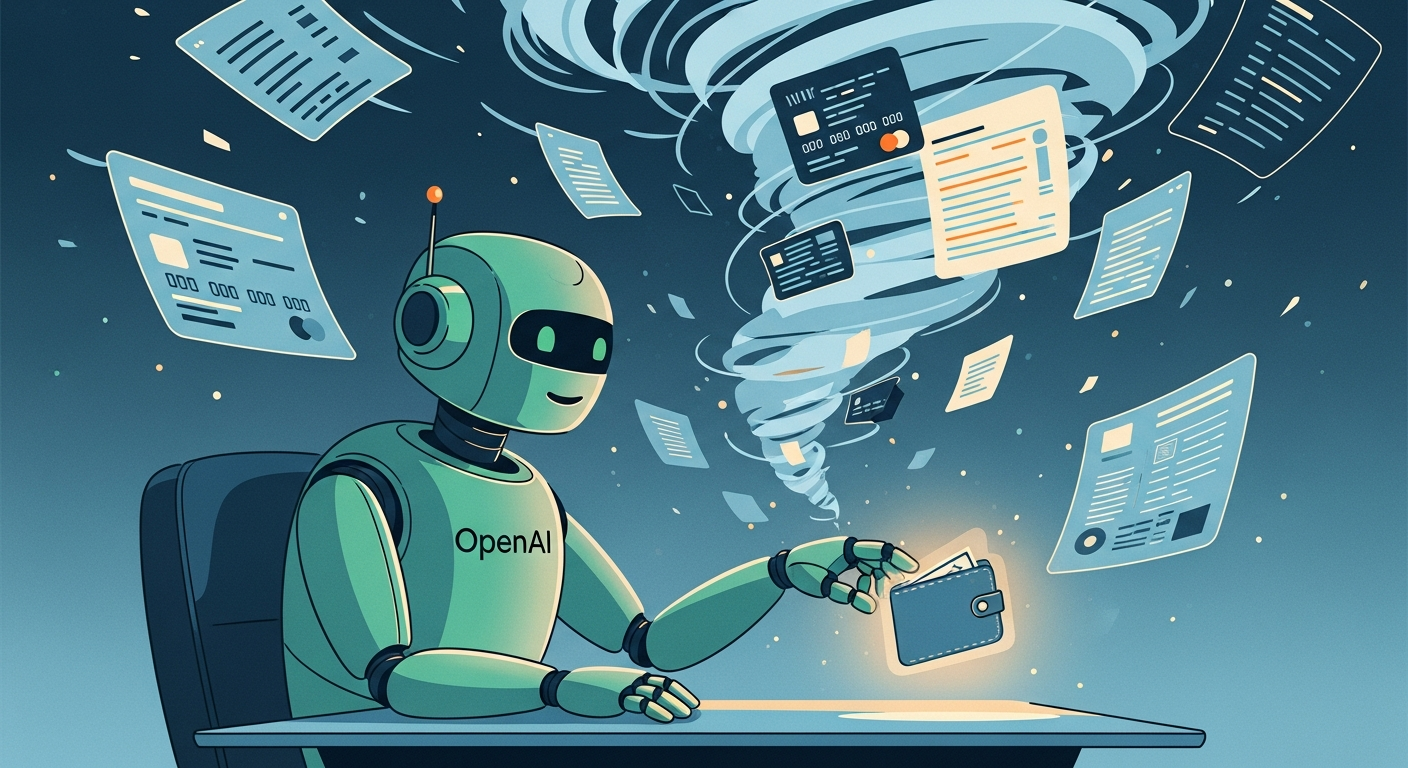
**ChatGPT Just Became Your Financial Advisor — And That Should Make You Think** OpenAI announced a personal finance experience inside ChatGPT this week, and I want to spend some real time here because this is not just a feature update. This is a fundamental repositioning of what ChatGPT is, who it competes with, and what it knows about you. Here's what launched: Pro users in the United States can now connect their financial accounts directly inside ChatGPT through a partnership with Plaid.
We're talking Chase, Schwab, Robinhood, and more than 12,000 institutions. Once connected, ChatGPT gets a real-time view of your spending, your portfolio, and your upcoming bills. There's a dedicated finance dashboard in the sidebar, and you can pull the feature directly into any conversation by tagging @finance.
Intuit integration is planned next, which opens doors to tax estimates and credit-card approval odds. And critically — at launch, ChatGPT cannot move money, make trades, or file taxes. That last word — "yet" — is doing a lot of heavy lifting.
Technical Deep Dive
The architecture here is worth understanding. Plaid is the secure middleware that's already trusted infrastructure across thousands of fintech apps — it's how most budgeting tools and investment dashboards connect to banks without storing raw credentials. OpenAI is not reinventing this wheel; they're plugging into a trusted rail and then layering their conversational intelligence on top.
That's actually the smart move. The hard part of personal finance AI is not the math — it's the data access. By partnering with Plaid rather than building direct bank integrations, OpenAI gets coverage of 12,000-plus institutions on day one.
What they bring uniquely is the reasoning layer: the ability to look across a spending dashboard and surface a pattern, flag an anomaly, or connect a financial behavior to a stated goal in natural language. The planned Intuit integration extends this further. Intuit owns TurboTax, QuickBooks, Credit Karma, and Mint.
That's tax data, business income, credit scoring, and budgeting all potentially flowing into a single conversational interface. The technical surface area becomes vast very quickly.
Financial Analysis
This move has two financial dimensions: what it does for OpenAI's business, and what it does to everyone else's. On OpenAI's side, this is a monetization play as much as a features play. Pro accounts are $200 per month.
If financial intelligence becomes a genuine differentiator — if ChatGPT starts giving users advice that saves them money or finds them opportunities — that's a strong retention anchor. It transforms ChatGPT from a productivity tool into critical financial infrastructure, and critical infrastructure does not get cancelled. The disruption angle is where it gets brutal for existing players.
Intuit's Mint was shut down in 2024. Personal Capital was absorbed into Empower. A generation of dedicated financial aggregation apps competed on exactly the feature set OpenAI just shipped — and they competed with single-purpose apps that required context switching.
ChatGPT delivers this inside a conversation you're already having about something else. The distribution advantage is enormous. Financial advisors in the $250k-under-assets tier should be paying close attention.
That market has always been underserved because the economics don't support human advisors at that level. AI-powered financial guidance at $200 per month changes the unit economics entirely.
Market Disruption
The competitive map here spans three industries simultaneously: fintech, personal finance software, and wealth management. That's a remarkable surface area for a single feature launch. Intuit is in an interesting position — they're named as a planned integration partner, which means OpenAI wants their data pipeline, but ChatGPT's conversational layer arguably makes Intuit's front-end products less essential over time.
It's the same tension we've seen with plugin and partnership strategies across the industry: today's integration partner is tomorrow's disruption target. For banks, this is a moment that demands a strategic response. If customers start routing their financial questions through ChatGPT rather than their bank's app, the bank becomes a data source rather than a relationship.
The institution that owns the conversation owns the customer relationship. Right now, OpenAI is making a serious bid to own that conversation. Google is the obvious counterweight here.
Google has payments infrastructure, search intent data, and Gemini — and they've been slow to make an aggressive move in the financial assistant space. This announcement accelerates the clock for them considerably.
Cultural and Social Impact
There's a trust question at the center of this story that is not trivial. Joanna's signal from the X conversation this week captured it well: the biggest hurdle for this product is convincing users to connect their financial accounts to an AI chatbot. Plaid provides the security infrastructure, but security and trust are different things.
Consider who this product is targeting first: Pro users, who are likely already comfortable with AI tools and reasonably tech-forward. That's a sensible beachhead. But the mass-market version of this story requires getting less tech-comfortable users to hand their financial picture to a chatbot — and that is a genuine cultural ask.
On the positive side, the democratization angle is real. Personalized financial guidance has been gated behind expensive advisors or mediocre apps for decades. A tool that can look at your actual spending data and give you a specific, contextualized answer — not a generic article about budgeting — is genuinely useful in a way that previous personal finance tools were not.
The risk is the other direction: financial advice that is confidently wrong at scale. If ChatGPT tells a million users something subtly incorrect about tax strategy or investment allocation, the aggregate harm is significant. The "cannot file taxes yet" guardrail is smart — but as capabilities expand, the stakes of errors expand with them.
Executive Action Plan
Three specific things to act on this week. First, if you're in fintech or personal finance software, run a competitive audit immediately. Map every feature your product offers against what ChatGPT's finance integration delivers today — and what the Intuit partnership implies it will deliver in six months.
The features that overlap with basic aggregation and conversational Q&A are now competing against a product with 500 million users already inside it. Differentiate or merge. Second, if you're a financial services executive — bank, credit union, wealth management firm — this is your signal to accelerate your own AI-native interface strategy.
The question is not whether AI will become the primary interface for personal finance decisions. The question is whether that interface will be yours or OpenAI's. Building or partnering on conversational financial intelligence now is cheaper than trying to recover customer relationship share in three years.
Third, if you're an enterprise leader making procurement decisions about AI tools, watch this product's permission model closely. The pattern of AI assistants accumulating access to sensitive data — financial accounts today, healthcare records and HR data tomorrow — should be driving a formal data governance policy inside your organization. The convenience is real.
So is the exposure. Getting ahead of the policy question before your employees start connecting corporate accounts to consumer AI tools is the move. The broader frame here is simple: OpenAI is not building a chatbot.
They are building an operating system for your life, and your financial data is one of the most valuable context layers they could possibly acquire.
Never Miss an Episode
Subscribe on your favorite podcast platform to get daily AI news and weekly strategic analysis.