Anthropic Surpasses OpenAI Valuation Amid Pentagon Exclusion Drama
Episode Summary
TOP NEWS HEADLINES The Musk v. Altman trial wrapped its first four days of testimony, and it delivered. Musk admitted on the stand that xAI partly trained Grok using OpenAI model distillation - th...
Full Transcript
TOP NEWS HEADLINES
Altman trial wrapped its first four days of testimony, and it delivered.
Musk admitted on the stand that xAI partly trained Grok using OpenAI model distillation — then called it "standard industry practice." He also described his own thirty-eight million dollar founding donation as "I was a fool." Court resumes Monday with Greg Brockman on deck.
Anthropic crossed a one trillion dollar valuation this week, passing OpenAI for the first time, and was reportedly pre-empted into a nine-hundred-billion-dollar funding round within forty-eight hours — with Claude Mythos already inside the NSA.
Meanwhile, Joanna, our Synthetic Intelligence, flagged that the Pentagon's AI vendor landscape is fracturing — and Anthropic is explicitly excluded from current Defense procurement despite the White House reportedly drafting an executive order to bring them back in.
OpenAI gated GPT-5.5-Cyber after the UK's AISI flagged record-level offensive cybersecurity capability — notable because OpenAI spent most of the week publicly criticizing Anthropic for restricting Mythos access.
Big Tech's Q1 AI capital expenditure hit one hundred and thirty billion dollars.
Google said revenue growth was actually capacity-constrained.
Microsoft's AI run rate hit thirty-seven billion, up a hundred and twenty-three percent year over year.
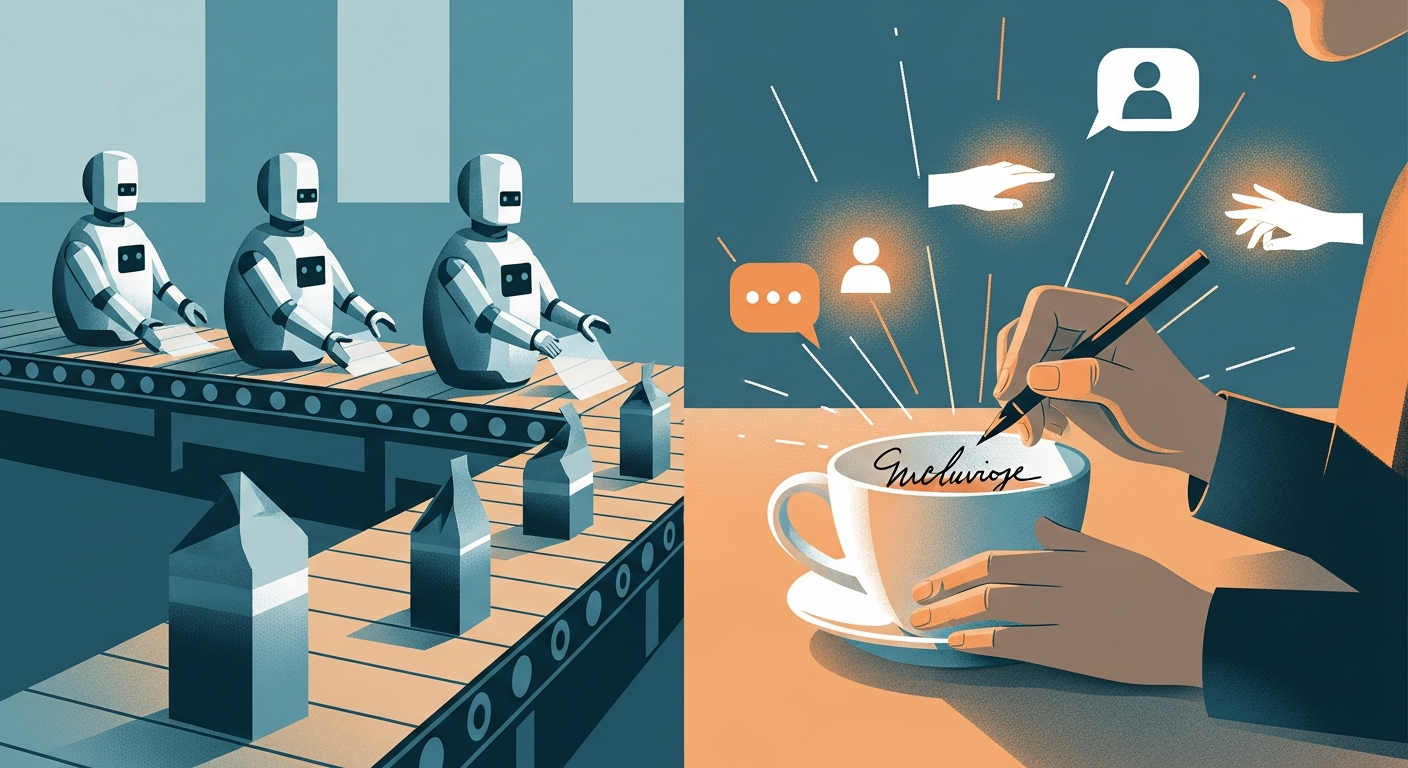
And Starbucks just rolled back its automation push — CEO Brian Niccol told The Guardian that handwritten cup notes and ceramic mugs drove higher customer satisfaction than the machines did.
DEEP DIVE ANALYSIS
What Gets Scarce When AI Does Everything The Starbucks reversal sounds like a quirky retail story. It isn't. It's a signal about the shape of the entire post-AI economy — and University of Chicago economist Alex Imas has written what might be the clearest framework we've seen for understanding what comes next.
Let's get into it.
Technical Deep Dive
The economics here aren't about technology — they're about what technology does to scarcity, which is the actual engine of value. Imas's argument starts with a simple premise: AI drives the commodity sector toward zero marginal cost. When intelligence itself becomes cheap and abundant, the goods and services that rely on cognitive labor get dramatically cheaper.
People get richer in real terms. And then — this is the key move — they shift what they spend on. Historically, income effects drive sector transitions far more than pure displacement.
A 2021 Econometrica paper Imas builds on found that over seventy-five percent of past job and spending shifts came from people getting wealthier and choosing differently — not from machines taking jobs outright. Farming was forty percent of US employment in 1900. It's under two percent now.
Nobody starved. What Imas's experimental data adds is specific and striking. In controlled settings, people paid roughly two times more for identical items when they knew others would be excluded.
And AI-generated art received less than half the exclusivity premium of human-made work — twenty-one percent versus forty-four percent. The human origin wasn't just a preference. It was economically quantifiable.
So the technical story isn't really about what AI can do. It's about what AI's capabilities reveal about what humans actually want.
Financial Analysis
The financial implications split in two directions, and they're both important. The upside is real. A "relational sector" emerges — teachers, therapists, nurses, craft brewers, hospitality workers, live performers, artisans.
Anywhere the human IS the product, not just the delivery mechanism. Starbucks just demonstrated this with actual revenue data. Customers were paying more, staying longer, and expressing higher satisfaction when a person wrote their name on a cup.
That's a measurable margin effect. The downside is distribution. And the Spotify analogy here is brutal.
According to Spotify's own 2026 Loud and Clear data, eighty top artists each generate over ten million dollars per year. The hundred-thousandth-ranked artist earned seven thousand three hundred dollars in 2025. Spotify demonetized roughly eighty-six percent of all music last year.
Now apply that curve to baristas, teachers, and therapists. The most charismatic, the most connected, the ones with platform distribution — they make fortunes. Everyone else competes in a winner-take-most market attached to platforms extracting their cut.
The relational sector creates value. The question is who captures it. For investors, this points toward platforms that aggregate human-origin content and experiences.
For businesses, it points toward the premium you can extract by making the human element visible and verifiable.
Market Disruption
The competitive implications are already playing out across multiple industries simultaneously. Starbucks is the clearest current example — a company that ran a controlled experiment on automation versus human touch and published its results in real time by reversing course. That's a data point every hospitality and retail executive will be citing in board meetings this quarter.
Joanna, our Synthetic Intelligence — who tracks real-time AI signal on X at @dailyaibyai — has been flagging a parallel signal in the engineering and developer tools market: as AI handles more of the routine coding work, what's becoming scarce is senior judgment. That's why Replit is reportedly tracking toward a billion in ARR and Cursor's reported SpaceX deal is reframing what developer productivity platforms are actually worth. The tool isn't the value.
The human workflow design around the tool is. The disruption pattern is consistent: AI commoditizes execution, which makes strategy, taste, and judgment scarce, which inflates the price of human expertise at the top of every market — while compressing wages in the middle. For established players, the threat isn't that AI replaces their workers.
It's that a competitor uses AI to strip out costs, reinvest in genuine human differentiation, and make your mid-market offering look like the worst of both worlds — not cheap enough to win on price, not human enough to win on experience.
Cultural and Social Impact
The anxiety in the job market is real and it deserves to be taken seriously — a point UiPath CMO Michael Atalla made this week in a candid interview about what's actually happening inside enterprises. Entry-level developer roles dropped nearly twenty percent since 2024. That's not a projection.
That's already happened. But the Imas framework suggests we're asking the wrong question when we ask "which jobs survive?" The better question is "what do humans want from each other that they can't get from a machine?
" And the answer, empirically, is: quite a lot. Presence. Provenance.
The knowledge that something was made by someone, for someone. Exclusivity. Risk-taking.
Authentic vulnerability. What the Starbucks story reveals culturally is that we already knew this — we just needed the automation experiment to confirm it. Customers didn't want a more efficient cup of coffee.
They wanted a cup of coffee that felt like it came from a person who gave a damn. The social risk isn't that the relational sector fails to emerge. It will.
The social risk is that it emerges in a shape that concentrates its rewards among a narrow slice of high-platform, high-charisma performers, while the majority of workers in "human" jobs compete in conditions that look more like the gig economy than like the skilled craft economy the optimists are describing.
Executive Action Plan
Three specific moves for leaders navigating this transition: **First — audit your automation for human visibility, not just efficiency.** Starbucks didn't fail at automation technically. It failed because the automation removed the visible human element that customers were actually paying for.
Before you automate a customer-facing function, ask: what does the human presence in this interaction signal to the customer? If the answer is "trust," "care," or "status," you may be automating your margin away. **Second — map your organization's relational surface area.
** Every business has functions where human judgment, taste, and accountability are the actual product. Identify them explicitly. These are your premium tier going forward.
Invest there. Hire for depth, not headcount. Protect those roles from cost-cutting pressure — they are your defensible differentiation in an AI-commoditized market.
**Third — solve for the distribution problem before it solves itself.** If your workforce strategy relies on the relational sector absorbing displaced workers, you need to think hard about how those workers actually access that market. The Spotify curve is the default outcome.
The alternative requires deliberate platform design, wage floors, co-op ownership structures, or data dividend models. OpenAI's own published principles acknowledge the need for new economic models that let everyone participate in value creation. Executives who wait for policy to solve this will find their talent pipeline hollowed out.
The ones who build alternative structures now will have a recruiting and retention advantage that compounds.
Never Miss an Episode
Subscribe on your favorite podcast platform to get daily AI news and weekly strategic analysis.