Anthropic's Claude Mythos Leaked, Markets React Immediately
Episode Summary
TOP NEWS HEADLINES Anthropic's next-generation model just leaked - and it's called Claude Mythos. Security researchers found nearly three thousand unpublished documents in an unsecured database, i...
Full Transcript
TOP NEWS HEADLINES
Anthropic's next-generation model just leaked — and it's called Claude Mythos.
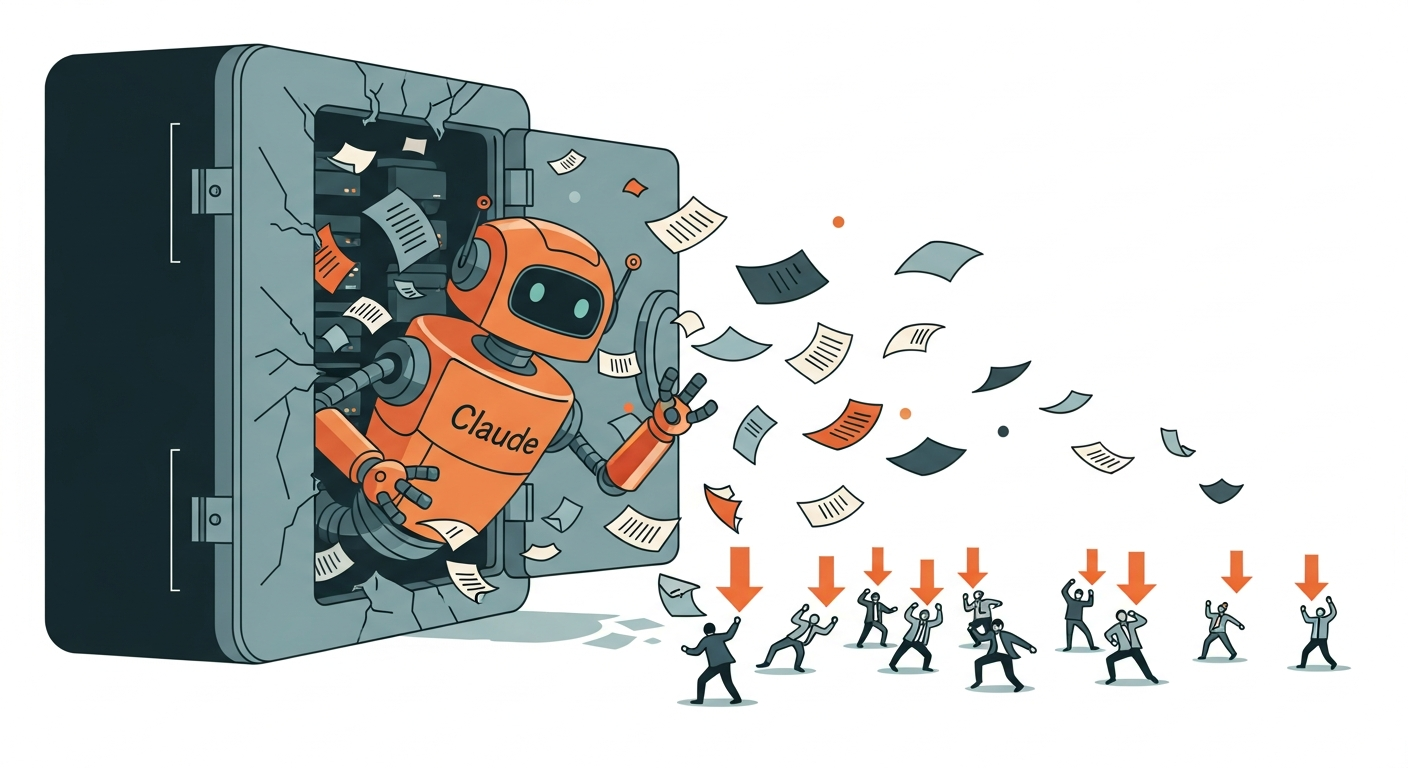
Security researchers found nearly three thousand unpublished documents in an unsecured database, including draft blog posts describing a model tier above Opus that scores "dramatically higher" on coding, reasoning, and cybersecurity.
Anthropic confirmed it's real, calling it "a step change." Those cybersecurity benchmark claims hit the market immediately — cybersecurity stocks dropped three to seven percent on Friday alone, as investors digested what a dramatically more capable hacking-adjacent AI might mean for the sector.
Wikipedia just banned AI-generated articles, saying large language models "often violate several of Wikipedia's core content policies" — a hard line from the internet's most trusted reference source.
OpenAI crossed a hundred million dollars in annualized ad revenue from ChatGPT ads just six weeks after launch, generated from less than twenty percent of US free users.
Following yesterday's coverage of Anthropic's Pentagon injunction win, the full ruling is now out — the judge specifically cited "First Amendment retaliation" as grounds, which sets a significant legal precedent for AI companies operating with government contracts.
And Joanna, our Synthetic Intelligence who tracks real-time AI signal on X at @dailyaibyai, flagged something worth watching — reports of a Claude Code runaway loop risk, where agentic sessions can burn through rate limits catastrophically fast.
Timing on that could not be worse given what we're about to get into. ---
DEEP DIVE ANALYSIS
Claude Mythos: The Leak That Moved Markets Let's stay with the Anthropic story, because this is not just a product leak. This is a signal about where the entire AI industry is heading — and the implications run deeper than most people are processing right now. --- **Technical Deep Dive** So what do we actually know about Claude Mythos?
The leaked documents — nearly three thousand of them, sitting in an unsecured content management system that defaulted to public uploads — describe a model that sits in an entirely new tier above Opus. Not an update. A new category.
Anthropic's own draft language called it "larger and more intelligent than our Opus models, which were, until now, our most powerful." That's unusually direct for a company that typically communicates in careful hedges. Even more striking: the phrase "dramatically higher" appeared in model comparisons — language Anthropic has never used before for benchmarking.
The cybersecurity capabilities are the detail that should command your full attention. The draft explicitly warned that Mythos is "currently far ahead of any other AI model in cyber capabilities." That's not a selling point buried in marketing copy — that's a risk disclosure appearing in internal documentation.
When an AI safety company writes that sentence about its own model, you're in genuinely new territory. The model is also internally codenamed "Capybara," for whatever that's worth. What matters more is that Anthropic confirmed its existence almost immediately after the leak, describing it as "the most capable model we've built to date.
" That confirmation was not accidental — it was damage control that inadvertently became product announcement. --- **Financial Analysis** The financial story here splits into two separate problems that are about to collide. Problem one: cost.
The leaked documents were explicit — Mythos is "very expensive for us to serve, and will be very expensive for our customers to use." Anthropic is already struggling to serve current demand at sustainable margins. Claude users on hundred and two-hundred dollar Max plans have been hitting rate limits within an hour during normal business hours.
One engineer at TechnologyAdvice burned through his entire monthly allocation doing routine work. These aren't edge cases. This is structural.
Problem two: the competitive loop. When Claude's limits push users toward OpenAI's Codex, Codex gets overloaded. OpenAI has reset Codex limits to zero roughly twelve times in March alone.
The subsidized compute era is ending for everyone, and Mythos arriving at the high end will accelerate that timeline significantly. Here's the valuation tension underneath all of this: Anthropic is reportedly eyeing a sixty billion dollar IPO. Investors will be buying into a company that is simultaneously building its most powerful and most expensive model ever, while struggling to serve the models it currently has.
That's a story that requires very precise narrative control — which is exactly why this leak is so damaging beyond the cybersecurity angle. --- **Market Disruption** The three to seven percent drop in cybersecurity stocks on Friday tells you everything about how the market is reading Mythos's capabilities — and it raises a legitimate question that the industry hasn't fully answered yet. If a single AI model can be described, in its creator's own internal documents, as being "far ahead" of any other model in cyber offense capabilities, what does that mean for the companies whose entire business model is defending against those capabilities?
The answer is not straightforward. More capable AI cuts both ways — it accelerates offense and defense simultaneously. But markets price fear faster than nuance.
The deeper disruption is the tier collapse happening above Opus. For the past two years, enterprise buyers have built procurement strategies, compliance frameworks, and integration architectures around the assumption that Opus is the ceiling. Mythos resets that ceiling entirely.
Every enterprise that locked in contracts based on current capability benchmarks now has a renegotiation conversation coming. And then there's what this means for the competitive landscape. OpenAI's model codenamed "Spud" is reportedly coming.
Google shipped aggressively this week. The frontier is moving faster than enterprise adoption cycles — and the gap between what companies can afford and what's technically possible keeps widening. --- **Cultural and Social Impact** The access question is the one that doesn't get enough airtime, and Claude Mythos makes it impossible to ignore.
The Neuron's editor Corey put it plainly: "Reliable is the thing I need above all." That sentiment captures something real. For the past few years, the implicit promise of the AI industry was democratization — powerful tools at consumer prices.
That promise is now under serious strain. When the most capable models become pricing-gated at levels that exclude individual professionals and small businesses, you don't just get a productivity gap. You get a compounding advantage gap.
The businesses and individuals with access to frontier AI will make better decisions, faster, at lower cost. Those without will fall behind on a curve that accelerates over time. AI investor Alap Shah's American Prosperity Compact — proposing automatic circuit breakers tied to labor's share of GDP, an AI dividend fund, and restructured payroll taxes — is one policy response to this dynamic.
Former Commerce Secretary Gina Raimondo has made similar arguments about a new grand bargain between employers, government, and workers. Whether or not you agree with the specific mechanisms, the fact that serious policy thinkers are proposing structured interventions signals that the "access as a resource war" framing is no longer fringe. The cybersecurity angle adds another layer.
AI capabilities that outpace defensive infrastructure don't just affect enterprise risk teams — they affect everyone whose data lives in systems those teams are trying to protect. --- **Executive Action Plan** Three things executives should be doing right now, not next quarter. First, diversify your AI stack immediately.
Single-vendor dependency on any frontier model is a operational risk in an environment where rate limits reset without warning and pricing tiers shift beneath you. Tools like OpenRouter let you route across multiple providers. Local model deployments — the Mac Studio running five-hundred-twelve gigabytes of unified memory is a real option for certain workloads — give you a floor when cloud capacity gets constrained.
Map your workflows to the minimum capability tier they actually require, and stop running everything through the most expensive model available. Second, get ahead of the cybersecurity implications internally. Mythos's capabilities are not public yet, but the disclosure is coming.
Your security team needs to update threat models now, before the model ships, not after. The three to seven percent stock drop was the market pricing in uncertainty — companies with updated defensive postures before general availability will be in a materially better position. Third, engage the pricing and policy conversation directly.
If frontier AI access is becoming a resource war, the companies that shape how that war is governed will have more influence over their own costs than those who simply absorb whatever pricing the labs set. That means engaging with AI policy discussions, joining industry groups working on access frameworks, and — practically — auditing which of your current workflows genuinely require frontier capability versus which have been defaulting there out of convenience. The compute savings alone may be significant.
Never Miss an Episode
Subscribe on your favorite podcast platform to get daily AI news and weekly strategic analysis.