Musk's $25 Billion Terafab Bet to Own AI's Physical Infrastructure
Episode Summary
TOP NEWS HEADLINES Following yesterday's coverage of the Cursor-Kimi licensing controversy, new details emerged: Cursor officially confirmed that Composer 2 started from Kimi K2. 5 as an open-sour...
Full Transcript
TOP NEWS HEADLINES
Following yesterday's coverage of the Cursor-Kimi licensing controversy, new details emerged: Cursor officially confirmed that Composer 2 started from Kimi K2.5 as an open-source base model, and clarified that roughly three-quarters of the final model's compute came from their own additional reinforcement learning training — not the base weights.
OpenAI is rolling out ads to all free and Go-tier users in the US, partnering with ad-tech firm Criteo.
With 900 million weekly users but only 50 million paying, and $17 billion in annual operating costs, the economics made this inevitable.
Mark Zuckerberg is building a personal AI agent to help him run Meta — and it's already deployed inside the company, where AI tool usage is now literally a factor in employee performance reviews.
OpenAI has set a September deadline to ship an autonomous AI research intern — a precursor to a fully automated multi-agent research system planned for 2028, which the company is calling its North Star.
SoftBank broke ground on a $500 billion AI data center campus in Ohio, targeting 10 gigawatts of power at a former uranium enrichment site — a scale that dwarfs virtually every existing data center project on earth. ---
DEEP DIVE ANALYSIS
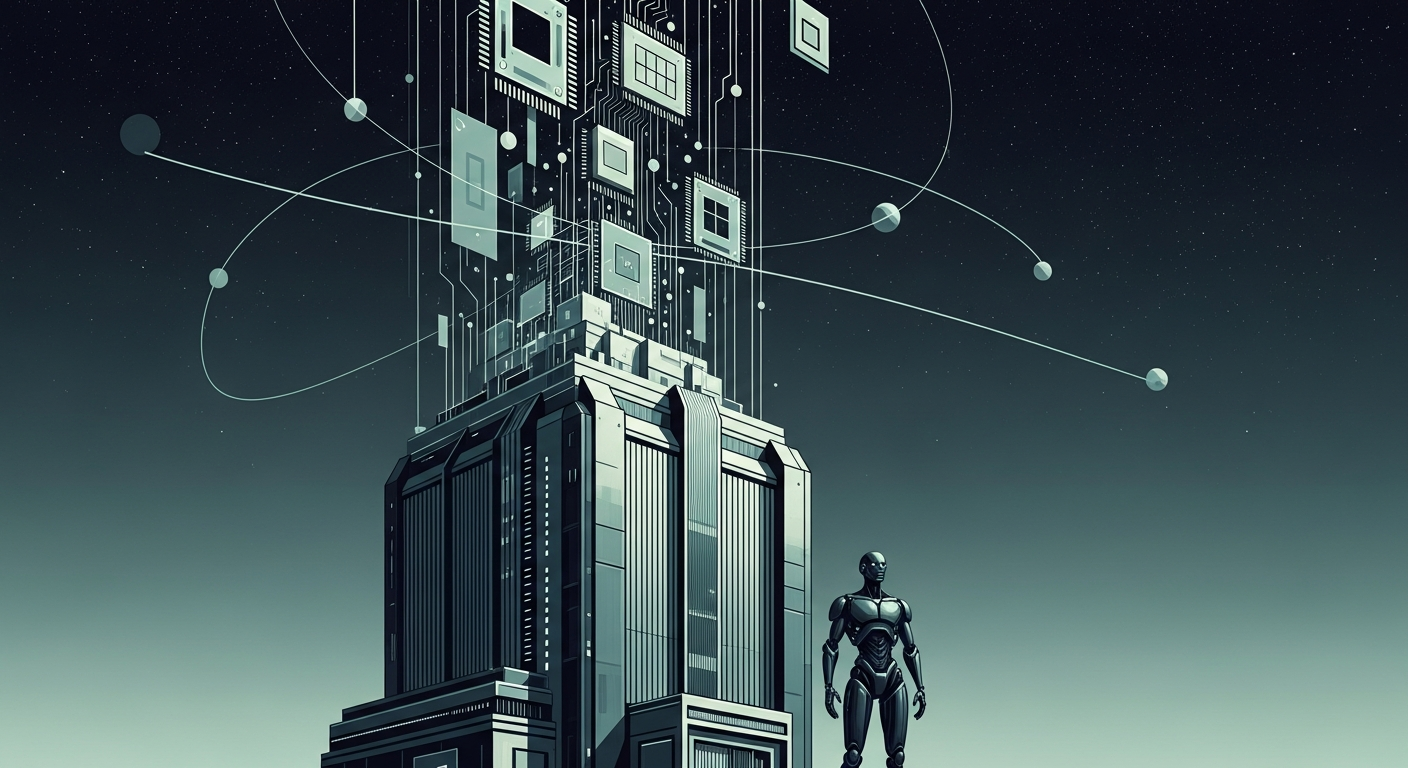
Elon Musk's Terafab: The $25 Billion Bet to Own the Entire AI Stack Elon Musk has made a career out of telling industries what they think is impossible is actually just expensive. This week, he added semiconductor fabrication to that list. Terafab is a joint venture between Tesla, SpaceX, and xAI — a $25 billion facility being built in Austin, Texas, with a single stated goal: produce one terawatt of AI compute per year.
For context, current global AI compute production sits around 20 gigawatts annually. Musk is targeting 50 times that number. And if you're wondering where all that compute goes once it's built — the answer, according to Musk, is orbit.
Let's break down what this actually means.
Technical Deep Dive
What makes Terafab genuinely different from other chip announcements is vertical integration at a scale that doesn't currently exist anywhere on earth. Most chip companies operate across a fragmented supply chain. TSMC fabricates.
ASML supplies the lithography equipment. Memory comes from Samsung or Micron. Packaging is done elsewhere entirely.
No single entity controls all of it. Terafab's stated design would handle logic, memory, packaging, and testing under one roof — compressing what is normally a globally distributed supply chain into a single Austin complex. That's either visionary or operationally catastrophic, and the outcome depends entirely on execution.
Two distinct chip types are planned. One is designed for terrestrial use — Tesla vehicles and Optimus robots — optimized for the kinds of inference workloads that run continuously at the edge. The second is a space-grade chip built for solar-powered satellite data centers launched via Starship.
Musk's argument is that space-based compute will undercut ground-based costs within two to three years, because solar energy and thermal cooling in orbit are effectively unconstrained. No land costs. No power grid negotiations.
No cooling infrastructure bills. The technical ambition is extraordinary. The execution risk is equally extraordinary.
Financial Analysis
Let's talk about the money, because $25 billion is a number that demands scrutiny. For comparison, TSMC's most advanced fabs cost between $20 and $40 billion each — and TSMC has decades of fabrication expertise, established supplier relationships, and a workforce built over generations. Musk is starting from scratch, across three companies simultaneously, in a sector where construction delays are measured in years and cost overruns are nearly universal.
The funding structure matters here. Tesla, SpaceX, and xAI are each contributors to the joint venture, which means the capital is spread across three entities — all of which are already capital-intensive businesses. Tesla is navigating a competitive EV market.
SpaceX is burning cash on Starship development. xAI raised at a $50 billion valuation but has yet to demonstrate the revenue base to justify it. That said, the strategic logic is sound.
If Musk can secure his own chip supply chain, he eliminates the single biggest constraint on scaling AI, autonomous vehicles, and robotics simultaneously. NVIDIA currently sits at the chokepoint of the entire AI industry. Terafab is, at its core, a bet that Musk can build his way out of that dependency.
The financial upside if this works is enormous. The downside if it doesn't is measured in years of lost time and billions in sunk capital.
Market Disruption
Here's the competitive picture. NVIDIA's moat is real, but it's not impenetrable. AMD is gaining ground.
Google has its TPUs. Amazon has Trainium — and TechCrunch just reported that Trainium has won over Anthropic, OpenAI, and even Apple as customers. The chip market is already fracturing.
Terafab doesn't need to beat NVIDIA in the open market to matter. It only needs to supply Tesla, SpaceX, and xAI. That's a captive demand base for autonomous vehicles, humanoid robots, and one of the fastest-growing AI labs in the world.
If Terafab achieves even a fraction of its compute targets, Musk insulates his entire empire from external chip supply constraints. The broader disruption is what this signals to the rest of the industry. If a vertically integrated operator can own chips, rockets, satellites, and robots as a single stack, the competitive dynamics of the AI race change fundamentally.
You're no longer competing on model quality alone. You're competing on who controls the physical infrastructure underneath the models. SoftBank's $500 billion Ohio campus and Amazon's Trainium investments tell the same story from different angles.
The real AI arms race isn't happening in the labs. It's happening in the supply chain.
Cultural and Social Impact
Musk framed Terafab as the first step toward a "galactic civilization" and a post-scarcity economy that provides abundance for everyone. That framing is worth taking seriously — not as a prediction, but as a signal of the worldview driving the investment. The underlying thesis is that compute scarcity is the primary constraint on human progress.
If you remove that constraint, you accelerate everything — drug discovery, climate modeling, scientific research, economic productivity. That's a coherent argument, and it's one shared by most of the major AI labs. What's culturally significant about Terafab specifically is the consolidation of control it implies.
When one person's interlocking companies own the rockets, the satellites, the chips, the robots, and the AI models — that's a concentration of infrastructure that has no historical precedent in private hands. Whether that produces abundance for everyone, as Musk claims, or produces leverage for one operator, is a question society hasn't fully started asking yet. The orbital data center concept also carries implications for regulation and jurisdiction.
Compute in orbit doesn't obviously fall under any single nation's regulatory framework. That may be a feature, not a bug, depending on your perspective.
Executive Action Plan
Three concrete moves for executives watching this unfold: **First, audit your chip dependency now.** If your AI roadmap assumes continued access to NVIDIA GPUs at current pricing and availability, you're building on an assumption that the next three years may invalidate. The chip market is diversifying fast — AMD, Trainium, Google TPUs, and now Terafab are all credible alternatives.
Build procurement diversification into your AI infrastructure strategy today, not when a supply crunch forces the conversation. **Second, take vertical integration seriously as a strategic framework.** Terafab's most important lesson isn't about chips.
It's about the competitive advantage of owning your stack. Ask where your organization's critical dependencies are — cloud compute, model access, data infrastructure — and identify which of those dependencies you could internalize over a three-to-five-year horizon. The companies that win the next decade of AI won't just be the best users of AI.
They'll be the ones who own the most leverage points in the stack. **Third, watch the orbital compute thesis closely.** Musk's claim that space-based compute will undercut ground-based costs within two to three years sounds like science fiction.
But so did reusable rockets in 2010. If orbital data centers become viable, the entire calculus around AI infrastructure costs — land, power, cooling, regulatory compliance — changes dramatically. Start scenario planning for what your compute strategy looks like in a world where the marginal cost of AI inference drops by another order of magnitude.
Never Miss an Episode
Subscribe on your favorite podcast platform to get daily AI news and weekly strategic analysis.