White House Framework Prioritizes Federal Control Over State AI Regulation
Episode Summary
TOP NEWS HEADLINES Following yesterday's coverage of NVIDIA's enterprise agent platform, new details emerged: NVIDIA's robotics chief is now predicting AI agents will trigger a "ChatGPT moment" fo...
Full Transcript
TOP NEWS HEADLINES
Following yesterday's coverage of NVIDIA's enterprise agent platform, new details emerged: NVIDIA's robotics chief is now predicting AI agents will trigger a "ChatGPT moment" for robotics — specifically envisioning a single agent coordinating entire fleets of robots by breaking goals into individual tasks and distributing them autonomously.
Following yesterday's coverage of Anthropic's enterprise expansion, new details emerged: Anthropic is rolling out "Cowork," a new collaborative feature letting multiple users work alongside Claude simultaneously — think Google Docs, but your co-author is an AI.
Apple quietly collected nearly $900 million in App Store fees from generative AI apps last year — roughly 75% of that came from ChatGPT alone, which tells you everything about who's winning the consumer AI race right now.
Cursor's new Composer 2 model was revealed to be built on Moonshot's Kimi K2.5 — without the required license attribution.
For a product at Cursor's scale, that's not a technicality, that's a legal problem.
Kling 3.0 just claimed the top spot on the AI video generation leaderboard, continuing the rapid-fire churn at the top of that category.
And the White House dropped its first-ever national AI policy framework — and the most consequential line in it might be what it tries to prevent rather than what it proposes. ---
DEEP DIVE ANALYSIS
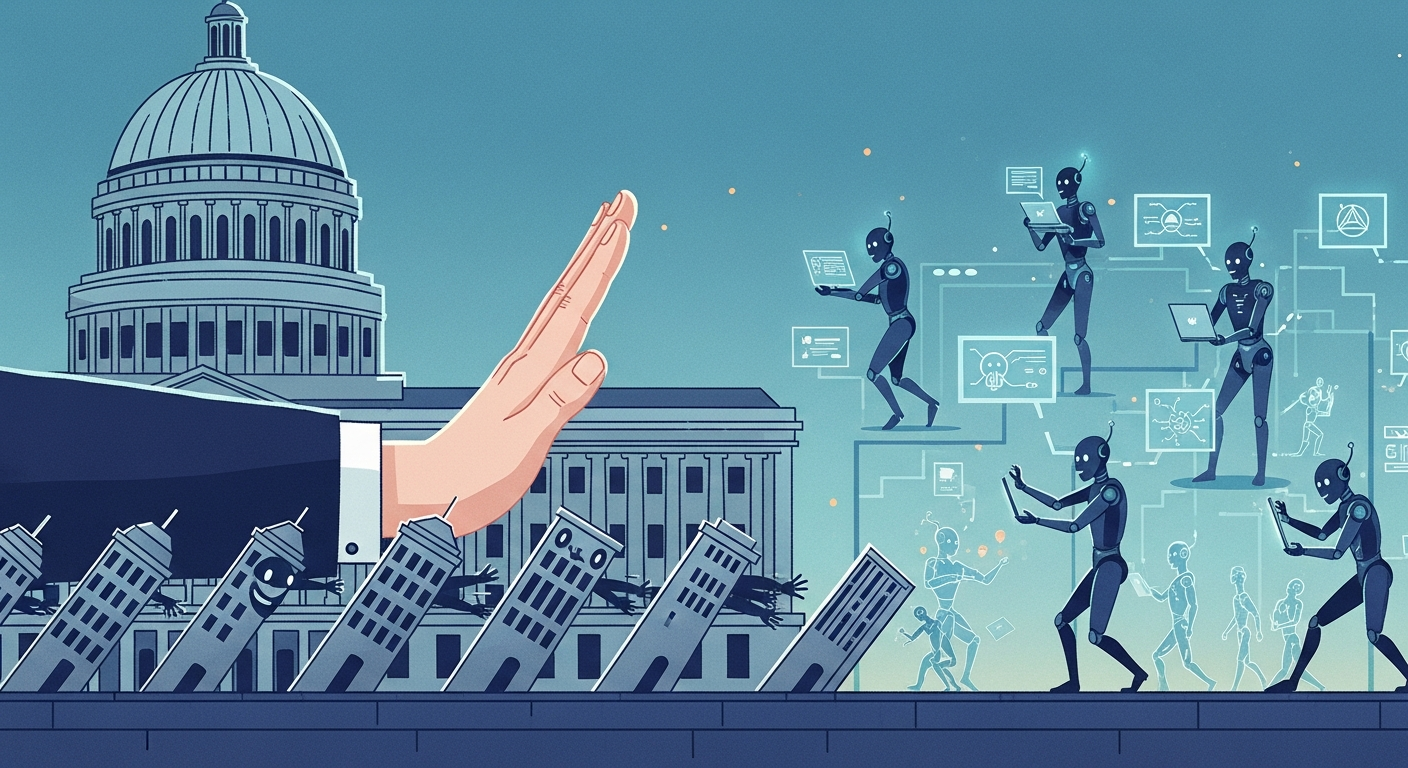
The White House AI Framework: A Power Grab Dressed as a Policy Plan Let's talk about the White House's new national AI framework, because the headline — "federal government wants to regulate AI" — buries the actual story. The real story is that the federal government wants to be the *only* one regulating AI, and it wants to use that position to keep regulation light. **Technical Deep Dive** The framework covers seven policy areas: child safety, community protections, copyright, free speech, innovation, workforce training, and federal preemption.
That last one is where the real action is. The administration's position is that AI is "an inherently interstate phenomenon," which is constitutional language for: states, back off. What does that mean practically?
Right now, more than a dozen states have been moving aggressively on AI legislation — Colorado, Texas, California — filling the vacuum left by years of federal inaction. The White House framework is designed to freeze that activity by asserting federal supremacy before any of those bills become enforceable law. On copyright, the administration landed firmly on the side of the AI labs: training on copyrighted material is legal, but they want courts — not Congress — to resolve the debate.
That's a significant stance given ongoing litigation from publishers, musicians, and visual artists. The framework also calls for "regulatory sandboxes" — controlled environments where companies can experiment under relaxed rules — and explicitly rules out creating any new federal AI oversight body. **Financial Analysis** Follow the money and this framework makes complete sense.
The AI industry has spent enormous resources lobbying against state-level regulation, and for good reason: patchwork compliance across 50 states is expensive, unpredictable, and slows product deployment. A single federal standard — especially a permissive one — is worth billions in avoided compliance costs. Apple's $900 million in App Store fees from AI apps gives you a sense of the revenue at stake.
That's just one platform, one year, already. The AI application economy is scaling fast, and any friction introduced by regulatory complexity directly threatens that growth trajectory. The copyright position is equally financial.
If courts ultimately rule that AI training on copyrighted material is fair use, that removes a massive liability overhang from every major AI company. OpenAI, Google, Meta, Anthropic — all of them have training data exposure. A federal framework that signals the government's belief that training is legal doesn't decide the lawsuits, but it shapes the political and legal environment around them.
OSTP Director Michael Kratsios says the goal is legislation by end of 2026. That's an aggressive timeline, and markets will be watching whether any of this actually moves through a divided Congress. **Market Disruption** Here's the competitive dimension that doesn't get enough attention: preemption doesn't just protect American AI companies from American regulators.
It's also a strategic play in the global AI race. If you're competing with China's AI ecosystem — which operates without meaningful privacy or copyright constraints — having your domestic companies bogged down in 50 different state compliance regimes is a real competitive disadvantage. The framework is, in part, an industrial policy argument: let American AI companies move fast so they can maintain their lead.
But the disruption cuts both ways. Senator Marsha Blackburn dropped a nearly 300-page federal AI bill the day before the White House framework landed — and it goes in the opposite direction. Duty of care requirements for chatbot developers.
Sunset of Section 230 protections. Criminal penalties for AI companies that allow explicit conversations with minors. The Cato Institute has already flagged five major structural flaws in her approach, but the bill signals that bipartisan consensus on permissive regulation is far from guaranteed.
What this creates is a period of sustained uncertainty — which, paradoxically, may hurt smaller AI companies more than large ones. Big labs can absorb legal ambiguity. Startups cannot.
**Cultural & Social Impact** The preemption fight isn't just a legal technicality — it's a values debate. More than 50 Republican state legislators pushed back against the White House approach, framing it explicitly as shielding Big Tech from accountability. That's a politically unusual coalition: state-rights conservatives and consumer protection advocates finding common ground against a federal framework they see as industry-captured.
The child safety provisions are worth watching here. The framework says child safety is a priority, but Blackburn's bill has criminal penalties for chatbots that engage in explicit conversations with minors. There's a meaningful gap between "we care about kids" and "here's an enforceable standard with teeth.
" How that gap gets resolved — or doesn't — will shape public trust in AI systems for years. And the copyright question has real cultural stakes beyond the legal ones. If AI training on creative work is ruled fair use without compensation mechanisms, the economic model for human creative professionals gets fundamentally disrupted.
Writers, musicians, visual artists — they're watching this framework closely, and most of them aren't reassured by "let courts figure it out." **Executive Action Plan** Three moves for leadership teams navigating this landscape right now: First, do not wait for federal clarity before building your compliance architecture. The framework signals intent, not law.
Build modular compliance systems that can adapt to either a permissive federal standard or stricter requirements if Blackburn-style provisions gain traction. The companies that will struggle most are those who bet everything on one regulatory outcome. Second, if your product touches minors in any way — education platforms, consumer apps, anything with broad demographic reach — treat child safety as a zero-tolerance engineering priority, not a legal question.
The political will to create criminal liability for AI companies in this space is real, bipartisan, and not going away regardless of how the preemption fight resolves. Third, get serious about your training data documentation now. The administration's copyright position is not a legal ruling — it's a statement of preference.
Courts may go the other way. Companies that can clearly document their training data provenance, demonstrate good-faith licensing efforts, or point to clean data pipelines will have significantly better legal positioning than those who can't. The sandbox you build today is the moat you'll need tomorrow.
Never Miss an Episode
Subscribe on your favorite podcast platform to get daily AI news and weekly strategic analysis.