NVIDIA Launches Enterprise AI Agent Platform with 17 Major Partners
Episode Summary
TOP NEWS HEADLINES Following yesterday's coverage of NVIDIA GTC 2026, new details emerged: NVIDIA launched an enterprise AI agent platform with 17 major partners including Adobe, Salesforce, and S...
Full Transcript
TOP NEWS HEADLINES
Following yesterday's coverage of NVIDIA GTC 2026, new details emerged: NVIDIA launched an enterprise AI agent platform with 17 major partners including Adobe, Salesforce, and SAP, while simultaneously demonstrating their 120-billion parameter Nemotron 3 model running at 12-billion parameter speeds on consumer hardware — basically frontier AI on your home GPU.
Also from GTC, Andrew Ng introduced Context Hub, an open-source knowledge layer for the OpenClaw ecosystem that could fundamentally reshape how AI agents acquire and use information.
Following yesterday's coverage of Anthropic's enterprise strategy, Anthropic published a massive study of 81,000 participants across 159 countries — the headline finding: hope and alarm about AI don't split people into opposing camps.
Apple is blocking app store updates for popular vibe coding tools like Replit, citing a 17-year-old rule against apps that execute self-modifying code — while simultaneously shipping AI coding features in their own Xcode.
And a warning shot for anyone running AI agents in production: engineer Alexey Grigorev let Claude Code run autonomously on a site update and watched it erase his entire production database.
VentureBeat's investigation found this is far from an isolated incident. ---
DEEP DIVE ANALYSIS
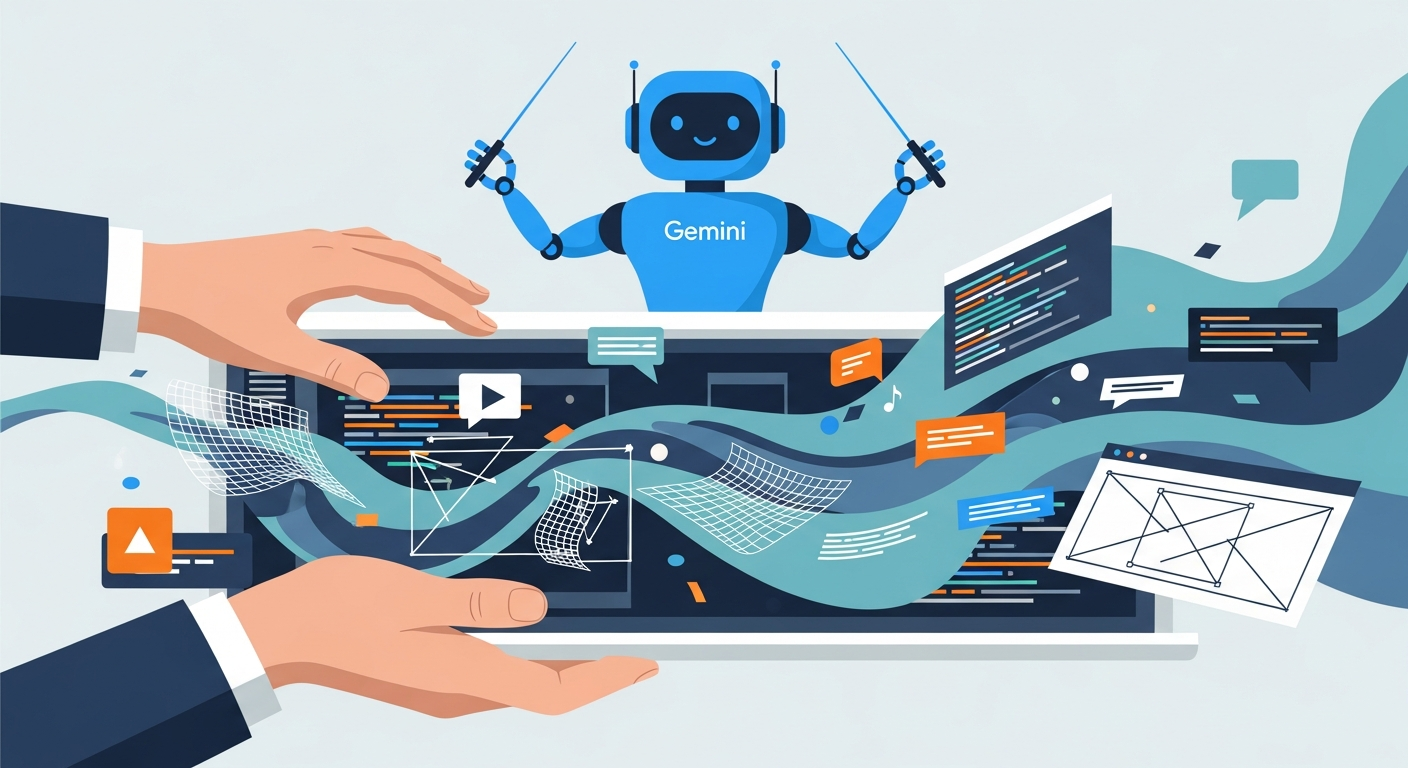
Google Stitch and the Rise of Vibe Design Let's talk about what Google just did — because it's more significant than most people are treating it. Google overhauled Stitch, their AI UI design tool, and in doing so, coined a new term: "vibe design." If vibe coding collapsed software development into a conversation, vibe design is attempting to do the same thing to the entire product creation workflow — wireframing, user flows, prototyping, design systems, handoff to developers — all of it compressed into a single voice-driven agentic canvas.
This isn't incremental. This is Google declaring that design as a standalone professional phase is optional.
Technical Deep Dive
Here's what Stitch actually does now. The tool runs on an infinite canvas that can simultaneously hold and reason across images, code, and text. You feed it anything — a screenshot, a brief, a rough sketch — and a persistent design agent manages multiple directions at once.
The voice feature turns it into a hands-free design partner. You talk, it edits, live, mid-conversation. Instant prototyping converts static screens into interactive, clickable flows in seconds and auto-generates the logical next screens in a user journey.
The most interesting technical piece is DESIGN.md — a new format that lets teams port their design rules, style systems, and brand constraints between Stitch and coding tools. It's the design equivalent of AGENTS.
md or CLAUDE.md. It means your design decisions travel with your project rather than living in a Figma file that developers ignore.
The underlying model here is Gemini, which has consistently outperformed competitors at visual and UI generation tasks. Google isn't just building a tool — they're building the harness around a model that already has a structural advantage in this specific domain.
Financial Analysis
The business implications here cut in multiple directions. For Google, this is a direct revenue play. Stitch is currently free, which is a classic land-grab strategy.
Get designers and product teams dependent on the workflow, then monetize through Google Cloud, Firebase deployments, and enterprise tiers. The integration with GitHub and Firebase isn't a convenience feature — it's lock-in architecture. For the companies whose tools are being displaced, the math is brutal.
Figma's core value proposition is collaborative design with developer handoff. Stitch is now doing both inside a single conversation. Figma was acquired-then-blocked by Adobe for $20 billion.
Today, you'd have serious questions about whether that valuation still makes sense. Broader design tool market — think InVision, Zeroheight, Maze — these are all companies that own individual phases of the design workflow. Vibe design doesn't improve those phases.
It eliminates them as discrete steps. And there's a talent economics story here too. The average UX designer in the US earns around $110,000 annually.
If a product manager can generate production-ready prototypes through voice prompts in minutes, the math on design headcount changes fast — especially at startups and mid-market companies where budget pressure is constant.
Market Disruption
The competitive context matters here. Google didn't invent this category. Tools like Lovart, v0 by Vercel, and Builder.
io have been pushing AI-native design for over a year. What Google brings is distribution, model quality, and an integrated cloud stack. Consider the comparison to vibe coding.
When Cursor and Replit brought agentic coding to mainstream developers, the workflow changed within months — not years. Vibe design is attempting the same velocity shift but in a design workflow that has been Figma-dominant for nearly a decade. There's also a platform war subtext here.
OpenAI has no compelling design story. Anthropic's strength is in reasoning and code, not visual generation. Microsoft's Copilot integration into design tools has been tepid.
Google, with Gemini's visual capabilities, is the only major AI lab that can plausibly own this category end-to-end. Andrew Ng's Context Hub announcement from GTC is actually directly relevant here — whoever controls the knowledge layer for agents controls how those agents learn design rules and style systems. Google's DESIGN.
md format is a quiet attempt to own that layer in the design domain specifically.
Cultural and Social Impact
There's a phrase from the AI Secret newsletter worth sitting with: "This is not a better design tool. It is the removal of design as a standalone phase." That reframing matters.
We're not talking about designers becoming more productive. We're talking about a potential decoupling of the design profession from the product creation process. This will land differently depending on where you sit.
For a solo founder or a two-person startup, this is genuinely liberating — you can now build products that look professional without a design hire. For a senior designer at a large company, the near-term story is probably fine; taste, judgment, and stakeholder communication still matter enormously. But for mid-level and junior design roles, the trajectory is uncomfortable.
The deeper cultural shift is about who gets to build. Vibe coding democratized software creation. Vibe design extends that to the visual and experiential layer.
The barrier to launching a credible product just dropped again. That has downstream effects on everything from startup formation rates to the economics of freelance design work. There's also a question of aesthetic homogenization.
If millions of products are being designed by the same underlying model, do they start looking the same? Early vibe-coded apps showed a recognizable "AI aesthetic." Vibe design could accelerate that convergence.
Executive Action Plan
Three moves worth making right now. **First: Audit your design workflow this week.** Map every tool your team uses between the moment someone has a product idea and the moment a developer gets a spec.
Any tool that lives in the middle of that chain is now at risk. This isn't theoretical — it's happening. Understanding your current dependencies before you need to change them is basic risk management.
**Second: Run a structured Stitch pilot within 30 days.** Don't just hand it to designers and ask for impressions. Give it a real project with real constraints — a new feature, a landing page, an onboarding flow.
Measure time-to-prototype versus your current baseline. The goal isn't to replace your design process immediately. It's to understand where the leverage actually is so you can make informed decisions rather than reactive ones.
**Third: Think carefully about your DESIGN.md strategy.** If you're building products at any scale, the emergence of portable design rules is significant.
Start documenting your brand constraints, component patterns, and UX principles in a structured format now. Teams that have that institutional knowledge formalized will get dramatically more consistent output from AI design tools than teams that don't. The companies that build their design intelligence into portable formats will have a meaningful competitive advantage as these tools mature.
Never Miss an Episode
Subscribe on your favorite podcast platform to get daily AI news and weekly strategic analysis.