OpenAI, Google, and Alibaba Launch Efficiency-First AI Models
Episode Summary
TOP NEWS HEADLINES Following yesterday's coverage of the OpenAI Pentagon deal, new details emerged: Sam Altman publicly called the original contract "opportunistic and sloppy" at an all-hands meet...
Full Transcript
TOP NEWS HEADLINES
Following yesterday's coverage of the OpenAI Pentagon deal, new details emerged: Sam Altman publicly called the original contract "opportunistic and sloppy" at an all-hands meeting, said he'd "rather go to jail" than follow unconstitutional orders, and announced significant revisions — though ChatGPT uninstalls are already up 295% since the deal dropped.
Following yesterday's coverage of Anthropic's funding talks, new details emerged: the company is now on track for a twenty billion dollar annual revenue run rate, more than doubling from nine billion just a few months ago, with Claude Code cited as a major growth driver.
Following yesterday's GPT-5.4 leaks, OpenAI officially released GPT-5.3 Instant today — focused on conversational flow, cutting the "cringe" preachy tone, and reducing hallucinations by roughly twenty percent.
They also quietly teased that "5.4 is sooner than you think." Google launched Gemini 3.1 Flash-Lite, their fastest and cheapest Gemini 3 model — at twenty-five cents per million input tokens, that's one-quarter of Anthropic's Haiku and one-eighth of Gemini 3.1 Pro.
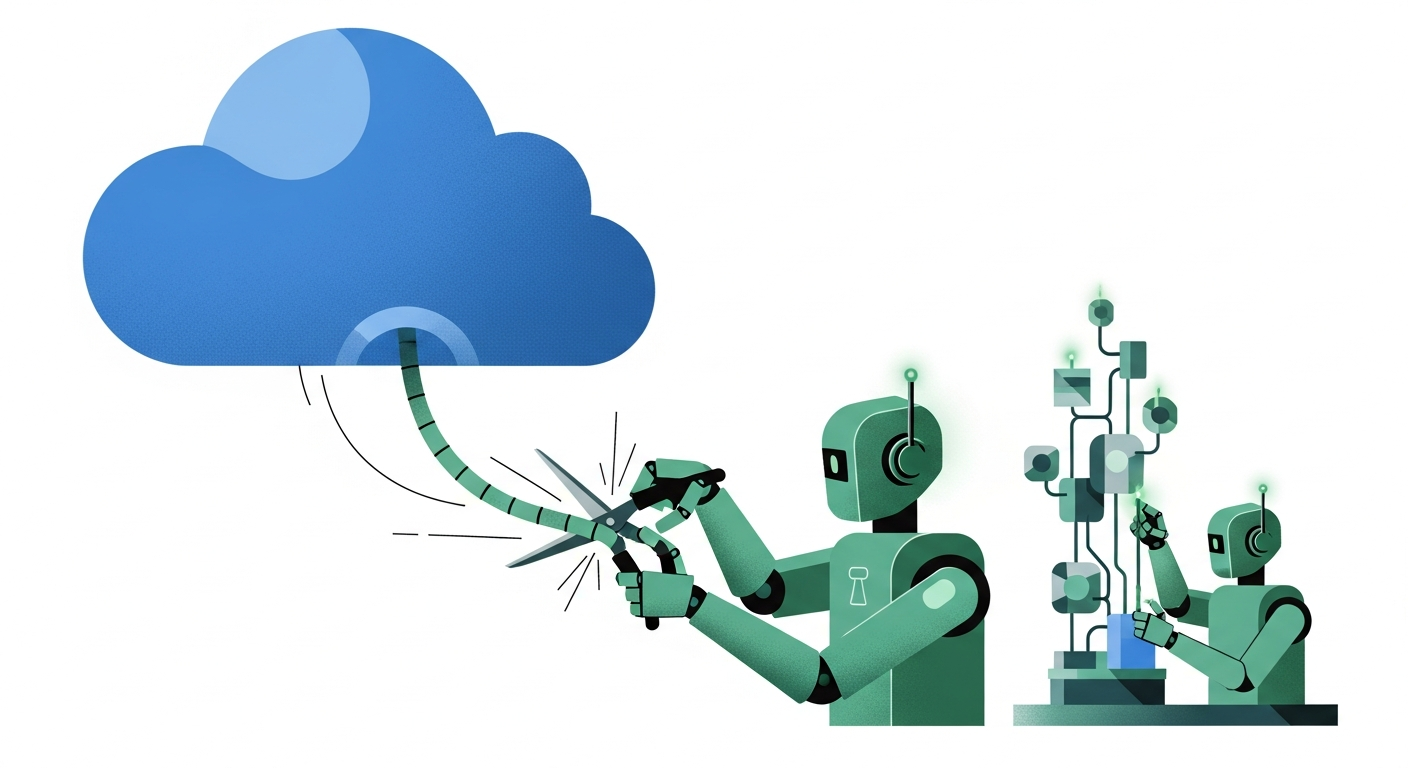
Alibaba's Qwen team shipped four small Qwen 3.5 models — from 0.8 billion to 9 billion parameters — capable of running directly on your phone or laptop with no cloud required.
And in a notable personnel move, OpenAI's VP of Research Max Schwarzer announced he's leaving to join Anthropic, saying he's "looking forward to supporting friends there at this important time." ---
DEEP DIVE ANALYSIS
**The Efficiency Wars: The Race for Intelligence Density** Let's talk about what actually happened in AI today — because on the surface it looks like three product launches. But zoom out, and you're watching the entire industry pivot in real time. In the span of twenty-four hours, OpenAI dropped GPT-5.
3 Instant, Google dropped Gemini 3.1 Flash-Lite, and Alibaba shipped four Qwen 3.5 Small models that can run on your phone.
None of these are trying to be the smartest AI ever built. All three are optimized for the same thing: speed, cost, and accessibility. This is the intelligence density race — and it's the most consequential shift in AI product strategy since the original ChatGPT launch.
**Technical Deep Dive** So what's actually different under the hood? Start with GPT-5.3 Instant.
OpenAI built this model explicitly for real-time applications — live copilots, voice assistants, tools where a two-second delay is a death sentence for the user experience. Hallucinations dropped 26.8% on web search tasks and 19.
7% on internal knowledge benchmarks. They've also retired the GPT-5.2 Instant API, effective June 3rd.
Google's Flash-Lite is a different animal. It's 2.5 times faster time-to-first-token versus Gemini 2.
5 Flash, 45% faster output speed, and it includes adjustable "thinking levels" — developers can literally dial reasoning up or down per task. That's a genuinely useful architectural choice for enterprise workloads where not every query needs deep reasoning. But the boldest technical bet belongs to Alibaba.
Their Qwen 3.5 Small family uses Scaled Reinforcement Learning to punch well above its weight class — the 9 billion parameter model competes with systems five to ten times its size on reasoning benchmarks. And because it runs locally, the inference cost is essentially zero.
Elon Musk congratulated them on the information density. That's how you know it landed. **Financial Analysis** The pricing signals here are stark.
Flash-Lite at twenty-five cents per million input tokens isn't just competitive — it's a weapon. That's one-quarter of Anthropic's Haiku, which itself was already positioned as a budget option. When Google is willing to go that low on a model that's genuinely capable, it compresses margins across the entire industry.
For OpenAI, the financial story around 5.3 Instant is less about pricing and more about retention. ChatGPT uninstalls surged 295% after the Pentagon deal.
Fixing the "cringe" problem isn't just a product improvement — it's damage control. The company has 50 million paying subscribers. Even a 5% churn event at those numbers is catastrophic.
Meanwhile, Anthropic just hit a $20 billion annual revenue run rate, doubled from nine billion just a few months ago. The Pentagon fallout is driving users directly to Claude. That's not a coincidence — it's a competitive moat being built in real time off OpenAI's brand crisis.
The efficiency wars aren't just about model costs. They're about who survives the next twelve months of market consolidation. **Market Disruption** Here's the framework that matters: AI is becoming infrastructure.
Nobody brags about how powerful their electricity is. They care that it's cheap, reliable, and everywhere. These three launches are the clearest signal yet that we're approaching that phase.
For enterprise buyers, this changes the calculus entirely. The question is no longer "which model is smartest?" It's "which model is good enough for this specific task, at this price point, at this latency?
" Flash-Lite's positioning for high-volume workloads — translation, content moderation, real-time apps — is exactly this framing. Google is selling infrastructure, not intelligence. The Qwen 3.
5 story is potentially the most disruptive long-term. Free, local, capable — that's not a product, that's a platform shift. Developers building on-device applications no longer need a cloud dependency for basic AI tasks.
The implications for privacy, latency, and cost structure are enormous, particularly in markets where cloud costs are prohibitive. And note what's happening to the mid-tier: models that are powerful but not fast or cheap are getting squeezed from both sides. The frontier keeps moving up, the efficiency tier keeps improving, and the space in between is shrinking fast.
**Cultural and Social Impact** The "cringe problem" OpenAI is explicitly trying to fix with 5.3 Instant deserves more attention than it's getting. The company literally used the word "cringe" in their own communications to describe their default model's personality.
That's an extraordinary admission — and it tells you something important about where AI adoption stalls. Users don't abandon AI tools because they're not smart enough. They abandon them because the interaction feels condescending, preachy, or exhausting.
The over-refusal problem, the endless caveats, the lectures before answers — these aren't safety features, they're friction. And friction kills habits. Anthropic's Super Bowl ads took direct shots at ChatGPT's personality, and apparently it cut close enough to the bone that OpenAI made fixing it a headline feature of their next release.
That's cultural competition now, not just technical competition. The local model story from Qwen has its own social dimension. Running AI on your own device means your queries never leave your hardware.
For anyone with privacy concerns — journalists, lawyers, medical professionals, people in countries with aggressive surveillance — that's not a nice-to-have, it's a requirement. The intelligence density race is quietly making private AI access a reality for the first time. **Executive Action Plan** Three specific moves if you're making decisions based on today's news.
First, audit your current AI API spend and map it against task complexity. You almost certainly have workloads running on flagship models that don't need flagship intelligence. Flash-Lite at $0.
25 per million input tokens versus $3 or $4 for frontier models is a 10-to-15x cost difference. For high-volume tasks like classification, summarization, or content moderation, that math should be forcing a migration conversation right now. Second, if you're building any product with a conversational AI component, pay close attention to the 5.
3 Instant release notes — specifically the hallucination reduction numbers and the archery example they used to demonstrate reduced over-refusal. The benchmark that matters isn't intelligence, it's whether your users finish conversations feeling helped or lectured. Test 5.
3 Instant against your current stack this week. Third, and this is the longer-term play: start evaluating on-device AI for any use cases where privacy, latency, or connectivity are constraints. Qwen 3.
5 at 9 billion parameters running locally is genuinely capable now. The infrastructure investment to support on-device inference is non-trivial, but the competitive advantage of offering truly private AI — no data leaving the device, no cloud dependency — is going to become a meaningful differentiator within 18 months. Get ahead of it.
Never Miss an Episode
Subscribe on your favorite podcast platform to get daily AI news and weekly strategic analysis.