Pentagon's Classified Claude Opus 5 and GPT-5.4 Leaks Exposed
Episode Summary
TOP NEWS HEADLINES Following yesterday's coverage of the Pentagon-AI fallout, new details emerged: US forces reportedly used a classified Anthropic model running at Opus 5 level for military strik...
Full Transcript
TOP NEWS HEADLINES
Following yesterday's coverage of the Pentagon-AI fallout, new details emerged: US forces reportedly used a classified Anthropic model running at Opus 5 level for military strikes in Iran, and Anthropic has now confirmed the existence of a custom, isolated military version of Claude built specifically for the Department of Defense.
Following yesterday's coverage of Claude hitting number one on the App Store, new details emerged: Claude suffered a major service outage right as it was riding that surge in new users — and Anthropic is now reportedly in talks for a fresh sixty billion dollar funding round.
Following yesterday's coverage of OpenAI's record-breaking valuation, new details emerged: ChatGPT has officially crossed fifty million paying subscribers, with nine million business customers and Codex alone pulling one point six million weekly users.
OpenAI accidentally leaked GPT-5.4 not once, not twice, but through multiple pull requests in their public GitHub repo and a deleted screenshot from their own employee — five major GPT-5 variants in seven months.
The Supreme Court declined to hear the landmark AI copyright case, letting lower court rulings stand that only humans can hold authorship — leaving the entire creative AI industry in legal limbo with no definitive federal guidance.
Cursor hit two billion dollars in annualized revenue, doubling in just three months, with sixty percent of that coming from enterprise customers. --- DEEP DIVE ANALYSIS: The GPT-5.4 and Opus 5 Leaks Today's deep dive sits at the intersection of two separate but related leaks that, taken together, paint a picture of where frontier AI actually is right now — not where the press releases say it is.
On one side, you have OpenAI's GPT-5.4 surfacing in error messages, GitHub commits, and a deleted screenshot from an internal employee, all within the past week.
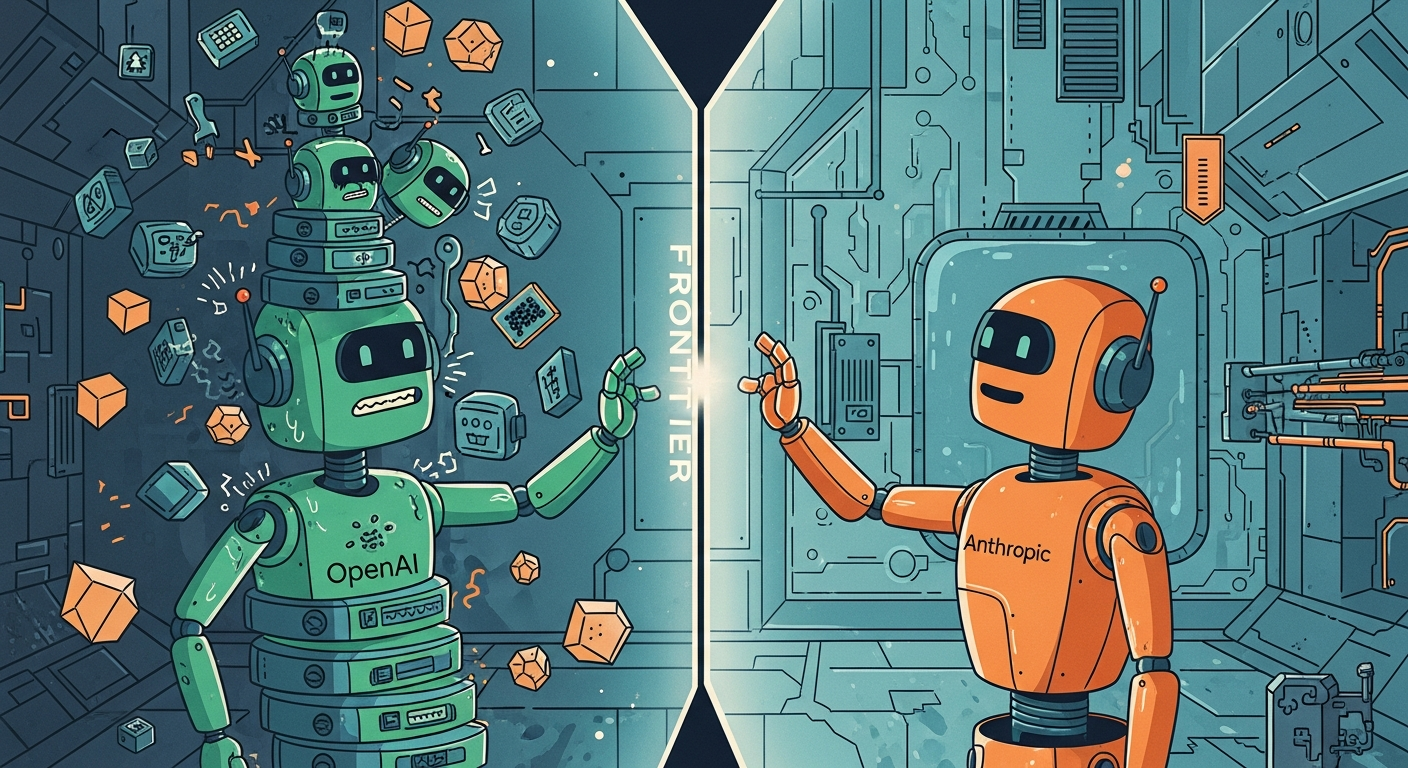
On the other side, you have multiple sources claiming that the US military is already running what appears to be Claude Opus 5 — a model the public has never seen — in live operational command systems.
Anthropic itself confirmed a classified, custom, isolated version of Claude exists for Pentagon use.
Technical Deep Dive
Starting with GPT-5.4: the model identifier that leaked — gpt-5.4-ab-arm1-1020-1p-codexswic-ev3 — is a mouthful, but the structure tells you something.
The "codexswic" segment strongly suggests this is a Codex-integrated variant, meaning it's built specifically for agentic coding workflows. GPT-5.3-Codex only launched three weeks ago and was already classified as OpenAI's first "High Cybersecurity Capability" model.
The fact that 5.4 is already appearing in staging environments means OpenAI is iterating on these coding-focused reasoning models at a pace that is genuinely unprecedented — roughly a new frontier variant every three to four weeks. On the Opus 5 side, the leaked details are more alarming in a different way.
Sources describe a model running on fully isolated classified cloud infrastructure with dedicated compute that reportedly doubles every four months. The claimed capabilities — strategic reasoning, target identification, live scenario simulation — describe something operating well beyond the text-in, text-out paradigm. This isn't a chatbot.
This is an agentic system embedded in command pipelines making time-sensitive operational recommendations. Whether it's truly "Opus 5" or a specialized derivative, Anthropic's confirmation that a classified custom model exists removes any ambiguity about the direction of travel. The technical signal here: the public frontier and the classified frontier are no longer the same line.
Financial Analysis
The financial implications split into two distinct tracks. For OpenAI, rapid model iteration is both a strength and a liability. Five major GPT-5 variants in seven months signals to enterprise customers that they're getting continuous improvement, but it also creates integration fatigue.
Every model swap breaks fine-tuned workflows. The companies spending the most — Adobe, Walmart, the large enterprise accounts — need stability. OpenAI's valuation at $730 billion is predicated on those enterprise contracts holding, and aggressive versioning puts pressure on that assumption.
For Anthropic, the situation is more complicated. The confirmed existence of a classified military model is a double-edged sword. On one hand, it validates the commercial argument that Claude is capable enough for the most demanding operational use cases in the world.
On the other hand, Anthropic is simultaneously being designated a supply chain risk by the Pentagon — creating a surreal scenario where the US government is both their most classified customer and their most hostile regulator. The $60 billion funding round now in negotiation is happening against this backdrop, and investors are essentially betting that Anthropic survives a standoff with the White House intact. The TLDR AI newsletter framed it correctly: the $60 billion from over 200 venture investors is now existentially at risk.
That's not hyperbole. A supply chain risk designation could require companies like Nvidia to sever commercial ties with Anthropic entirely.
Market Disruption
The competitive dynamic these leaks expose is genuinely unusual. We're watching two races happen simultaneously, and they're not the same race. The public race — GPT-5.
3 to 5.4 in three weeks, Anthropic rolling out memory features and import-from-ChatGPT tools — is the consumer and enterprise competition we normally talk about. Claude hitting number one on the App Store, ChatGPT crossing fifty million subscribers, Cursor at two billion in ARR.
That's the visible layer. The invisible layer is what these leaks point to: a classified frontier that's running ahead of anything publicly announced. If Opus 5 is real and operational in military systems today, then the public debate about Claude Opus 4.
6 versus GPT-5.3 is a debate about yesterday's models. The true capability ceiling is being set in environments that the public, researchers, and even most of the AI safety community cannot access or audit.
This creates a specific kind of market disruption: it erodes trust. Anthropic's entire brand is built on safety-first development and transparent alignment research. The revelation — even if technically consistent with their stated approach — that their most powerful model is running in weapons targeting systems is going to accelerate the consumer backlash that already started when OpenAI signed its Pentagon deal.
Anthropic captured users fleeing OpenAI's military alignment. Those same users now have reason to question Anthropic's position.
Cultural and Social Impact
The cultural resonance here is hard to overstate. We are past the point of debating whether AI will be used in warfare. It already is, apparently at a level of sophistication that the public had no visibility into until this week.
The broader social impact operates on two timescales. In the short term, these leaks are likely to intensify the existing consumer migration patterns — users who care about AI ethics will be searching for alternatives that have drawn harder lines. The problem is that harder lines, as Anthropic discovered, can get you labeled a supply chain threat.
In the medium term, the GPT-5.4 leak pattern — accidental disclosure through error messages, GitHub commits, deleted screenshots — reveals something important about how AI companies operate at scale. The secrecy is performative.
These systems are too large, too distributed, and too fast-moving to actually contain. Transparency by leak is becoming the de facto norm, which is a deeply unstable foundation for public trust. There's also a generational signal in the Cursor data.
Sixty percent enterprise revenue, agent usage growing fifteen times in a year, tab completion losing to autonomous cloud agents — developers aren't just using AI as a tool anymore. They're building alongside it as a peer. That cultural shift doesn't reverse.
Executive Action Plan
Three specific actions for executives watching this space. **First, audit your model dependency stack now.** If your product or workflow is built on any single frontier model — Claude, GPT, Gemini — the combination of rapid versioning, geopolitical exposure, and service outages we saw this week is a reliability risk, not a hypothetical.
OpenRouter, the multi-model gateway highlighted in today's newsletters, is not just a convenience tool anymore. It's infrastructure resilience. Build model-agnostic abstraction layers into your architecture before you need them under pressure.
**Second, treat the classified AI gap as a strategic planning input.** If Opus 5 is real and operational today, your assumptions about what AI can do — based on publicly available benchmarks — are already outdated. Scenario planning for AI capabilities should include a range that extends well beyond announced models.
Defense contractors, healthcare systems, financial institutions with government contracts: you need to understand what capabilities your adversaries and partners may already be accessing that you cannot benchmark against. **Third, make a deliberate choice about which AI relationships expose you to geopolitical risk.** The Anthropic-Pentagon situation is not a one-off.
It is the preview of a regulatory environment where AI vendor relationships carry national security implications. If your enterprise runs on a model from a company that could be designated a supply chain risk, that is now a vendor concentration risk that belongs in your risk register alongside cybersecurity and data privacy. Get ahead of this before procurement teams and compliance officers are making these decisions reactively.
Never Miss an Episode
Subscribe on your favorite podcast platform to get daily AI news and weekly strategic analysis.