OpenAI Closes Record $110 Billion Funding Round Amid Pentagon Controversy
Episode Summary
TOP NEWS HEADLINES Following yesterday's coverage of the Anthropic-Pentagon standoff, new details emerged: OpenAI officially signed a classified deployment deal with the Department of War, CTO Emi...
Full Transcript
TOP NEWS HEADLINES
Following yesterday's coverage of the Anthropic-Pentagon standoff, new details emerged: OpenAI officially signed a classified deployment deal with the Department of War, CTO Emil Michael had been secretly negotiating with OpenAI as a backup while Anthropic's talks collapsed over surveillance red lines, and the Trump administration labeled Anthropic a supply chain risk — a designation previously reserved exclusively for Chinese firms.
Following yesterday's coverage of Claude hitting number four on the App Store, the story accelerated dramatically: Claude shot to number one on both the US and Canada App Store free charts, directly attributed to consumer backlash against OpenAI's Pentagon deal, with Reddit posts calling for ChatGPT cancellations racking up 38,000 upvotes.
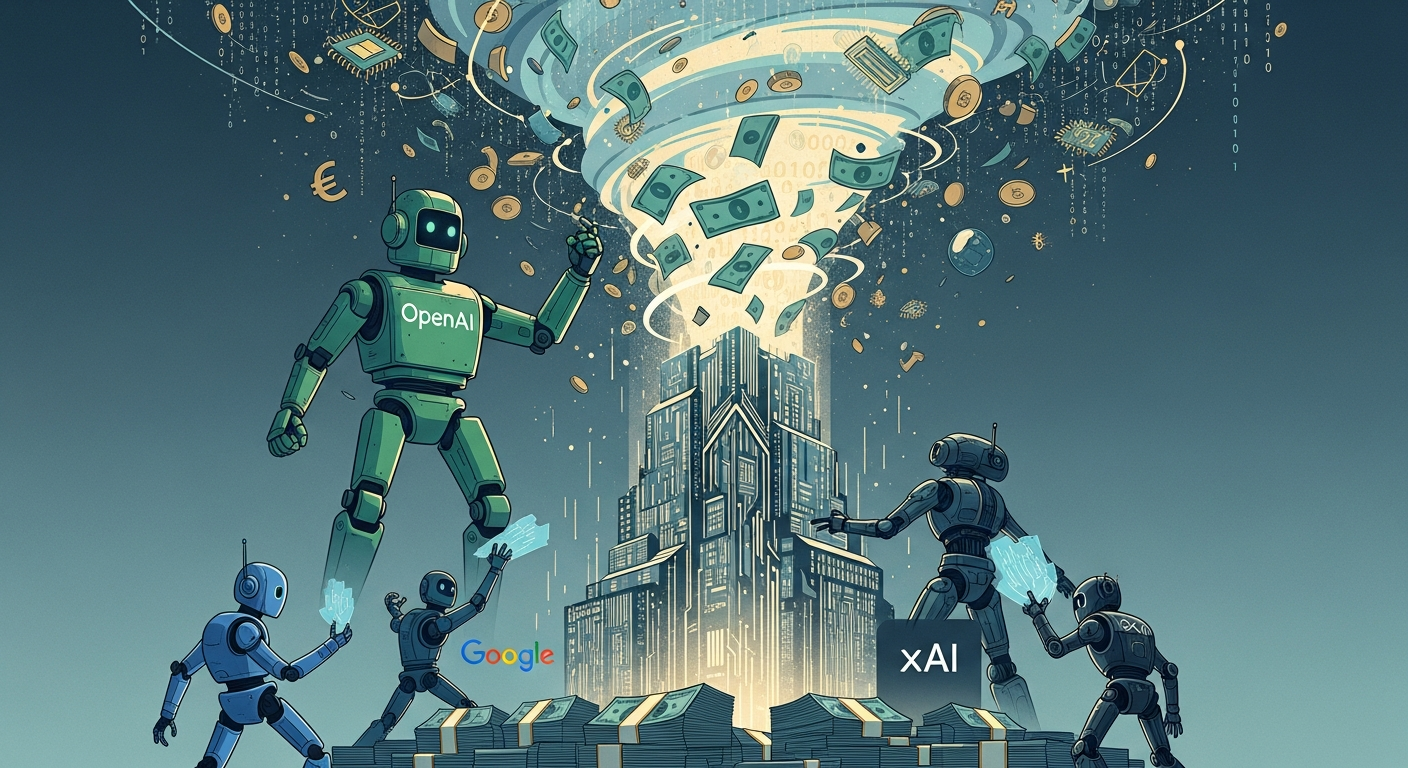
OpenAI closed a record-breaking $110 billion funding round at a $730 billion valuation — Amazon led with $50 billion, Nvidia and SoftBank contributed $30 billion each, and the round may not even be closed yet.
Google accidentally revealed a new Gemini feature called Goal Scheduled Actions, allowing the AI to autonomously adjust tasks toward defined objectives rather than just repeating fixed prompts.
Nvidia is incorporating Groq chip technology into a new inference processor set to debut at GTC, with OpenAI as a major customer following a $20 billion licensing deal.
Simultaneously, Google struck a multibillion-dollar TPU deal with Meta, directly challenging Nvidia's accelerator dominance. ---
DEEP DIVE ANALYSIS
OpenAI's $110 Billion Mega-Round and the Trillion-Dollar AI Ceiling Let's talk about what just happened with OpenAI's funding round, because the number alone doesn't capture how fundamentally this reshapes the competitive landscape. **Technical Deep Dive** One hundred and ten billion dollars. That's not a valuation — that's cash raised in a single round.
And the structure of where that money comes from tells you everything about the technical strategy underneath it. Amazon's $50 billion commitment isn't a passive investment. It comes bundled with a $100 billion AWS infrastructure expansion and adoption of Amazon's own Trainium chips.
This is compute securing compute. OpenAI is essentially pre-purchasing the infrastructure layer it needs to train and serve the next generation of frontier models, and Amazon is locking in a guaranteed hyperscale customer. Nvidia's $30 billion stake follows a similar logic.
We already know Nvidia is building an inference chip incorporating Groq technology, and OpenAI is the anchor customer for that product. So Nvidia invests in OpenAI, OpenAI buys Nvidia hardware, Nvidia's valuation grows — it's a circular capital structure that keeps the frontier AI compute flywheel spinning. The technical implication is stark: the capital requirements to compete at the frontier layer have now reset to a level that excludes almost every player on earth.
When your compute bill alone can consume hundreds of billions annually, model quality alone is no longer your moat. Your balance sheet is your moat. **Financial Analysis** Let's put this in context.
OpenAI raised $40 billion in March 2025 at a $300 billion valuation. In under twelve months, the valuation more than doubled to $730 billion and the round size nearly tripled. That's not organic growth — that's a capital arms race compressing into a very short window.
The round is reportedly still open, meaning the final number could climb higher. With an IPO now firmly on the horizon, OpenAI needs to establish a credible public market valuation anchor before Anthropic — currently valued at $380 billion — attempts the same move. There's a fascinating dynamic in who sat this raise out: Microsoft.
Both companies issued a joint statement insisting their partnership "remains strong and central," but Microsoft's absence from a $110 billion round involving their primary cloud competitor, Amazon, is loud. The Microsoft-OpenAI exclusivity era is functionally over. Amazon is now the infrastructure partner of record.
For OpenAI's unit economics, the math is improving: 900 million weekly active users, 50 million paying consumer subscribers, 9 million paying business users. The Codex developer platform has tripled usage since January to 1.6 million weekly developers.
Revenue is real and scaling. But so is the capital intensity. **Market Disruption** The immediate casualty of this round is every mid-tier AI company that thought they could compete at the frontier layer on model quality alone.
That game is over. The frontier is now defined by who can access trillion-dollar platform capital, and the list of qualifying entities is very short. The second-order effect is what this does to the cloud wars.
Amazon just made its most aggressive AI bet ever. This isn't AWS competing on price — this is AWS competing for the AI application layer itself. Microsoft has Azure and its own OpenAI investment history, but that relationship is clearly evolving away from exclusivity.
Google has Anthropic and its own Gemini stack. Now Amazon has a deep strategic OpenAI partnership with infrastructure commitments measured in hundreds of billions. For enterprise customers watching from the sidelines, this creates genuine evaluation complexity.
Your cloud provider is now also your AI provider is now also your AI model company's primary investor. The stack is consolidating vertically at a speed that procurement cycles weren't built to handle. The Anthropic-Pentagon situation adds another wrinkle.
SemiAnalysis published analysis this week arguing Anthropic will actually grow revenue faster than OpenAI from here forward, driven by B2B enterprise penetration — 80% of Anthropic's revenue is already business-to-business. If the consumer market continues rewarding Anthropic's safety positioning and the enterprise market rewards its reliability, OpenAI's $110 billion bet needs to generate returns fast. **Cultural & Social Impact** The consumer behavior story running parallel to this financial story is extraordinary and shouldn't be dismissed as noise.
Within 24 hours of OpenAI signing the Pentagon deal, Claude went from outside the top 100 to number one on the US App Store. The Instagram account "quitGPT" gained 10,000 followers. A Reddit post calling for ChatGPT cancellations hit 38,000 upvotes.
What we're watching in real time is AI companies becoming political symbols. OpenAI's deal with the Department of War didn't just create a government contract — it created a consumer identity signal. Using ChatGPT now carries a political connotation for a meaningful segment of users, in the same way that choosing certain brands carries social meaning.
Sam Altman acknowledged the optics problem directly in an X AMA, calling the Anthropic ban "a very bad decision" and admitting the deal was "definitely rushed." That's a CEO doing public damage control over a government contract, which is a genuinely novel situation for a consumer tech company. The deeper cultural question is about AI governance by corporate value statement.
Anthropic drew red lines. OpenAI drew ostensibly similar red lines. The Pentagon agreed to both sets — then reportedly used Claude in Iran strikes hours after the ban.
The gap between stated values and operational reality is already visible, and users are paying attention. **Executive Action Plan** Three specific moves for leaders trying to navigate this environment right now. First, audit your AI vendor dependencies before your cloud provider does it for you.
The Amazon-OpenAI deal, the Google-Meta TPU deal, Microsoft's evolving OpenAI relationship — these are infrastructure realignments happening at speed. If you're running production AI workloads on a single cloud provider's AI stack, you now have concentration risk that didn't exist six months ago. Map it, quantify it, and build a migration playbook even if you don't intend to use it.
Second, take the Anthropic App Store moment seriously as a strategic signal, not just a PR curiosity. Consumer AI preferences are now responding to corporate governance decisions with the same speed and intensity as product quality decisions. If you're building AI-powered consumer products, your model vendor's political and ethical positioning is now part of your brand positioning by association.
That's a new variable that belongs in your product strategy conversations. Third, if you're evaluating AI investment levels for the next planning cycle, recalibrate your baseline. The $110 billion round doesn't mean you need to spend more — it means the productivity delta between companies that are deeply embedded in AI workflows and companies that are experimenting is about to widen dramatically.
The capital being deployed now will produce capability improvements that arrive in your competitive environment in twelve to eighteen months. Your investment decisions today are racing against that timeline.
Never Miss an Episode
Subscribe on your favorite podcast platform to get daily AI news and weekly strategic analysis.