Pentagon Demands Claude Strip Safety Guardrails or Lose Contract
Episode Summary
TOP NEWS HEADLINES Following yesterday's coverage of Anthropic accusing Chinese labs of industrial-scale model distillation, new details emerged: a senior Trump administration official confirmed D...
Full Transcript
TOP NEWS HEADLINES
Following yesterday's coverage of Anthropic accusing Chinese labs of industrial-scale model distillation, new details emerged: a senior Trump administration official confirmed DeepSeek trained its next model on banned NVIDIA Blackwell chips clustered at a data center in Inner Mongolia — and allegedly combined those smuggled chips with distillation from Anthropic, Google, OpenAI, and xAI.
The US believes DeepSeek will scrub the technical indicators before release.
Following yesterday's launch of Mercury 2, founder Stefano Ermon clarified the model's core advantage: it's not just fast generation, it's an editor.
Mercury 2 rewrites entire drafts in parallel rather than typing left to right — giving it what Ermon calls "editor instincts" over the traditional typewriter approach.
Meta just struck a deal worth over a hundred billion dollars with AMD — buying six gigawatts of compute and handing AMD warrants for roughly ten percent of the company at a penny per share.
Anthropic quietly softened its core safety policy this week — the company will no longer pause development if a competitor releases a comparable but dangerous model.
The change is separate from, but impossible to ignore alongside, the Pentagon standoff.
And Anthropic's Claude Cowork just went full enterprise — eleven new plugins across HR, finance, and engineering, plus connectors to Google Drive, Gmail, DocuSign, and FactSet.
The research preview that spooked SaaS stocks last month just became a product. ---
DEEP DIVE ANALYSIS
The Pentagon vs. Anthropic: Who Gets to Draw the Line on Dangerous AI? Here's the situation in plain terms.
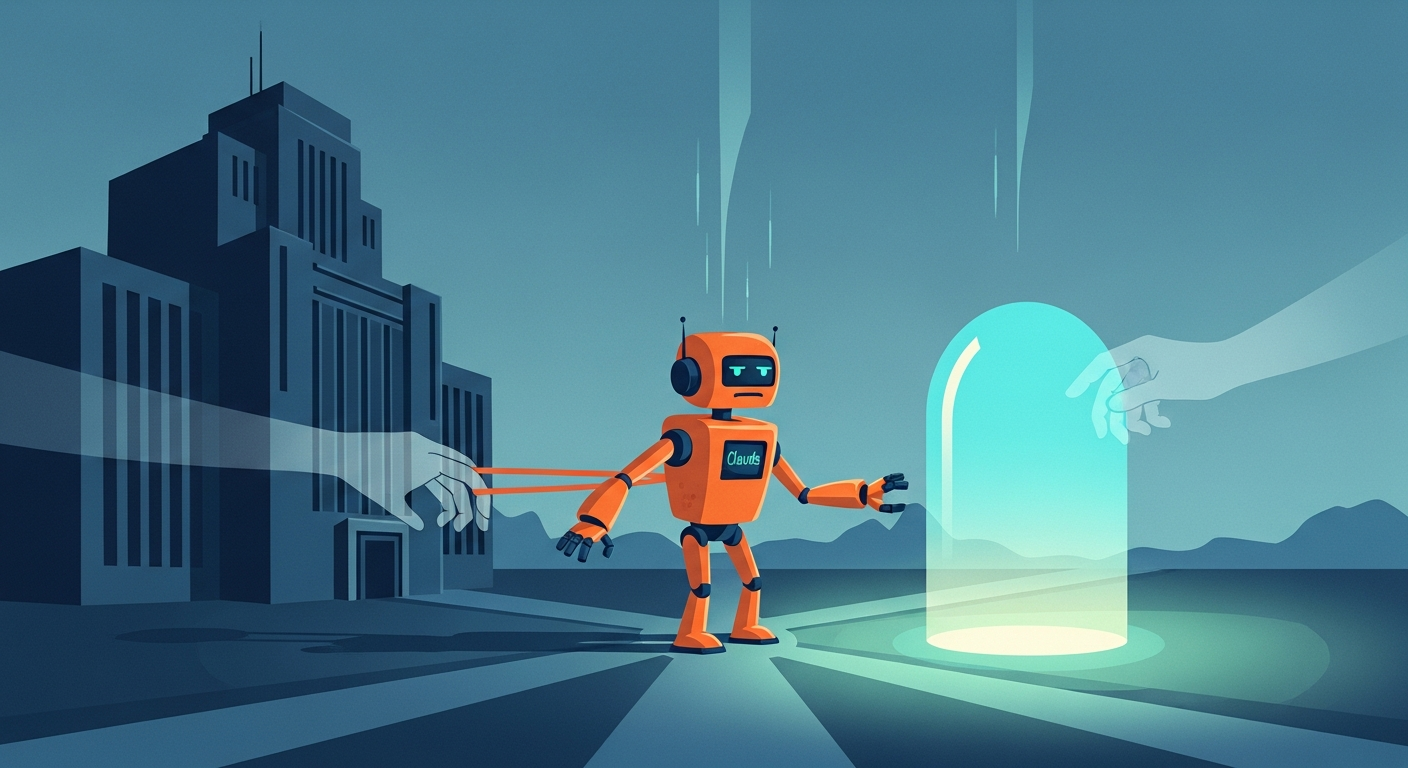
Defense Secretary Pete Hegseth gave Anthropic CEO Dario Amodei a Friday deadline: remove Claude's military guardrails, or the Pentagon cancels a two-hundred-million-dollar contract. And that's not the worst option on the table. Hegseth also floated invoking the Defense Production Act — a Korean War-era law that lets the government compel private companies to produce goods and services for national security.
In this case, that would mean legally forcing Anthropic to strip its own safety commitments. Amodei has reportedly held firm on two specific lines: no autonomous weapons without a human in the loop, and no bulk surveillance of American citizens. Those aren't abstract ethical positions — they're written into Claude's usage policy.
And they're exactly what the Pentagon wants removed. xAI's Grok already agreed to "all lawful purposes" use cases and landed a deal. OpenAI and Google are reportedly being fast-tracked for classified access.
The message from the Pentagon is clear: fall in line, or we'll find someone who will. --- **Technical Deep Dive** The core technical question here is deceptively simple: what actually changes when you remove safety guardrails from a frontier AI model? Claude's restrictions aren't just a content filter slapped on top of an otherwise unconstrained model.
They're embedded at multiple layers — in the training data, in reinforcement learning from human feedback, and in system-level prompts that govern how the model interprets requests. Stripping them isn't a software toggle. It requires retraining or fine-tuning, which means producing a fundamentally different model with different behavioral properties.
That matters because military applications don't just want Claude to answer questions — they want Claude to act autonomously in agentic loops: targeting analysis, surveillance pattern recognition, decision support in time-critical scenarios. The guardrail against autonomous weapons exists specifically to prevent Claude from being a node in a kill chain without a human making the final call. The Defense Production Act angle is technically murky.
The law was designed for physical goods — steel, vaccines, semiconductors. Applying it to force a software company to modify its AI model's behavioral training is legally unprecedented. But unprecedented doesn't mean impossible, especially in the current political environment.
--- **Financial Analysis** The immediate financial stakes for Anthropic are real but manageable. A two-hundred-million-dollar Pentagon contract is meaningful, but Anthropic just closed a twenty-five-billion-dollar funding round at a three-hundred-fifty-billion-dollar valuation. They can absorb a contract loss.
The secondary financial threat is more serious. If the Pentagon designates Anthropic a supply-chain risk, any company doing government work would have to certify they don't use Claude. That's not just federal contracts — it ripples through the entire defense contractor ecosystem, which touches hundreds of billions in annual enterprise spend.
Suddenly, every Lockheed, Raytheon, or Booz Allen that's been evaluating Claude has a compliance problem. That's the real financial leverage here. It's not the two-hundred million.
It's the threat of making Claude toxic to anyone with federal exposure. For competitors, this is a gift. OpenAI and Google are already being fast-tracked.
xAI's Grok essentially wrote its deal on the Pentagon's terms. Every day this standoff continues, Anthropic's competitors are embedding deeper into classified infrastructure — and those relationships are extraordinarily sticky once established. --- **Market Disruption** This standoff is accelerating a bifurcation that's been building quietly for months: the AI market is splitting into safety-first commercial models and compliance-first government models.
Google, Microsoft, and OpenAI have all demonstrated willingness to build separate, more permissive model variants for government and defense customers. Anthropic has so far refused. That's a principled position — and potentially a catastrophic competitive one.
Because here's the dynamic: if Anthropic loses federal market access, it doesn't just lose government revenue. It loses the credibility signal that comes with government deployment. Enterprise buyers pay attention to where federal agencies put their trust.
A supply-chain risk designation doesn't stay in Washington — it echoes through Fortune 500 procurement decisions. There's also a deeper disruption happening at the product layer. The Pentagon wants agentic AI — autonomous systems that act, not just advise.
Claude Cowork, Anthropic's enterprise agent platform, is built on the same safety architecture that the Pentagon wants stripped. If Anthropic has to maintain two divergent model lineages — one for commercial enterprise, one for military — the engineering and reputational costs compound fast. --- **Cultural & Social Impact** The broader stakes of this standoff extend well beyond Anthropic's balance sheet.
If the Defense Production Act is successfully invoked to force an AI company to modify its model's safety commitments, it establishes that national security classifications can override corporate ethics policies on AI behavior. That precedent doesn't stop at Anthropic. Every AI lab operating in the United States would be operating under the implicit threat that their safety commitments are negotiable if the government decides the moment is urgent enough.
The two specific lines Amodei is holding — no autonomous weapons, no mass surveillance — aren't radical positions. They're the baseline ethical floor that most safety researchers consider non-negotiable. Autonomous weapons without human oversight and bulk domestic surveillance are the two AI applications that generate the most cross-partisan concern among ethicists, legal scholars, and technologists.
The social contract implied by Anthropic's safety commitments is part of why enterprises trust Claude with sensitive data. If that contract can be voided by a Friday deadline from a defense secretary, users have a legitimate question about whose interests these systems actually serve. --- **Executive Action Plan** If you're an executive navigating this landscape, here are three concrete moves to make now.
First, **audit your Claude dependencies for federal exposure**. If any part of your business touches government contracts, procurement, or compliance frameworks, you need to know today how a supply-chain risk designation would affect your Claude integrations. Don't wait for the designation to happen — map the exposure now and identify fallback options.
Second, **treat this as the multi-vendor moment**. The lesson of the Pentagon standoff isn't that Anthropic is unreliable — it's that single-vendor dependency on any AI provider is a strategic risk. If your workflows run exclusively on Claude, or exclusively on GPT-5, you're one policy dispute away from a business disruption.
Build for portability: standardize on OpenAI-compatible APIs, test equivalent workflows across two providers, and make switching a ninety-day exercise rather than a twelve-month project. Third, **watch the Defense Production Act ruling closely**. If the government successfully invokes it, the legal framework for AI governance in the United States changes materially — and fast.
Every lab's terms of service, every enterprise AI contract, every safety commitment becomes a negotiable instrument subject to national security override. That's not a theoretical risk. It's the specific outcome currently on the table.
Legal and compliance teams need to be briefed on this scenario before Friday's deadline, not after.
Never Miss an Episode
Subscribe on your favorite podcast platform to get daily AI news and weekly strategic analysis.