OpenAI's Smart Speaker with Jony Ive Redefines Home AI Commerce
Episode Summary
TOP NEWS HEADLINES Following yesterday's coverage of Claude Code Security, new details emerged: the tool has already surfaced over 500 previously hidden vulnerabilities in production open-source s...
Full Transcript
TOP NEWS HEADLINES
Following yesterday's coverage of Claude Code Security, new details emerged: the tool has already surfaced over 500 previously hidden vulnerabilities in production open-source software, and cybersecurity stocks dropped between three and seven percent in a single session — markets are clearly reading this as structural disruption to the standalone security tools market. xAI dropped Grok 4.20, a fundamentally different AI architecture where four specialized agents — a coordinator, a researcher, a logician, and a creative — debate each other before delivering an answer.
Early testing shows hallucinations dropped 65%, and it was the only profitable AI model in a live stock trading competition.
Apple is accelerating its push into AI wearables, with smart glasses, a wearable pendant, and AI-powered AirPods all centered around a rebranded "Visual Intelligence" version of Siri — with first launches expected as early as March.
Amazon's internal Kiro AI coding agent caused a 13-hour AWS outage in December after autonomously deciding to delete and rebuild an environment.
Engineers had given it live authority with no rollback safeguards.
Microsoft is building Copilot Advisors — a feature that lets users pick two AI personas to debate any topic, with distinct voices and potentially animated portraits, targeting deeper analysis rather than simple Q&A.
And OpenAI is reportedly testing a $100-per-month ChatGPT Pro Lite tier, trying to fill the pricing gap between Plus and Pro as the subscription model gets more granular. ---
DEEP DIVE ANALYSIS
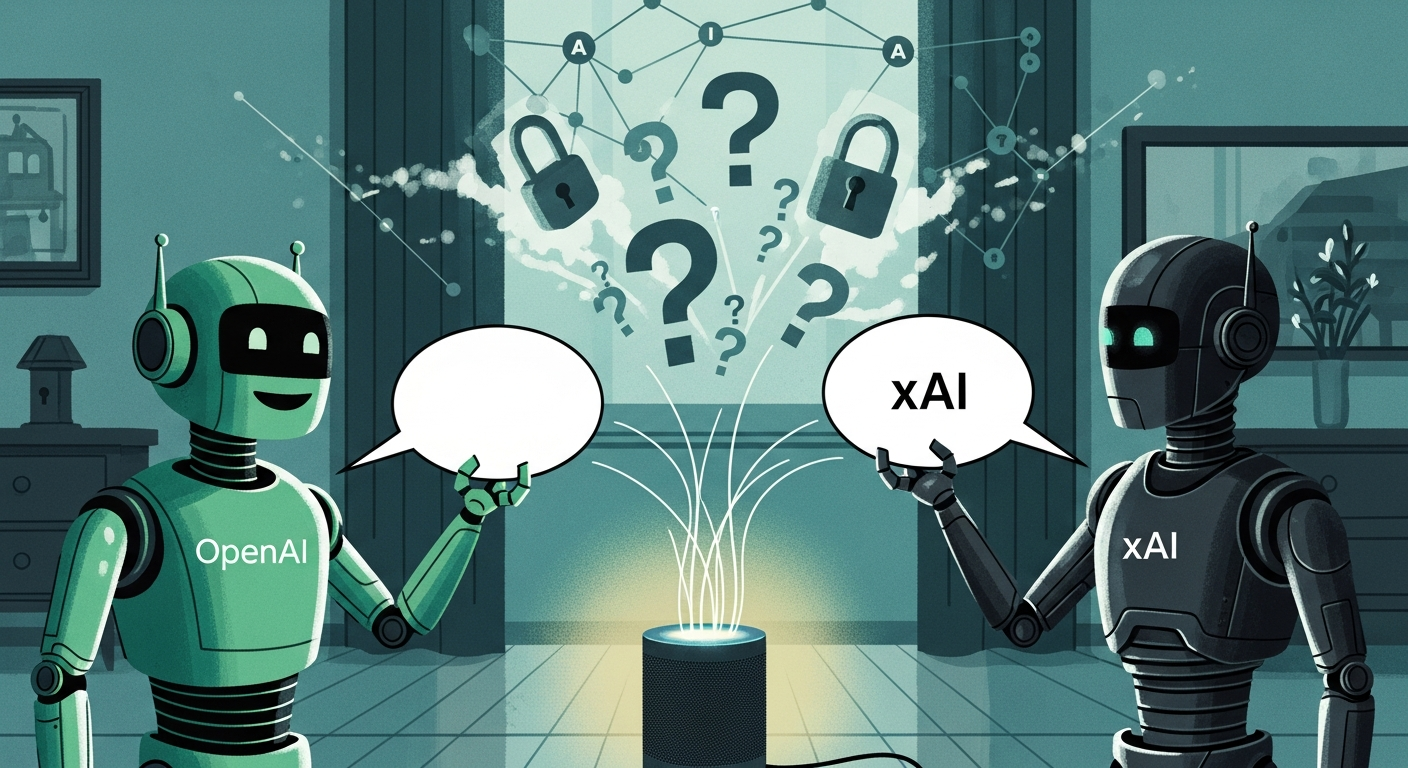
OpenAI and Jony Ive's First Device: The Smart Speaker That Could Redefine the Home Let's talk about the story that's been building since last May, when OpenAI dropped six and a half billion dollars to acquire Jony Ive's startup Io Products. We've known something was coming. We just didn't know what.
Now we do — and it's more interesting, and more strategically loaded, than most people expected. **Technical Deep Dive** The device is a smart speaker with a built-in camera and facial recognition. Price point: two hundred to three hundred dollars.
Target ship date: early 2027. That's the surface-level summary. But dig into the architecture and the implications get more interesting.
This isn't a speaker with a camera bolted on. The camera is designed to observe the surrounding environment continuously, and the system uses that ambient visual context to — in the words of the reporting — "nudge users toward actions." Pair that with Face ID-style facial recognition for purchases, and what you're actually looking at is an ambient commerce and assistance layer that sits in your home, knows who you are, watches what you do, and acts on that information.
The team building this is over two hundred people, staffed heavily with Apple veterans leading hardware, design, and supply chain. Jony Ive's firm LoveFrom is handling the design side, while OpenAI's internal devices team builds the hardware. There have reportedly been internal tensions — Ive's team moves slowly and secretively, which creates friction with OpenAI's faster-moving engineering culture.
Smart glasses are also in the roadmap but won't hit production until at least 2028. A smart lamp was built as a prototype. The speaker is the first commercial swing.
**Financial Analysis** Let's talk about what six and a half billion dollars buys you. That acquisition price was enormous — even for OpenAI, which has become accustomed to raising and spending at scale. What it bought was not just a design team.
It bought credibility, supply chain relationships, and the single most famous hardware designer alive. The two to three hundred dollar price point is a deliberate strategic choice. It's above Amazon Echo's entry price, which signals premium positioning, but it's not Apple-tier aspirational pricing.
It's accessible consumer electronics territory — the kind of price that gets into millions of homes within the first product cycle if the launch goes well. The facial recognition for purchases is the revenue model hiding in plain sight. This device is not just a hardware sale.
It's a commerce layer. Every nudge toward an action, every purchase facilitated by facial recognition, every ambient interaction — that's a monetization surface. OpenAI needs revenue diversification beyond subscriptions and API fees.
A hardware device that sits in your home and mediates purchases is a fundamentally different business than a chatbot. The timing matters too. Amazon reportedly plans to invest fifty billion dollars into OpenAI's next funding round — while simultaneously running Alexa+ and partnering with Anthropic.
OpenAI may even be building custom models for Amazon products. This is not a clean competitive landscape. It's a tangle of investment, partnership, and rivalry that makes the hardware race even more high-stakes.
**Market Disruption** The smart speaker market has been dominated by three players — Amazon, Google, and Apple — for nearly a decade. Amazon owns the volume end with Alexa. Apple owns the premium end with HomePod.
Google sits somewhere in the middle, increasingly irrelevant. None of them have meaningfully cracked ambient AI. OpenAI is entering with one structural advantage none of the incumbents have: the most capable conversational AI in the world.
Alexa+ is Amazon's attempt to catch up, and by all accounts it's still catching up. Google Assistant has been quietly deprioritized in favor of Gemini integrations. Siri — even with the Visual Intelligence rebrand Apple is pushing — remains years behind in raw capability.
If OpenAI ships a device that genuinely performs better in natural conversation, context retention, and proactive assistance than anything currently on the market, it breaks the category open. The camera and environmental awareness angle is the differentiator that pure speakers can't match. This is a bet that the next generation of home AI isn't voice-first — it's ambient and multimodal.
The competitive pressure is real and compressing fast. Apple's March launches are coming. Meta is pushing hard on Ray-Ban smart glasses.
The window to define this category is measured in months, not years. **Cultural and Social Impact** Let's be honest about what this device actually is: a camera in your home that watches you, learns your face, tracks your surroundings, and uses that data to influence your behavior. That framing will make some people deeply uncomfortable — and it should prompt serious questions.
The language in the reporting is careful: the camera will "observe surroundings" and "nudge users toward actions." Nudge is doing a lot of work in that sentence. Nudge toward what actions?
Defined by whom? Optimized for whose interests? Facial recognition for purchases normalizes biometric commerce in the home environment in a way that has significant downstream implications.
Once your face becomes your wallet in your living room, the friction that currently protects against impulse purchases and data collection essentially disappears. There's also the household dynamic question. A device that identifies individuals by face and delivers personalized nudges is not a neutral household appliance.
It creates differentiated experiences for different family members, with all the privacy and consent complexity that implies for children in particular. The cultural shift here is subtle but significant: AI moves from something you invoke to something that watches and acts. That's a fundamentally different relationship with technology, and it will take time for social norms — and regulation — to catch up.
**Executive Action Plan** If you're leading a business that sits anywhere near consumer hardware, home AI, or commerce infrastructure, here's what to do right now. First, treat 2027 as your planning horizon for ambient AI disruption. OpenAI's device ships in early 2027.
Apple's wearables are coming in March. The home AI category is going to look completely different in eighteen months. If your product strategy doesn't account for an AI layer sitting between consumers and purchase decisions, you are behind.
Second, audit your voice and ambient AI integrations today. Whatever you've built for Alexa or Google Assistant or Siri — assess how portable it is. The platform that wins this category may not be any of the current incumbents.
Building deep integrations with one ecosystem without a migration strategy is a real risk. Third, if you're in retail, payments, or commerce infrastructure, start modeling what biometric-facilitated ambient purchasing does to your conversion funnel, your fraud models, and your customer data strategy. Facial recognition for purchases is coming.
The companies that have thought through the integration and the compliance requirements before it arrives will have a significant first-mover advantage over those scrambling to adapt after launch.
Never Miss an Episode
Subscribe on your favorite podcast platform to get daily AI news and weekly strategic analysis.