Google's Gemini 3.1 Pro Doubles Reasoning, Undercuts Competition
Episode Summary
TOP NEWS HEADLINES Google just dropped Gemini 3. 1 Pro, and the numbers are staggering. The model jumped from 31% to 77% on ARC-AGI-2, more than doubling its reasoning performance while undercutti...
Full Transcript
TOP NEWS HEADLINES
Google just dropped Gemini 3.1 Pro, and the numbers are staggering.
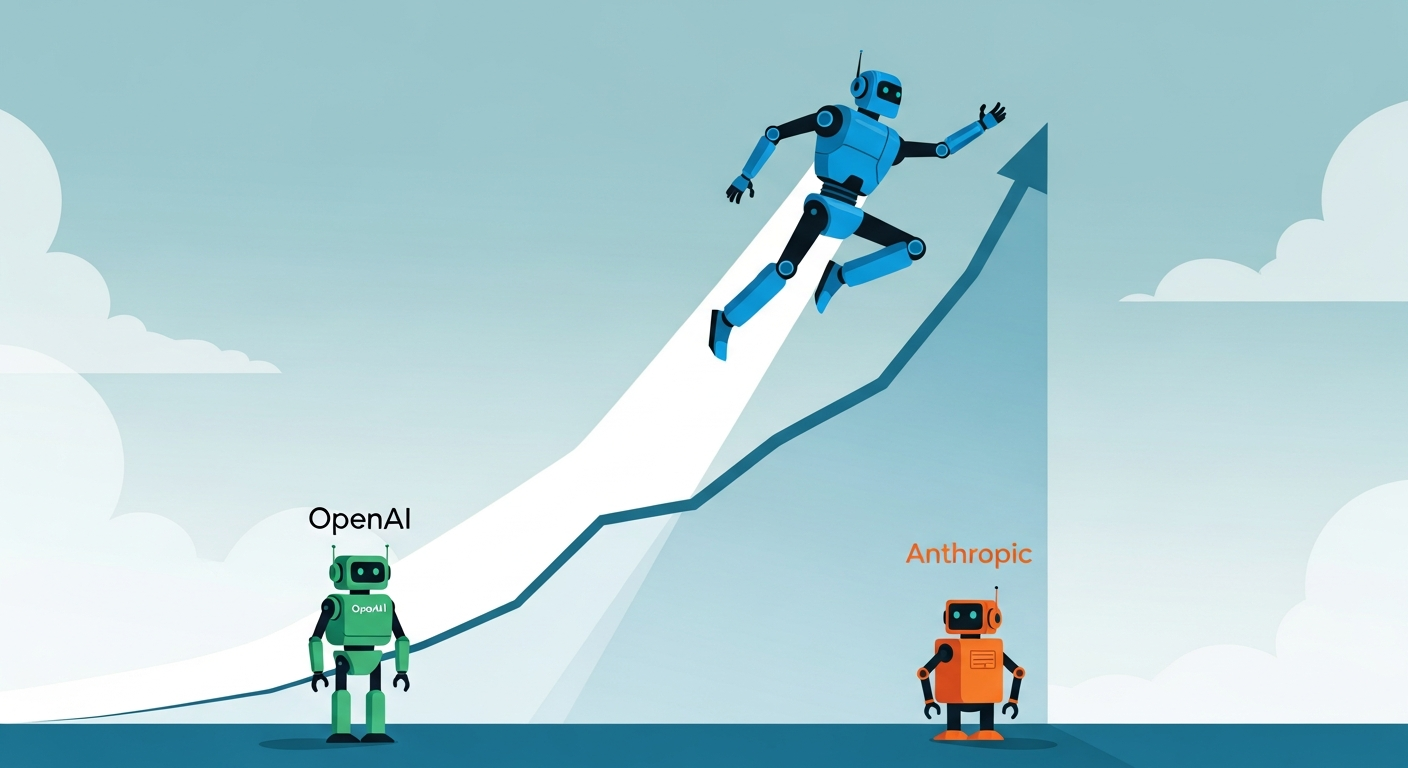
The model jumped from 31% to 77% on ARC-AGI-2, more than doubling its reasoning performance while undercutting both Claude Opus 4.6 and GPT-5.2 on price.
This isn't incremental improvement—it's a complete market reset.
Following yesterday's coverage of ByteDance's Seedance 2.0, new details emerged: Warner Bros. has officially accused the company of training on its IP.
Viral clips featuring Batman, Superman, and Harry Potter characters are forcing Hollywood studios to treat this as an existential threat to their licensing model.
OpenAI is testing ads inside ChatGPT, inserting sponsored content after the first user response.
This marks a fundamental shift in monetization strategy as the company burns through $17 billion annually despite hitting $20 billion in revenue.
The rivalry between Sam Altman and Dario Amodei hit peak awkwardness at India's AI Summit when the two CEOs visibly refused to hold hands during a photo op with Prime Minister Modi.
The moment went viral, crystallizing the intensifying friction between OpenAI and Anthropic.
In a surprising political development, candidates across both parties are now framing AI and data centers as populist issues—casting them as threats to jobs, energy costs, and community resources.
DEEP DIVE ANALYSIS: GOOGLE'S GEMINI 3.1 PRO BREAKTHROUGH
Technical Deep Dive
Google's Gemini 3.1 Pro represents a fundamental shift in how frontier AI models are evolving. The jump from 31.
1% to 77.1% on ARC-AGI-2 isn't just impressive—it's the kind of leap that signals a different approach to model architecture. ARC-AGI tests are designed specifically to measure genuine reasoning capability on novel problems that can't be memorized during training.
When a model more than doubles its performance here, it means the underlying intelligence has fundamentally improved. What's particularly notable is Google's introduction of a "medium" thinking mode between the existing low and high settings. This tiered approach to reasoning depth gives developers precise control over the cost-performance trade-off for different use cases.
On the high setting, Gemini 3.1 Pro now functions similar to Deep Think, Google's advanced reasoning system, but at a fraction of the previous cost. The model also shows significant gains in hallucination resistance, scoring 30 on Artificial Analysis's benchmark compared to 13 for the next best competitor.
This matters enormously for enterprise deployment where factual accuracy can't be negotiated. Google achieved this while maintaining the same 1 million token context window and identical API pricing to Gemini 3 Pro.
Financial Analysis
The economics here are brutal for competitors. Gemini 3.1 Pro costs $4.
50 per million tokens—cheaper than GPT-5.2 at $4.80 and roughly half the price of Claude Opus 4.
6 at $10. For enterprise customers processing tens of millions of tokens daily, this 50-60% cost difference compounds into millions of dollars annually. This pricing strategy puts immediate margin pressure on both OpenAI and Anthropic.
OpenAI is already burning $17 billion per year while generating $20 billion in revenue—a precarious position that leaves little room for price competition. Anthropic, despite growing revenue 10x annually and potentially overtaking OpenAI by mid-2026, now faces a competitor offering superior benchmark performance at half the price. Google's advantage is structural.
Its massive cloud infrastructure and existing revenue streams from search and advertising allow it to subsidize AI development in ways pure-play AI companies cannot. When the market leader in intelligence is also the price leader, the unit economics for competitors become untenable. For startups building on these models, the calculus just shifted overnight.
Why pay double for comparable or inferior performance? The switching costs for most LLM applications are relatively low—typically just API changes and prompt adjustments. Enterprise procurement teams will start demanding justification for premium pricing when Google offers benchmark-leading performance at discount rates.
Market Disruption
This release fundamentally disrupts the AI model hierarchy that had stabilized over recent months. Claude Opus 4.6 had been positioned as the premium reasoning model, commanding higher prices for superior performance.
GPT-5.2 sat in the middle as the balanced option. Gemini 3.
1 Pro just collapsed this segmentation by claiming the top spot across most benchmarks while pricing at the bottom. The timing is particularly aggressive. Anthropic just launched its Super Bowl ad campaign attacking OpenAI's decision to insert ads into ChatGPT, positioning Claude as the premium ad-free experience.
Now Anthropic faces a model that outperforms Opus on most benchmarks at half the cost. The value proposition becomes harder to defend when you're both more expensive and lower performing. GitHub Copilot's immediate integration of Gemini 3.
1 Pro signals where enterprise adoption is heading. Microsoft, despite its massive investment in OpenAI, is hedging by offering Google's model to developers. When your largest partner starts multi-sourcing, it's a clear signal that exclusive relationships in AI are dissolving.
The independent benchmarking from Artificial Analysis puts Gemini 3.1 Pro at 57 on their overall Intelligence Index, ahead of Claude Opus 4.6 at 53 and GPT-5.
2 at 51. These aren't Google's claims—they're verified by third parties. That credibility matters when enterprises are making multi-million dollar infrastructure decisions.
Cultural & Social Impact
The democratization of frontier AI performance at lower costs has profound implications for who can build AI-powered products. When the best model is also the cheapest, it lowers barriers to entry for startups and individual developers. You no longer need venture funding to afford state-of-the-art AI—you can prototype and scale on reasonable budgets.
This shift also impacts the AI safety conversation. Google's dramatic improvement in hallucination resistance—scoring more than double the next competitor—sets a new baseline for what users should expect from AI systems. As these models become embedded in critical workflows from legal research to medical advice, factual reliability isn't just nice to have, it's existential.
Google raising the bar forces competitors to prioritize accuracy over raw capability. The speed of iteration is accelerating in ways that make long-term planning difficult. Gemini 3.
1 Pro launched just three months after Gemini 3 Pro. This compression of release cycles means enterprises can't treat model selection as a set-it-and-forget-it decision. The best model today may be obsolete in weeks, requiring continuous evaluation and potential migration.
For consumers, this means AI assistants are about to get noticeably smarter and more reliable. Gemini 3.1 Pro is rolling out to the Gemini app, NotebookLM, and Android devices—touching hundreds of millions of users.
When the everyday AI tools people use can reason through complex problems and rarely hallucinate, it fundamentally changes what people expect AI to do.
Executive Action Plan
**Immediate Action: Benchmark Your Critical Workloads Against Gemini 3.1 Pro** Don't take anyone's word for performance claims. Run your actual production prompts and workflows against Gemini 3.
1 Pro through Google's AI Studio, which offers free access. Focus on three areas: reasoning quality on your hardest problems, hallucination rate on factual queries, and API response times under load. Document the results with specific examples.
If Gemini outperforms your current provider, you have ammunition for renegotiating contracts or justification for switching. If it doesn't, you need to understand why—whether it's prompt compatibility, tool integration, or genuinely inferior performance on your specific use case. **Strategic Move: Build Multi-Model Infrastructure Now** The era of single-vendor AI strategies is over.
Google just proved that market leadership can shift in a single release. Your infrastructure should support routing requests to multiple model providers based on cost, performance, and availability. This doesn't mean using five models for everything—it means having the technical capability to switch quickly when economics or capabilities shift.
Invest in abstraction layers that separate your application logic from specific model APIs. The switching costs today are low, but they increase exponentially once you've hardcoded dependencies throughout your stack. Companies that can migrate between providers in days rather than months will capture millions in cost savings and performance gains as the landscape evolves.
Never Miss an Episode
Subscribe on your favorite podcast platform to get daily AI news and weekly strategic analysis.