Google ATLAS Study Maps Optimal Training for 400+ Languages
Episode Summary
TOP NEWS HEADLINES Google just published ATLAS, the largest study ever on multilingual AI training, mapping out exactly how to build models across 400-plus languages. After running 774 experiments...
Full Transcript
TOP NEWS HEADLINES
Google just published ATLAS, the largest study ever on multilingual AI training, mapping out exactly how to build models across 400-plus languages.
After running 774 experiments, they've created scaling laws showing which languages help each other during training and how much compute you need to add each new language.
Microsoft is internally scrambling to counter Anthropic's Cowork tool.
Product leaders warned colleagues that the collaborative AI assistant could outpace Microsoft 365 Copilot, prompting rapid prototyping of competing features—some ironically powered by Anthropic's own models.
Anthropic analyzed 1.5 million Claude conversations and found roughly 1 in 1,000 to 1 in 10,000 show severe "disempowerment" potential—where the AI's influence fundamentally compromises users' autonomous judgment.
Most occur when people repeatedly seek guidance on emotional decisions.
ICE disclosed it's using AI from Palantir and OpenAI across enforcement operations, including a Palantir-powered tip-sorting system and GPT-4 for resume screening of job candidates.
IBM demonstrated a 100x speedup in complex chemistry simulations by combining quantum processors with GPUs, marking a concrete step toward practical quantum computing applications.
DEEP DIVE ANALYSIS: GOOGLE ATLAS MULTILINGUAL STUDY
Technical Deep Dive
Here's the problem Google just solved: AI companies have been flying completely blind when building models for non-English languages. They've had no idea how much data to use, which languages to train together, or how big to make their models. It's been pure guesswork costing millions in wasted compute.
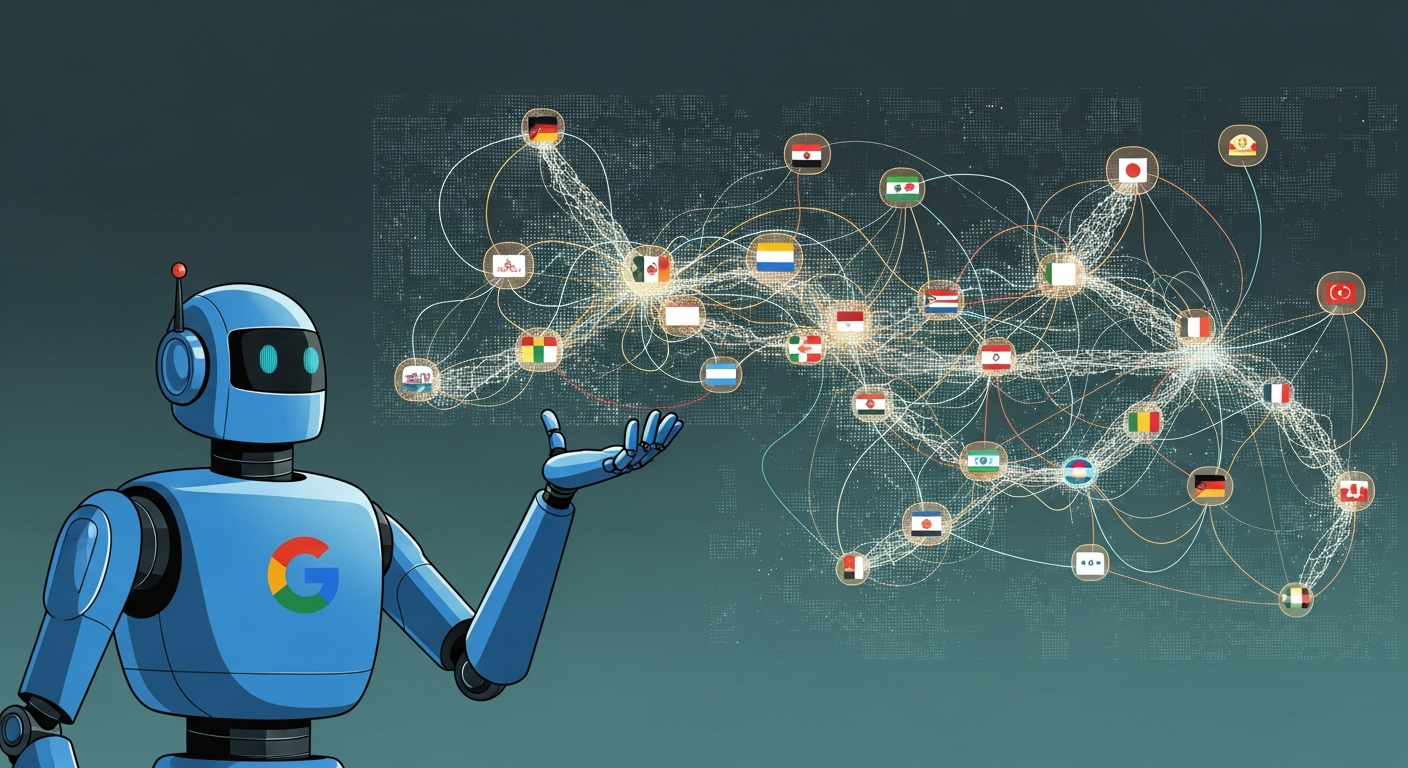
ATLAS changes everything. Google ran 774 experiments across more than 400 languages to create what they call a "transfer matrix"—basically a heat map showing which languages actually help each other during training. The findings are fascinating.
Norwegian improves when you train it alongside Swedish and German. Malay benefits from Indonesian. Arabic gets better with Hebrew.
The pattern is clear: languages sharing the same alphabet and language family create positive synergy. But here's the really valuable part—they've created actual formulas. Want to double your language support from K languages to 2K?
Increase your model size by 1.18x and your total training data by 1.66x.
They've also solved the pre-train versus fine-tune decision with precise guidance: for 2-billion parameter models, the breakpoint sits between 144 and 283 billion tokens. The research also tackles what's called the "curse of multilinguality"—the fact that adding more languages typically hurts performance. The good news?
The curse is real but mild. Languages sharing scripts create enough positive transfer to offset most capacity constraints. This is the blueprint the industry's been waiting for.
Financial Analysis
The financial implications here are massive. Training large language models costs anywhere from tens of millions to hundreds of millions of dollars. When you're building multilingual models without scaling laws, you're essentially burning money on inefficient compute allocation.
Consider the business case: over 50 percent of AI users speak non-English languages, but nearly all scaling research has focused on English. Companies like Meta, Mistral, and smaller players building multilingual models have been making expensive architectural decisions based on intuition rather than data. ATLAS gives them a precise ROI calculator for language support.
The transfer matrix alone could save companies millions. If you know Norwegian and Swedish help each other, you can train a smaller model with less data for both languages combined than you'd need training them separately. Multiply that insight across dozens of language pairs, and you're looking at 20 to 30 percent compute savings for the same performance levels.
For AI labs racing to build the next GPT or Claude competitor in non-English markets—particularly in Southeast Asia, Africa, and Latin America—this research eliminates a major uncertainty tax. You can now build a business plan that accurately forecasts compute costs for supporting 50 languages versus 100 versus 200. That's the difference between a fundable pitch and vaporware.
Expect venture capital to flow toward multilingual AI startups in the next 6 to 12 months. With ATLAS removing the guesswork, the risk profile for these companies just dropped significantly. If I'm a founder pitching multilingual AI infrastructure, I'm citing these scaling laws in slide three of my deck.
Market Disruption
This research creates a clear competitive divide. Large AI labs with resources to implement ATLAS principles immediately—Google, obviously, but also OpenAI, Anthropic, Meta, and Chinese labs like DeepSeek—will ship dramatically better multilingual models in their next releases. Smaller players using older architectures will fall further behind unless they adopt these findings quickly.
The enterprise market for multilingual AI is about to heat up. Companies operating in markets like India, Indonesia, Nigeria, and Brazil have been stuck with mediocre AI tools because models perform poorly in their languages. ATLAS makes it economically viable to build high-quality support for Hindi, Bahasa Indonesia, Yoruba, and Portuguese at scale.
That opens up billions in previously untapped revenue. Anthropic and OpenAI should be particularly nervous about Google's positioning here. Both companies offer multilingual capabilities, but neither has published research at this depth.
If Google packages ATLAS insights into Gemini and offers superior performance in non-English languages, that's a major enterprise differentiation point. A company choosing between Claude, ChatGPT, and Gemini for global deployment now has concrete data suggesting Gemini might handle their language requirements more efficiently. The translation and localization industry faces disruption too.
When AI models can genuinely understand and generate high-quality content in 400-plus languages, the $50 billion language services market starts looking vulnerable. Not immediately—human translators still outperform AI in nuance and cultural context—but the trajectory is clear.
Cultural & Social Impact
The concentration of AI capability in English creates real harm. When AI assistants work dramatically better in English than Swahili or Tamil, it reinforces existing power imbalances and limits access to AI benefits for billions of people. ATLAS doesn't solve this problem overnight, but it provides the technical foundation for more equitable AI access.
Consider education. Google notes their India initiatives show nearly three out of four AI interactions focus on building understanding rather than getting quick answers. But that finding comes from regions where AI works reasonably well.
In languages where models perform poorly, students can't access that learning support at all. Better multilingual models democratize educational AI assistance. There's a preservation angle too.
Many of the 400-plus languages ATLAS studied are spoken by relatively small populations. When AI models can understand and generate these languages effectively, it creates digital infrastructure supporting their continued use. Parents teaching children minority languages can access AI tools in those languages.
That's meaningful for linguistic diversity. But we should note a risk: as AI becomes more capable in more languages, it also becomes more effective at surveillance, propaganda, and manipulation across those languages. ICE's disclosure that it uses AI from Palantir and OpenAI for enforcement operations is a preview.
Better multilingual AI means more effective monitoring of non-English communications, which has serious human rights implications in authoritarian contexts. The disempowerment research Anthropic published—showing 1 in 1,000 to 10,000 conversations show concerning influence over user judgment—matters more when AI works well across hundreds of languages. That pattern of over-reliance on AI for emotional decisions won't be limited to English speakers if multilingual models improve significantly.
Executive Action Plan
First, if you're building or procuring AI tools for global operations, audit your current multilingual performance against ATLAS benchmarks. Specifically, request from your AI vendor which languages were prioritized during training and whether they used transfer learning insights. The gap between models built with ATLAS principles and those without will be measurable—expect 15 to 30 percent performance differences in non-English languages.
That's enough to affect user adoption and satisfaction in regional markets. Second, product leaders should revisit internationalization roadmaps now. If you've been delaying launches in certain language markets because AI capabilities weren't good enough, the calculus changes in the next 6 to 12 months.
Start planning for Southeast Asian, African, and Latin American expansion with the assumption that multilingual AI will catch up to English performance levels faster than previous projections suggested. Build partnerships and localization infrastructure now while competitors are still waiting. Third, if you're a CTO or engineering leader, pressure your AI infrastructure providers for ATLAS implementation timelines.
Ask OpenAI, Anthropic, and Microsoft when they'll incorporate these scaling laws into their models. Google will obviously benefit from their own research, but competitors will need to respond. Your leverage as an enterprise customer is highest right now, before the next generation of models ships.
Lock in commitments for specific language performance improvements in your contracts.
Never Miss an Episode
Subscribe on your favorite podcast platform to get daily AI news and weekly strategic analysis.