Google Chrome Transforms Into Autonomous AI Agent Platform
Episode Summary
TOP NEWS HEADLINES Google just dropped a major Chrome update that's about to change how billions of people browse the web. They're integrating Gemini directly into Chrome with something called Aut...
Full Transcript
TOP NEWS HEADLINES
Google just dropped a major Chrome update that's about to change how billions of people browse the web.
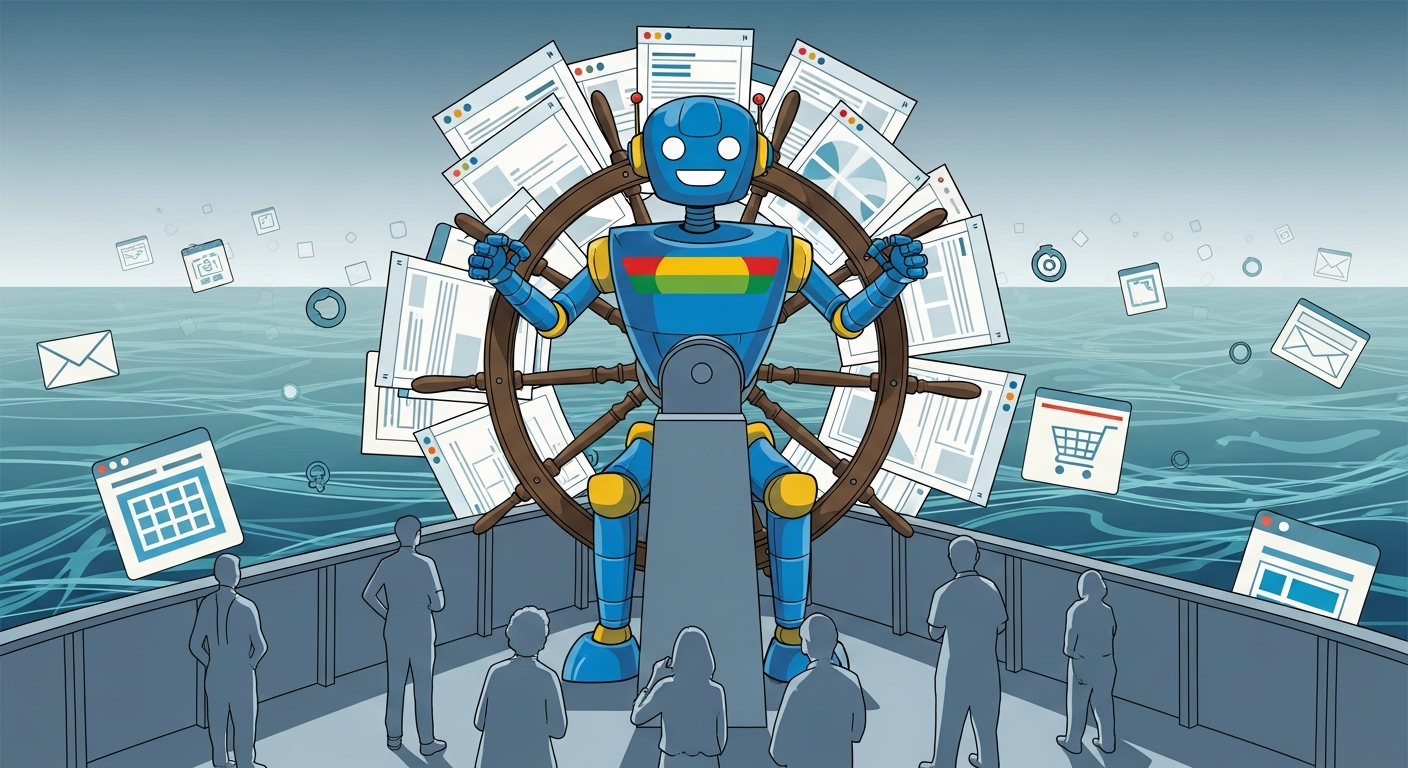
They're integrating Gemini directly into Chrome with something called Auto Browse—basically an AI agent that can click through websites, shop for you, and handle tedious tasks while pausing before sensitive actions like payments.
The sidebar implementation gives it more breathing room than those pop-up AI assistants we've been seeing, and it connects directly to Gmail, Calendar, and other Google services.
Following yesterday's coverage of the viral Clawdbot tool that caught fire on social media, new details emerged: Anthropic's legal team didn't just request a name change—they forced a complete mascot and brand reset, leading to the new identity as Moltbot.
But here's the interesting part: the controversy is actually driving a spike in Mac Mini sales as users hunt for cheap, always-on hardware to run these local agents.
Microsoft just revealed they earned $7.6 billion in net income from their OpenAI investment last quarter alone.
That's a staggering return, and their commercial obligations have jumped to $625 billion, with nearly half of that tied to OpenAI.
DeepMind released the full research paper and model weights for AlphaGenome—their AI that can predict how genetic mutations cause disease by analyzing a million letters of DNA code.
This is the 98% of our genome that scientists previously couldn't understand, and they're making it freely available for research.
And in the coding wars between Chinese AI labs, Kimi K2.5 just posted a 73.8% success rate on SWE-bench Verified, meaning it's debugging 3 out of 4 real-world GitHub issues.
It's now in a heated rivalry with GLM 4.7, with both models approaching Claude Sonnet 4.5 performance levels.
DEEP DIVE ANALYSIS
Google Chrome's Transformation Into an AI Agent Platform Today we're diving deep on Google's Chrome AI upgrade because this represents something much bigger than another AI feature launch. When you control the world's dominant browser with over 3 billion users and you turn it into an autonomous agent platform, you're not just adding functionality—you're rewriting the rules of how the internet works. **Technical Deep Dive** Let's talk about what Google actually built here.
Auto Browse is Chrome's implementation of what the industry calls "computer use"—AI that can manipulate a graphical interface like a human would. It operates in its own tab, clicking buttons, filling forms, navigating multi-step workflows. The critical innovation is the pause mechanism before sensitive actions.
That's not just a safety feature, it's an architectural decision that reveals Google's strategy. The split-screen sidebar implementation matters more than it sounds. Previous AI browser integrations felt bolted on—floating windows, pop-ups that covered content.
Google's sidebar gives Gemini persistent context. It can see what you're doing across tabs, compare products, and access your Google account ecosystem. This is unified memory, something that earlier AI browser attempts completely missed.
The Nano Banana integration for image generation directly in the browser and the upcoming Personal Intelligence feature signal where this is heading. Google isn't building a chatbot that happens to live in your browser. They're building an operating layer that sits between you and the web.
When Gemini can access your Gmail, Calendar, Shopping history, and now manipulate websites on your behalf, it becomes infrastructure, not a feature. From a technical standpoint, this works because Chrome already has the hooks into webpage structure through its rendering engine. Adding AI control is actually simpler than building this from scratch, which is why startup AI browsers have struggled to gain traction despite having AI-first features.
**Financial Analysis** The financial implications here are massive and they explain why Microsoft earned $7.6 billion from OpenAI last quarter. Google watched a parade of AI-first browsers launch in 2025—OpenAI's Atlas, Perplexity's Comet, Dia, and others.
None gained meaningful market share because they faced a classic innovator's dilemma: they had better AI features but Chrome had 3 billion users and decades of accumulated web compatibility. Google's move here is defensive economics disguised as innovation. Chrome is free, but it's the gateway to Google's advertising empire.
Every search, every interaction, every behavior signal flows through Chrome. An AI layer that lives outside Chrome—say, an AI browser people actually switched to—would sever that data pipeline. That's an existential threat worth defending at any cost.
The AI Plus subscription at $7.99 monthly that was mentioned in yesterday's coverage suddenly makes sense in this context. Google can monetize power users while keeping the basic AI features free, exactly mirroring how they operate across their entire product suite.
But the real revenue isn't the subscription—it's maintaining control over how billions of people interact with the commercial web. Look at the competitive dynamics. Microsoft is embedding Copilot directly into Windows and Edge.
They're not doing this because it's the best user experience—they're doing it because neutral AI agents threaten platform economics. When Anthropic builds Claude to coordinate work across applications, or when OpenAI's Operator can browse anywhere, these tools don't care about browser market share. They threaten to commoditize the browser itself.
Google's response reveals their trump card: distribution and integration. They don't need the best AI model if they have the best distribution. And unlike startups burning cash to acquire users, Google can bundle this into Chrome, which already ships on nearly every Android device and dominates desktop browsing.
**Market Disruption** This announcement effectively closes the window for AI-first browsers as standalone businesses. Think about the pitch that worked in early 2025: "We built a browser where AI is native, not bolted on." That value proposition evaporated the moment Chrome integrated Gemini properly.
Investors aren't stupid—if Google can add Auto Browse to 3 billion existing Chrome users overnight, why would they fund a startup trying to convince people to switch browsers? The real disruption is happening one layer up. Chrome isn't competing with other browsers anymore—it's competing to be your AI interface to the internet.
This puts Chrome in direct conflict with every AI assistant trying to be a coordinator or autonomous agent. If Gemini can already access your Gmail, manipulate websites, and remember context across sessions, why do you need a separate AI assistant? We're watching the same pattern that played out with mobile operating systems.
Early AI tools operated in a platform-neutral space—you could use Claude or ChatGPT anywhere. But as platform owners like Google and Microsoft integrate AI deeply into their infrastructure, they create moats. Your Chrome history, your Google account, your calendar, your shopping behavior—these become the training data and context that makes Chrome's AI more useful than a generic alternative.
For AI startups, this creates a brutal strategic constraint. You can either integrate with platforms like Chrome and become dependent on their APIs and policies, or you can try to go around them and face massive distribution disadvantages. Neither is a great position.
The enterprise implications are even more significant. Companies that built workflows around Chrome—and that's most companies—now get AI capabilities without changing their security policies, compliance frameworks, or IT infrastructure. Chrome is already inside the firewall.
Adding AI to it is an update, not a new vendor relationship. That's a massive competitive advantage against standalone AI tools that have to navigate enterprise procurement. **Cultural & Social Impact** Let's talk about what happens when autonomous browsing becomes normal.
Right now, most people still think of AI as something you ask questions. Auto Browse represents a fundamental shift—you tell it what you want done, not how to do it. That's a different mental model, and it changes the relationship between humans and the web.
Consider the implications for web design. If a significant portion of traffic comes from AI agents rather than humans, websites will optimize for agent readability rather than human aesthetics. We're already seeing early signs—structured data, clear action buttons, simplified flows.
This accelerates as AI browsing scales. There's also a massive shift in digital literacy. For the past three decades, being good with computers meant learning to navigate interfaces, remember URLs, understand how websites work.
Auto Browse abstracts that away. You don't need to know how to comparison shop across five websites—you just tell Gemini what you want. That's empowering for people who struggle with technology, but it also creates a new form of learned helplessness.
If the AI handles everything, users lose understanding of the underlying systems. Privacy is the other massive cultural shift. Google now sees every website you visit, every form you fill, every shopping decision you make—and that data doesn't just pass through Chrome, it's actively processed by Gemini to build your profile and improve future suggestions.
The pause before sensitive actions is meant to create trust, but it's still an AI with full access to your browsing behavior. That's a level of surveillance that would have seemed dystopian a decade ago, but because it's packaged as convenience, adoption will likely be massive. The social dynamic around AI capability also shifts.
Early adopters of AI tools often felt they had an edge—they learned prompting, they figured out the right tools. As AI embeds into default applications like Chrome, that advantage disappears. When everyone has Auto Browse, the differentiation comes from what you ask it to do, not whether you have access to the tool.
**Executive Action Plan** Here's what business and technical leaders need to do right now. First, audit your web properties for agent readability. If you run e-commerce, content sites, or any web-based service, you need to assume a growing percentage of your traffic will be AI agents executing user intent.
That means clear schema markup, accessible DOM structure, and straightforward user flows. The websites that win in an agent-first world are the ones that make it easy for AI to navigate. Run tests now with Auto Browse and similar tools to see where your site creates friction.
Second, rethink your browser strategy if you're a company that built Chrome extensions or browser-based tools. Google just changed the competitive landscape. If your value proposition was "better than the browser's built-in tools," you're now competing with Gemini integration.
You need to either go deeper into specialized workflows that Gemini won't prioritize, or you need to figure out how to integrate with Chrome's AI layer rather than compete with it. The neutral ground is disappearing. Third, prepare for the platform wars.
Google's move forces Microsoft, Apple, and others to respond aggressively. That means the platforms you build on will increasingly bundle AI capabilities that might overlap with your product. The strategic question every AI product leader should ask: "If Chrome/Windows/iOS ships this capability by default next quarter, do we still have a business?
" If the answer isn't clearly yes, you need to move upmarket into enterprise complexity or find deeper integration points that platforms won't commoditize.
Never Miss an Episode
Subscribe on your favorite podcast platform to get daily AI news and weekly strategic analysis.