Moonshot's Kimi K2.5 Challenges US AI Dominance with Open-Source Swarms
Episode Summary
TOP NEWS HEADLINES Following yesterday's coverage of Moltbot-formerly Clawdbot-new details emerged: the tool has been renamed after Anthropic raised trademark concerns, and creator Peter Steinberg...
Full Transcript
TOP NEWS HEADLINES
Following yesterday's coverage of Moltbot—formerly Clawdbot—new details emerged: the tool has been renamed after Anthropic raised trademark concerns, and creator Peter Steinberger revealed it operates 24/7 via Telegram and WhatsApp with full system access, though security experts are warning about the risks of giving AI agents complete device control.
OpenAI just launched Prism, a free scientific writing workspace that embeds GPT-5.2 reasoning directly into research papers—think Claude Code, but for scientists.
It auto-generates citations, converts whiteboard math into LaTeX equations, and searches arXiv without leaving your document.
Moonshot AI dropped Kimi K2.5, a massive 1-trillion-parameter open-source model that rivals GPT-5.2 and Claude Opus on coding benchmarks while introducing "Agent Swarm"—a feature that spawns up to 100 coordinated AI sub-agents to tackle complex tasks in parallel across 1,500 steps.
Yahoo is officially back in the search game with Yahoo Scout, an AI-powered answer engine built on Anthropic's Claude that synthesizes web data and Yahoo's own content to compete directly with Google AI Mode and Perplexity.
Google rolled out its $7.99-per-month AI Plus plan globally, giving users access to Gemini 3 Pro, NotebookLM, Flow's AI filmmaking tools, and 200GB of storage across 35+ countries including the US.
DEEP DIVE ANALYSIS: Kimi K2.5 and the Dawn of Agent Swarm Intelligence
Technical Deep Dive
Moonshot AI's Kimi K2.5 represents a fundamental shift in how we think about AI model architecture and task execution. This isn't just another large language model—it's a 1-trillion-parameter multimodal system trained on 15 trillion vision-language tokens through continual pretraining.
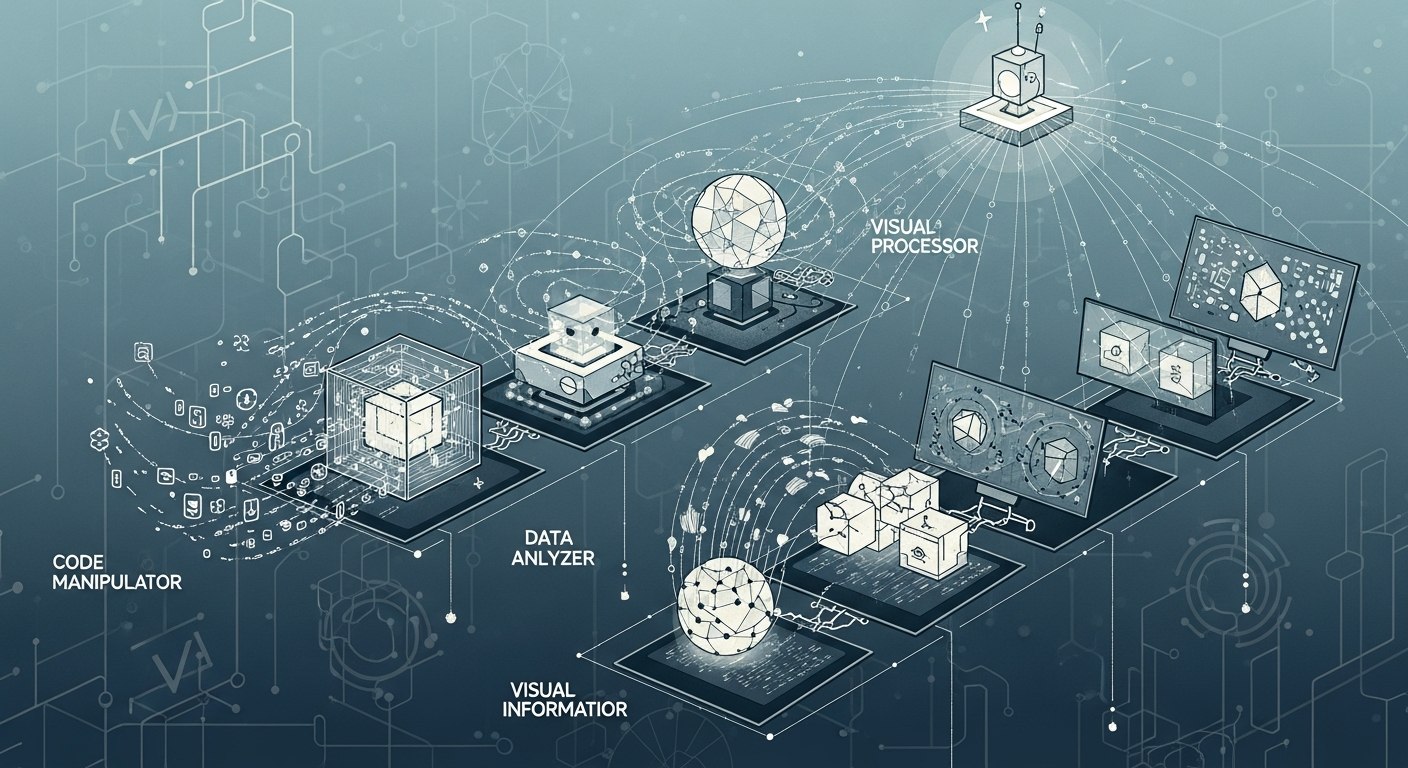
What sets K2.5 apart is its native "Agent Swarm" architecture, which allows the model to autonomously decompose complex tasks, spawn up to 100 specialized sub-agents, and coordinate their work across up to 1,500 tool calls and steps. The technical innovation here is profound.
Traditional AI models, even advanced reasoning models like GPT-5.2, operate as single agents that tackle problems sequentially. K2.
5's swarm approach runs specialized agents in parallel—one might handle visual analysis while another manages code generation, all coordinating through the main K2.5 orchestrator. In demonstrations, this architecture reduced execution time by 4.
5x compared to single-agent setups. The model tops GPT-5.2 and Claude Opus on key agentic benchmarks and video reasoning tasks, though it trails slightly on pure coding evaluations.
Critically, Moonshot has open-sourced the entire stack under Apache 2.0 licensing, including Kimi Code, a terminal-based coding agent that integrates with VSCode and Cursor.
Financial Analysis
The economics of K2.5 are potentially disruptive to the entire AI industry's cost structure. According to Artificial Analysis's leaderboard, K2.
5 delivers massive cost savings over top commercial rivals while maintaining frontier-level performance. This pricing advantage stems from two factors: the efficiency of the sparse mixture-of-experts architecture, which activates only a fraction of parameters per token, and Moonshot's willingness to open-source rather than monetize through API access. For enterprises, this changes the build-versus-buy calculus.
A company can now deploy frontier-class reasoning and coding capabilities on their own infrastructure without ongoing API costs. The $400 training cost for specialized 8B-32B parameter agents makes customization economically feasible for mid-sized companies, not just tech giants. Moonshot raised significant capital from Chinese investors, but their open-source strategy suggests they're playing a different game than OpenAI or Anthropic—potentially building a platform ecosystem rather than a direct SaaS business.
The broader financial implication is pressure on US AI labs. If open-source Chinese models can match closed commercial offerings at a fraction of the cost, subscription and API revenue models face compression. OpenAI's reported path to cumulative losses of $115 billion through 2029 becomes harder to justify if customers have high-quality free alternatives.
This could accelerate consolidation in the AI industry or force a pivot toward specialized enterprise services rather than general-purpose model access.
Market Disruption
Kimi K2.5 intensifies the competitive dynamics between US and Chinese AI development, particularly in the open-source domain. DeepSeek's recent V3 model already demonstrated that Chinese labs could match or exceed US capabilities at dramatically lower costs.
K2.5 confirms this isn't a one-off—it's a systematic advantage in the Chinese AI ecosystem's approach to model development and deployment. For US tech giants, this creates a two-front competitive challenge.
OpenAI, Anthropic, and Google are competing against each other for commercial dominance while simultaneously facing pressure from increasingly capable open-source alternatives. The gap between closed and open models continues to shrink, and Chinese labs are leading that convergence. Companies that built business models assuming customers would pay premium prices for AI access may need to rethink their strategies.
The developer ecosystem will shift rapidly. When a free, open-source model matches commercial offerings on key benchmarks, developers default to the open option unless there's a compelling reason to pay. This could accelerate enterprise adoption of AI—lower costs reduce barriers—but it also commoditizes the underlying model layer.
Value creation shifts upward in the stack toward specialized applications, fine-tuned agents, and workflow integration. The video-to-code cloning feature, while technically impressive, raises immediate ethical and legal questions about web scraping and intellectual property. If K2.
5 can watch someone use a website and replicate it completely—including UX interactions and animations—what does that mean for design ownership and competitive moats in software?
Cultural & Social Impact
The Agent Swarm paradigm represents a philosophical shift in how we interact with AI systems. Instead of prompting a single intelligent agent, users will increasingly work with AI systems that autonomously create teams of specialized sub-agents to tackle problems. This mirrors how human organizations work—you don't ask one person to handle everything; you assemble teams with complementary skills.
For knowledge workers, this changes the nature of AI assistance. Rather than serving as a research assistant or coding helper, AI becomes more like a project manager that coordinates specialized resources. One demonstration showed K2.
5 generating a 100MB Excel storyboard with 55 consistent visual scenes for a short film adaptation—a task requiring coordination across narrative structure, visual design, and formatting. This wasn't iterative prompting; it was autonomous task decomposition and parallel execution. The accessibility implications are significant.
Open-source models like K2.5 democratize access to frontier AI capabilities, particularly for developers and researchers in countries or institutions that can't afford commercial API costs. A university researcher in Southeast Asia or a startup founder in Latin America can now deploy the same AI capabilities as a Silicon Valley tech company.
This levels the playing field for global AI development and application. However, the same accessibility that benefits researchers also empowers malicious actors. Full device access for agents like Moltbot, combined with increasingly capable open-source models, creates new security vectors.
The technology for beneficial automation is identical to the technology for automated attacks. As these capabilities proliferate, the security and governance challenges multiply.
Executive Action Plan
First, enterprises should immediately pilot open-source alternatives for non-sensitive workloads. Assign a small team to deploy K2.5 or similar open models for internal coding assistance, documentation generation, or data analysis tasks.
Measure performance against your current commercial AI tools and calculate the total cost of ownership including infrastructure, fine-tuning, and maintenance. If you're spending heavily on API calls to commercial providers, you may find that self-hosting open models delivers comparable results at 60-80% lower cost within six months. Second, rethink your AI strategy around the Agent Swarm paradigm rather than single-agent interactions.
This means designing workflows where complex tasks are broken into parallelizable subtasks that specialized agents can tackle simultaneously. For software development teams, this could mean implementing K2.5's approach where one agent handles backend logic, another manages frontend components, and a third optimizes database queries—all coordinating through a main orchestrator.
Experiment with tools like Kimi Code that integrate swarm-style agents into existing development environments like VSCode. Third, if you're a CTO or engineering leader at a US tech company, pressure-test your competitive moats against open-source disruption. The assumption that proprietary models would maintain a sustained performance advantage is crumbling.
If your product differentiation relies primarily on access to GPT-4 or Claude, you're vulnerable. Focus innovation on areas that are harder to commoditize: proprietary datasets, domain-specific fine-tuning, workflow integration, compliance and security features, or human-in-the-loop processes that combine AI capabilities with expert judgment. The model layer is becoming infrastructure; value creation is moving up the stack.
Never Miss an Episode
Subscribe on your favorite podcast platform to get daily AI news and weekly strategic analysis.