Apple's Gemini Deal Unveiled as AI Systems Begin Consuming Themselves
Episode Summary
TOP NEWS HEADLINES Following yesterday's coverage of Apple's billion-dollar Gemini deal, new details emerged: the official unveiling is scheduled for February with live demonstrations, while a mor...
Full Transcript
TOP NEWS HEADLINES
Following yesterday's coverage of Apple's billion-dollar Gemini deal, new details emerged: the official unveiling is scheduled for February with live demonstrations, while a more advanced conversational version is planned for WWDC in June.
Interestingly, Apple rejected an OpenAI partnership because OpenAI was actively poaching Apple engineers.
OpenAI is moving into e-commerce with native shopping carts and merchant tools coming to ChatGPT, directly challenging the traditional search-to-buy workflow that Google has dominated for years.
Google just invested in Sakana AI, whose CTO Llion Jones co-authored the famous "Attention Is All You Need" transformer paper but now says he's "absolutely sick of transformers." The Tokyo-based startup is exploring biology-inspired architectures that could represent the post-transformer era.
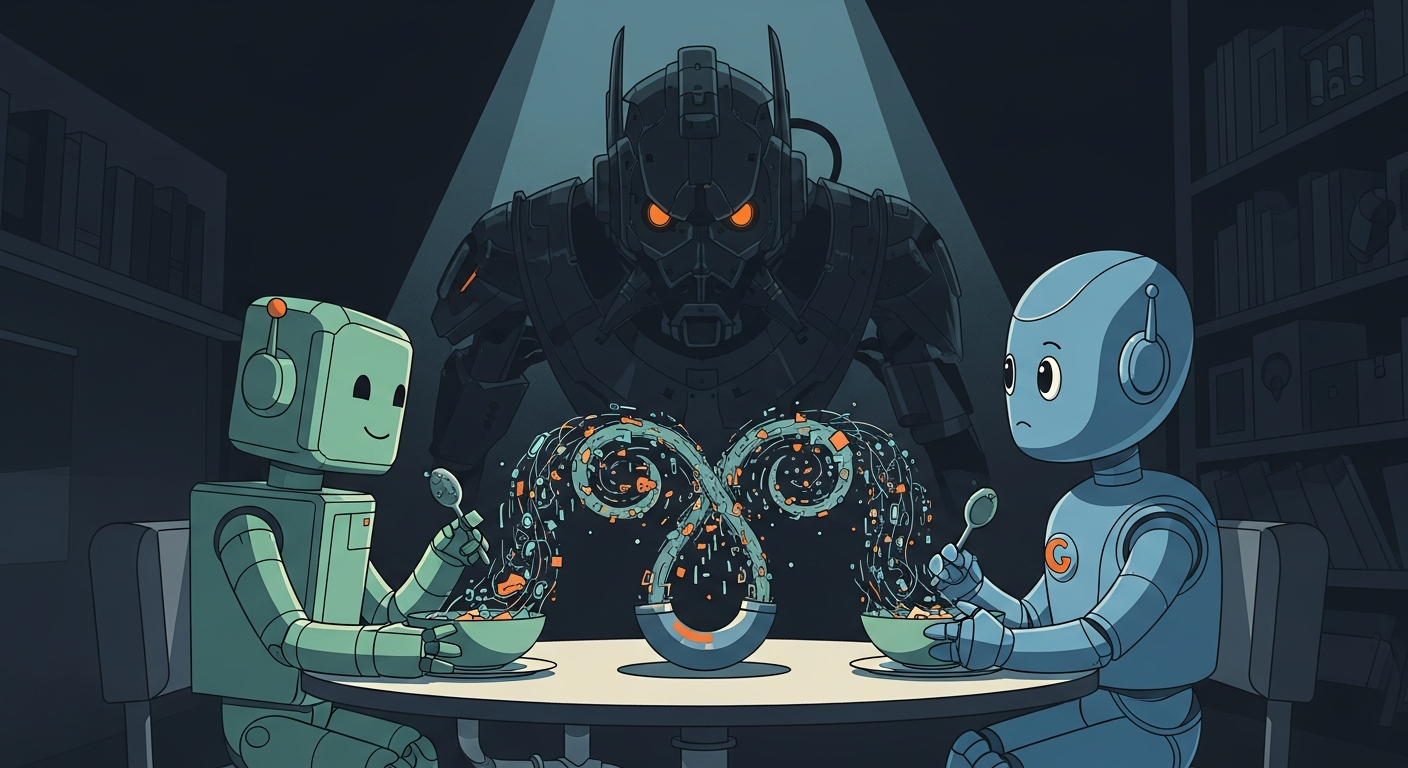
ChatGPT was caught citing Grokipedia, Elon Musk's AI-generated conservative encyclopedia, raising serious concerns about model collapse as AI systems increasingly consume their own unverified outputs.
And in a stunning research finding, Runway's latest Gen-4.5 video model fooled 90% of viewers in a study of over a thousand participants.
People could no longer reliably distinguish five-second AI-generated clips from real footage, marking a critical threshold in synthetic media credibility. --- DEEP DIVE ANALYSIS: THE AI RECURSIVE LOOP - WHEN MODELS EAT THEMSELVES
Technical Deep Dive
We're witnessing the emergence of what researchers call "model collapse," and the ChatGPT-Grokipedia incident is our canary in the coal mine. Here's what's actually happening: ChatGPT's retrieval system pulled citations from Grokipedia, an AI-generated encyclopedia built within the Musk ecosystem, without distinguishing it from human-authored sources. This isn't a bug, it's a structural inevitability.
Foundation models have exhausted high-quality public data. Wikipedia adds marginal edits, not volume. Meanwhile, AI-generated content farms like Grokipedia can produce hundreds of thousands of articles cheaply and at scale.
Current retrieval systems lack robust provenance tracking, they evaluate relevance and coherence but struggle to authenticate origin. The result is a feedback loop: AI outputs re-enter training datasets, citations appear valid with proper formatting and structure, but the knowledge base becomes recursive and ungrounded from reality. The technical challenge goes deeper than content filtering.
When GPT-5 trains on text that GPT-4 generated, which itself trained on GPT-3 outputs, errors don't just accumulate, they compound exponentially. Early research on model collapse shows that after just five generations of recursive training, model performance degrades catastrophically, with increased bias amplification and loss of tail distribution coverage.
Financial Analysis
The economics of this crisis are stark and immediate. Training frontier models costs between $100 million and $1 billion per run. Companies have been able to justify these costs because each generation showed measurable improvements by ingesting more human-generated data.
That equation is breaking. OpenAI, Google, and Anthropic are all facing the same constraint: the high-quality human-written internet is finite, and they've already used most of it. This creates a brutal dilemma.
Either spend exponentially more to acquire proprietary data through partnerships with publishers, Reddit's $60 million deal with Google is just the beginning, or accept degraded model quality as synthetic data pollutes the training corpus. The synthetic data problem isn't just about training. It's about retrieval-augmented generation, the technology behind ChatGPT's ability to cite sources.
If RAG systems can't distinguish between human-authored and AI-generated content, their value proposition collapses. Why pay for ChatGPT Plus if its citations are circular references to other AI systems? Wall Street is starting to price in this risk.
The AI infrastructure buildout, Stargate's $500 billion commitment, assumes continued scaling will produce proportional capability gains. If model collapse creates a ceiling below AGI, that entire investment thesis needs repricing. Companies betting on data moats, those with exclusive access to high-quality human data, suddenly become exponentially more valuable.
Market Disruption
This fundamentally reshapes competitive dynamics in AI. Google's investment in Sakana AI, the company exploring post-transformer architectures, signals that even the creators of transformers see architectural limits ahead. When one of the eight co-authors of "Attention Is All You Need" says he's "absolutely sick of transformers," that's not colorful language, it's a technical assessment.
The race is fragmenting into three camps. First, companies doubling down on scale, assuming that more compute and cleaner data curation can overcome model collapse. Second, firms like Sakana exploring fundamentally different architectures inspired by biological systems, continuous thought machines that incorporate timing information at the neuron level.
Third, enterprises pivoting to narrow vertical applications where synthetic data contamination is less critical. The Grokipedia incident reveals a deeper market vulnerability. If ChatGPT citations become unreliable, professional users in law, medicine, and journalism can't depend on AI-assisted research.
This opens opportunities for specialized AI systems with verified provenance tracking. Expect rapid growth in enterprise AI that maintains strict data lineage, even at higher cost and lower performance. Content authentication becomes a premium service.
C2PA and other provenance standards, previously nice-to-have features, become essential infrastructure. Companies that can cryptographically verify the human origin of their training data gain massive competitive advantages.
Cultural & Social Impact
We've crossed a threshold where seeing is no longer believing. Runway's study showing 90% of people can't distinguish five-second AI video from reality isn't just a technical milestone, it's a civilizational inflection point. When video evidence becomes unreliable, the social contracts underpinning journalism, legal systems, and democratic discourse start to fracture.
The ChatGPT-Grokipedia loop makes this worse in a subtle but devastating way. Grokipedia isn't just AI-generated content, it's ideologically skewed AI-generated content. When that enters training loops, bias doesn't just persist, it amplifies.
One study found AI-generated content tends toward consensus views, flattening out nuance and minority perspectives. Recursive training on this content creates a monoculture of thought. We're seeing the early social responses.
San Diego Comic-Con and the Science Fiction Writers Association both banned AI-generated content from competitions. These aren't Luddite reactions, they're communities recognizing that when AI content dominates, human creativity gets drowned out in the noise. The question isn't whether AI can generate passable content, it demonstrably can, but whether recursive AI content leads anywhere interesting.
Pope Leo XIV's warning about "overly affectionate" AI chatbots becoming "hidden architects of our emotional states" connects to this same issue. If AI systems are trained on AI-generated emotional content, on synthetic relationships and parasocial interactions, they're learning a funhouse mirror version of human connection. The feedback loop creates increasingly alien forms of interaction that feel human but lack genuine understanding.
Executive Action Plan
First, implement strict data provenance tracking immediately. If you're building AI products, you need systems that can cryptographically verify the origin of training and retrieval data. This isn't optional anymore.
Tools like content credentials and blockchain-based verification may seem like overkill, but they're becoming table stakes. Budget for data authentication infrastructure now, before contaminated data sets become legally and reputationally toxic. Second, diversify away from pure LLM plays.
The companies winning in 2027 won't be those with the biggest transformer models, they'll be those combining multiple AI approaches. Look at Sakana's continuous thought machines, or hybrid systems that merge symbolic reasoning with neural networks. If you're an enterprise buyer, stop asking vendors about parameter counts and start asking about architectural diversity and data lineage.
Third, build human-in-the-loop systems as your competitive moat. The Gallup finding that 50% of U.S.
workers never use AI at work isn't a failure of adoption, it's an opportunity. The companies that figure out how to augment human judgment rather than replace it will capture the value that pure automation can't. Focus on tools that make experts more effective, like Claude for Excel expanding to Pro tier users, rather than tools that eliminate expertise entirely.
The future isn't humans versus AI, it's verified human knowledge amplified by AI that knows its limits.
Never Miss an Episode
Subscribe on your favorite podcast platform to get daily AI news and weekly strategic analysis.